
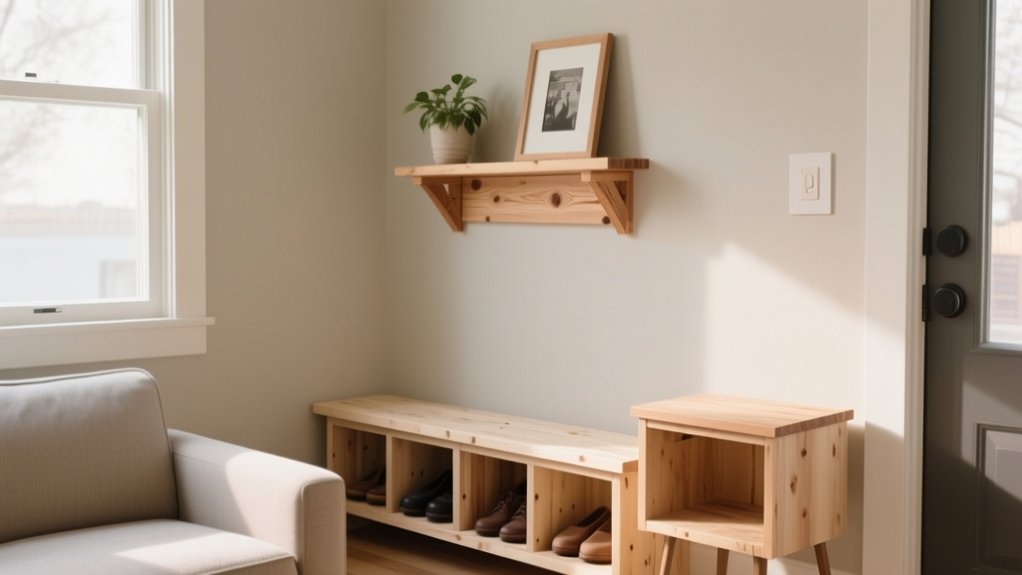
You’ll upgrade your home fastest with small, high-use builds: a wall key rack, peg rail, French-cleat tool strip, or a slim hallway shelf in birch ply or straight PAR softwood. Mark with a knife line, cut the waste side, then plane to fit for tight tolerances. Start with glued butt joints and clamps, then step up to dowels or stopped housings. Ease edges with a block plane, fix into studs, and finish in hardwax oil—next up, smarter layouts and cleaner installs.
Quick Beginner Woodworking Projects (Start Here)
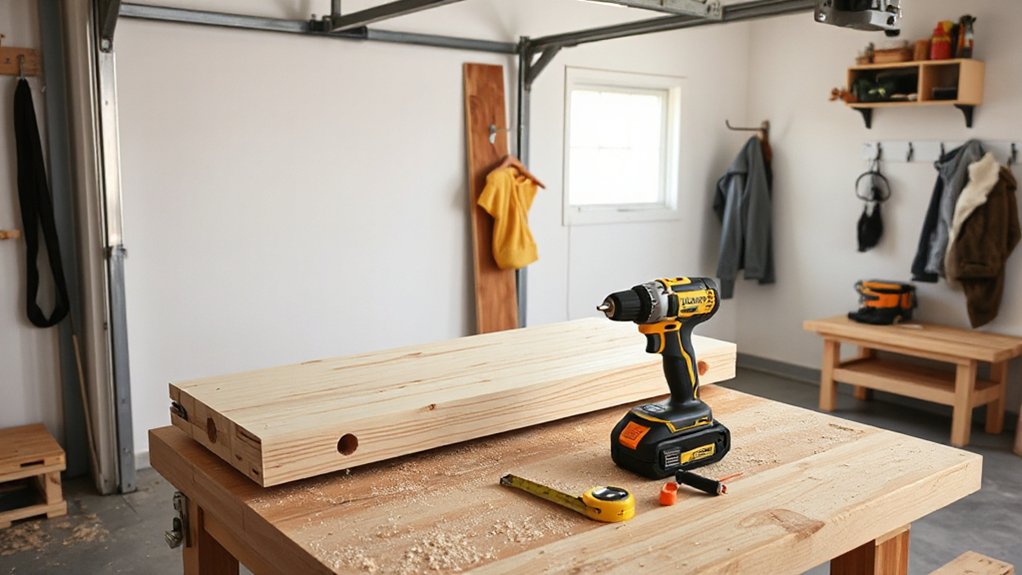
If you want to build confidence quickly, start with small, functional projects that teach accurate measuring, clean cuts, and simple joinery without demanding a full workshop. Begin with a wall-mounted key rack, a slim hallway shelf, or a plant stand sized for UK terraced rooms.
Mark out with a knife line, not pencil, then cut to the waste side and plane to fit; you’ll feel tolerance control immediately. Use glued butt joints with clamped cauls, then upgrade to dowelled corners or a stopped housing to preview advanced techniques without complexity.
Keep edges eased with a block plane for a furniture-grade touch. Prioritise woodworking safety: support stock, clamp work, manage dust extraction, and check cord routes before every cut.
Finish with hardwax oil for durability.
Basic Tools + Cheap Lumber (Beginner List)
Because your early results depend more on layout accuracy and stock quality than fancy machinery, build your beginner kit around a few reliable hand tools and a small, safe power-tool core.
Then practise on cheap, straight timber you can actually buy in the UK. Start with a 300mm combination square, tape, marking knife, pencil, and a bevel gauge for clean geometry.
Add a No.4 plane, 6mm/12mm chisels, a mallet, and a Japanese pull saw.
For power, a corded drill/driver, random-orbit sander, and jigsaw cover most cuts; use sharp blades and dust extraction for woodworking safety.
Buy PAR softwood, CLS stud timber, or birch ply from Wickes, B&Q, or local merchants; sight along boards for twist.
Keep edges honed, soles waxed, and bits cleaned—tool maintenance saves accuracy.
Beginner Woodworking Projects for Wall Storage
With your measuring kit sorted and a stash of straight PAR or CLS to practise on, wall storage makes a smart first build: it’s small, square, and immediately useful in a UK garage, shed, or box room.
Start with a French cleat strip: rip a 45° bevel, screw one half into studs, then hang modular bins or a tool rack off the mate. Keep tolerances tight; a 2mm twist shows on the wall.
For floating shelf designs, route a rear channel for a hidden batten, fix into masonry with proper plugs, then slide the shelf on and pin-screw underneath. Finish edges with a 2mm chamfer and hardwax oil.
You can also frame offcuts as Decorative wall art that hides keys and charging leads.
Beginner Woodworking Projects for Entryways + Mudrooms
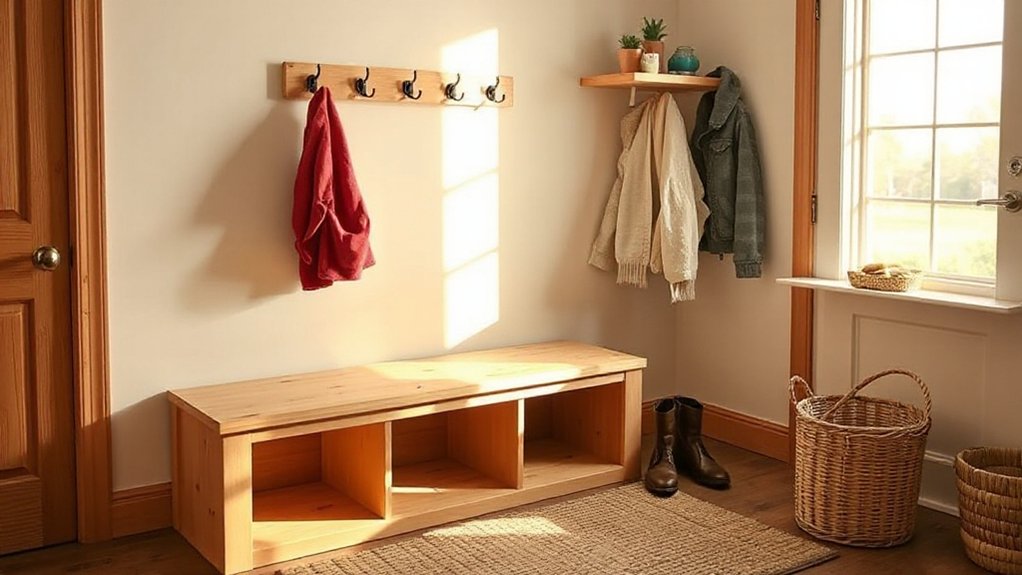
Although a hallway or mudroom looks simple, it punishes sloppy joinery with constant wet coats, muddy boots, and daily door traffic. So beginner builds here should prioritise durable materials and clean, space-efficient geometry.
Build a slimline oak or birch ply entry bench with through-screwed stretchers and sealed end grain; finish with hardwax oil for UK humidity swings.
Add a wall-mounted peg rail on battens so coats clear skirting and you can hit studs, not plasterboard alone. Keep edges radiused and wipe-clean.
- Use Decorative wood accents sparingly: a chamfered front arris reads premium and resists splintering.
- Make Custom wood signs with routed letters; seal with exterior varnish for damp air.
- Design to clear door swings: mock up with tape before cutting and drilling.
Beginner Storage Projects for Closets + Garages
If you plan your storage around real load cases and awkward UK dimensions (narrow alcoves, sloping garage floors, cold/damp corners), you’ll get closet and garage projects that stay square and usable. Start with a plywood carcass system on adjustable feet so you can level on uneven slabs and keep doors aligned.
In closets, build a 400–500mm-deep tower with a fixed back to stop racking, then add Custom drawer organizers sized to socks, belts, and A4 paperwork. Use 6mm bottoms in grooves and 12mm runners for simple, durable slides.
In garages, make a French-cleat wall from 18mm ply; it’s ideal for reconfigurable tool bins and Decorative shelf ideas, like edged oak-lipped shelves that resist knocks. Seal all faces, and vent panels against condensation.
Frequently Asked Questions
What Wood Finish Is Safest for Homes With Kids and Pets?
You’ll get the safest finish with water-based polyurethane or hardwax oil rated EN 71-3; they deliver Safe finishing and Non toxic coatings once fully cured. Choose low-VOC, rapid-cure systems, and ventilate well.
How Do I Prevent Wood From Warping After Installation?
You prevent warping by acclimatising timber on-site, sealing all faces, and allowing expansion gaps. Prioritise wood stabilization via straight grain and kiln-dried stock, and enforce moisture control with vapour barriers and stable indoor RH levels.
Do I Need a Permit to Build Wall-Mounted Shelves or Cabinets?
Usually you won’t need a permit for wall-mounted shelves or cabinets in the UK, but you must follow building codes. Check local permit requirements if you alter structure, fire escape routes, or electrics.
How Can I Match Stain Color to Existing Trim and Flooring?
You’ll nail stain color matching by sanding a hidden patch, then testing multiple stains on offcuts, sealing to preview undertone and sheen for trim blending. After your Bristol skirting mismatch, you’ll photograph, sample, and adjust.
What’s the Best Way to Hide Screws and Nail Holes Cleanly?
Use concealed fasteners where possible, then set fixings slightly below the surface. Fill with a colour-matched nail hole filler, overfill, sand flush, and touch up with stain or paint for a seamless UK-grade finish.
Conclusion
You’ve now got a clear path into woodworking that genuinely upgrades your home. Start with a tight tool kit, buy straight, kiln-dried softwood, and build in modules so everything aligns and scales. Whether you’re adding wall storage, a cleaner entryway, or garage and wardrobe organisation, you’ll improve flow and reduce visual noise. Measure twice, cut once: it’s the difference between a crisp shadow gap and a bodge. Keep tolerances tight, finishes durable, and you’ll get results.