Like you’re facing a familiar crossroads, your kitchen countertops require a clear-eyed assessment. You’ll weigh damage, age, and function against cost and long-term needs, deciding whether a repair suffices or a replacement makes sense. Consider how a new surface fits your style, maintenance, and how you’ll manage installation with minimal disruption. The right choice hinges on budget, timing, and planning details, and the next steps can shape your whole kitchen—so you’ll want to approach each factor with steady clarity.
Match Countertops to Your Lifestyle
When you’re choosing countertops, align your pick with how you cook and live. You’ll assess workflow, frequency of prep, and cleanup habits to match materials to real routines.
Consider durability for high-traffic prep areas, heat tolerance for hot pans, and scratch resistance if you chop frequently. Think about maintenance so it fits your time budget—some surfaces wipe clean, others need sealants.
Material options vary in look and feel, but you should also weigh installation constraints and repairability.
Color coordination matters for balance with cabinets, floors, and backsplash, so pick tones that either blend or pop with your scheme.
Don’t overlook edge profiles that influence grip and spill containment.
Choose a surface that supports your pace, then confirm it supports your daily rhythm.
Budget, Longevity, and Maintenance: a Practical Framework
Budget decisions set the foundation for long-term value, durability, and upkeep, so you should evaluate cost first, then map it to expected lifespan and maintenance needs. You’ll compare upfront price to long-term costs, including sealing, repairs, and resurface cycles.
Use a practical framework: assess material durability, confirm installation essentials, and project maintenance frequency. Prioritize options with proven performance in your environment, considering heat, moisture, and usage patterns.
Do a cost comparison across candidates, noting warranty terms and expected service intervals. Balance affordability with resilience, aiming for a countertop that minimizes downtime and disruption.
Document maintenance tasks you’ll perform, so you can budget both time and money. This approach keeps decisions grounded in real-world value rather than hype.
Repair or Replace: Decision Criteria
Here’s how to decide between repair and replacement: start by evaluating damage scope, material condition, and age, then weigh the cost, downtime, and future reliability. You’ll want a clear view of material durability and surface aesthetics as guiding factors.
If damage is localized, seams, chips, or small cracks, and the core material is sound, repair is typically the most practical choice, offering faster return to use and lower cost.
When wear affects large areas, underlying substrate deterioration, or recurring issues hint at durability limits, replacement becomes sensible to prevent ongoing problems and budget surprises.
Consider long-term needs: discontinue high-maintenance surfaces, compatibility with appliances, and changes in style.
Choose the option that minimizes disruption while maximizing reliability and visual appeal.
Plan Installation Timing and Milestones
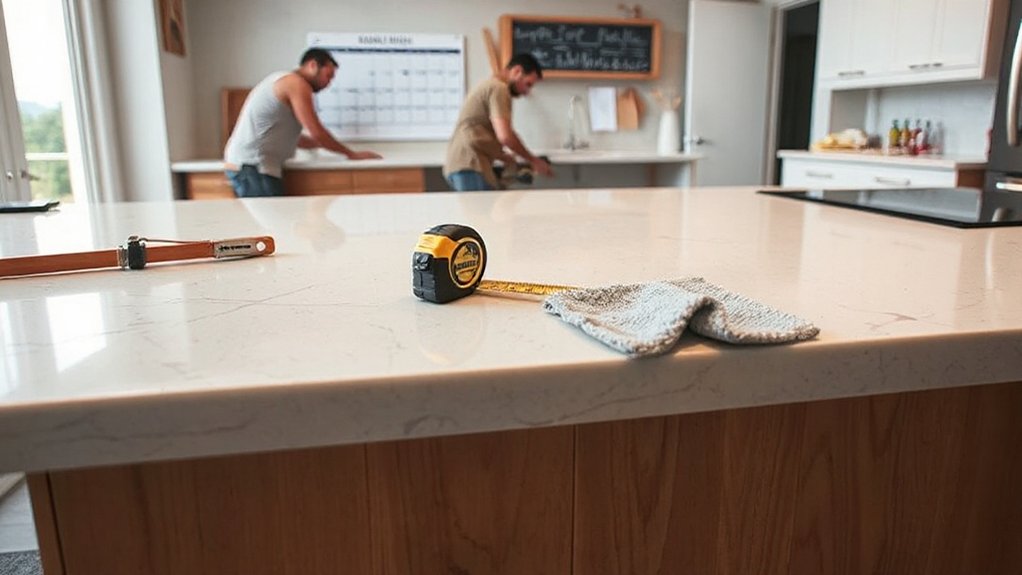
To plan installation timing and milestones, map out a realistic schedule that aligns with project scope, material lead times, and contractor availability. You’ll lock in a start window, verify delivery dates, and set buffer days for contingencies.
Focus on material durability expectations and how long tasks will take, then align them with your chosen contractor’s availability. Secure a firm acceptance window for quotes, and confirm any required permits or inspections early.
- Define critical path tasks and milestones with dates
- Verify material lead times and contingency buffers
- Confirm contractor selection, availability, and payment terms
- Schedule inspections and delivery windows to minimize downtime
This approach keeps the project predictable, minimizes delays, and guarantees timely completion.
Style and Installation Details to Prevent Countertop Mistakes
To prevent countertop mistakes, start by choosing a style that matches your kitchen’s use and existing finishes, then specify installation details that support durability and a flawless fit.
You’ll want material durability top of mind when selecting surfaces, so consider how heat, moisture, and daily wear will interact with the material.
Align edge profiles, seams, and backsplash transitions with your plumbing layout and cabinet tolerances to avoid gaps.
Prioritize installation precision: verify flatness, level all planes, and secure substrates before placing countertops.
Schedule supports and substrate prep to prevent sag or flex.
Confirm cutting blocks, sink cutouts, and appliance clearances before fabrication, and communicate exact field measurements to the fabricator.
Finally, endorse a detailed inspection checklist to catch misalignments early and make certain a clean, durable finish.
Frequently Asked Questions
How Long Should a DIY Countertop Install Typically Take?
A typical DIY countertop install takes about 1 to 2 days for a standard kitchen, depending on your prep and materials. You’ll pace faster if you’ve already measured precisely and planned cuts.
Use quality installation tools, follow the manufacturer’s instructions, and allow time for adjustments.
Expect a full day if you’re setting heavier slabs.
Countertop durability hinges on accurate sealing and levelling.
Don’t rush; verify gaps, edge profiles, and support before final seating and use.
What’s the Best Underlayment for My Chosen Material?
You’ll want a solid underlayment: for most engineered stone and laminate setups, a plywood or cementboard base is best for countertop durability and support.
Start with a level, reinforced subfloor, then choose underlayment rated for your material.
Use installation tools like a hammer, drill, and screws to secure it.
An interesting stat: 90% of countertop failures trace back to improper underlayment.
Prioritize the right underlayment to maximize durability and ease of installation.
Can I Mix Countertop Textures in the Same Kitchen?
Yes, you can mix countertop textures in the same kitchen. Start by ensuring color coordination across surfaces and sticking to a cohesive material palette to avoid visual chaos.
Verify material compatibility—some textures pair better when balanced with similar sheen or edge profiles. Use one dominant surface, with the others supporting it, and keep patterns restrained.
When in doubt, opt for complementary neutrals and sample-wide swatches to confirm the overall harmony.
How Do I Prevent Visible Seams in Laminate Countertops?
You seek a seam like a whisper, and here’s how you get it. Think of your laminate as armor; seam concealment comes from precise edge matching, controlled lighting, and careful alignment.
Use matching laminate patterns, a tight seam, and a dab of color-miller adhesive to minimize gaps. Laminate matching matters most at the join, so clean cuts and heat-press or roll the seam.
With steady hands you’ll seal the look, not the seam.
Are There Eco-Friendly Countertop Options and Costs?
Yes, there are eco-friendly countertop options and costs. You can choose sustainable materials like recycled glass, bamboo, concrete with low-VOC additives, or reclaimed stone.
Expect higher upfront costs for premium options, but long-term savings from durability and lower maintenance. Look for eco friendly finishes, low-VOC sealants, and certifications (FSC, Greenguard).
Compare lifetime costs, installation, and waste disposal. You’ll balance budget against durability, aesthetics, and environmental impact to pick the best sustainable choice.
Conclusion
When you weigh repair or replacement, picture your kitchen as a living canvas. You’ll map durability against daily use, budget against timeline, and style against upkeep. Imagine the seam of new counters aligning with cabinets, the click of a sander, the hush of measuring tape, the exact moment planning becomes reality. You’ll choose that steady rhythm: repair where it sings, replace where it strains. In the end, a cohesive surface reflects your routine, your taste, and your future.