
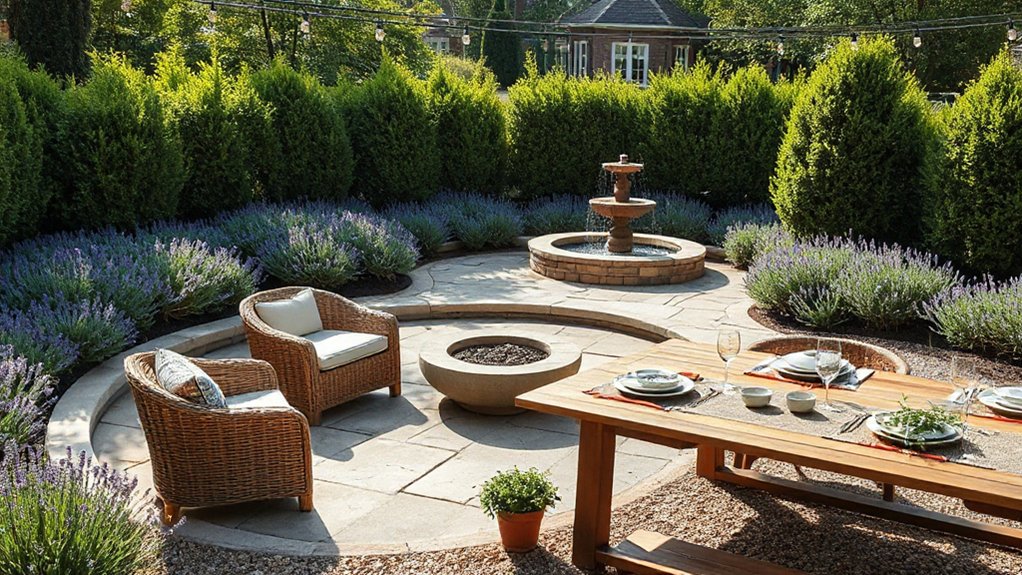
Design your entertaining garden by setting clear goals and mapping circulation from entry to gathering zones. Create conversation-friendly seating in semi-enclosed clusters and separate dining from prep areas to streamline flow. Plan easy, durable paths with contrasting materials and accessible routes, then select weather-resistant finishes and modular, weatherproof furniture. Align shade, shelter, and lighting to extend usability year-round while optimizing breeze and scent balance. Track budget with phased upgrades and implement a maintenance routine to keep it inviting; more detail awaits.
Set Clear Goals for Your Entertaining Garden
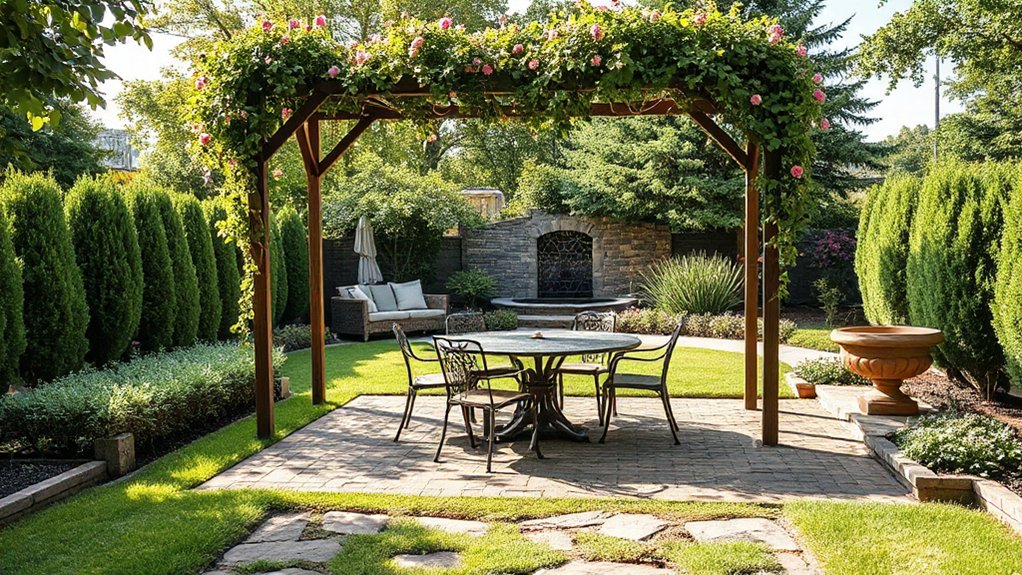
Setting clear goals is essential to shaping a garden that works for entertaining. You map spaces, flows, and uses, then translate them into measurable criteria. Define how often guests arrive, throughput between zones, and preferred ambiance.
Identify performance targets for sightlines, noise attenuation, and microclimates, so you can verify outcomes later. Clarify your priorities: garden aesthetics, year‑round interest, ease of maintenance, and safety in circulation.
With goals set, you assess constraints like sunlight, drainage, and soil; you determine required plant selection to meet color, texture, and seasonal bloom demands.
Establish success metrics for seating capacity, access to amenities, and visual cohesion. Document decisions, assign owners, and schedule periodic reviews to guarantee alignment with evolving entertaining needs.
Map Circulation From Entry to Gathering Zones
Establish clear wayfinding cues, including material changes, lighting contrasts, and step-free access where possible. Evaluate bottlenecks around entry thresholds, service nodes, and shade provisions to maintain comfortable pacing.
Integrate Pathway design considerations with functional zones to minimize cross-traffic and maximize safety. Align planting along circulation edges to guide movement without obstructing views or accessibility; implement Plant selection that stabilizes soil, controls erosion, and supports seasonal cues.
Document schematic diagrams, scale tolerances, and testing criteria for ongoing refinement of circulation efficiency.
Design Seating That Sparks Conversation
To foster conversation, arrange seating in semi-enclosed clusters that encourage eye contact and easy turn-taking.
Align chairs and benches to create circle- or arc-formations with clear sightlines, while maintaining smooth circulation paths for casual chats.
Prioritize flexible, conversation-friendly setups that support both intimate exchanges and group dynamics without obstructing movement.
Conversation-Friendly Seating
Craft seating that invites dialogue by arranging chairs and sofas into intimate, face-to-face clusters rather than long, parallel rows. You design each cluster to foster eye contact and controlled acoustics, balancing proximity with personal space.
Position seating to create distinct conversation zones, using varying heights and back supports to reduce cross-talk and direct attention toward the speaker. Choose materials with comfortable textures and predictable resilience to seasonal changes, ensuring consistent usability.
Integrate Garden art as focal anchors that prompt discussion without overpowering voices, and incorporate wildlife habitat cues that invite natural storytelling and shared observation.
Keep sight lines clear to signals of interest, and avoid clutter that fragments dialogue. Document chair angles and distance targets for repeatable, scalable layouts across events.
Circulation for Chats
Position seating to create intimate clusters that invite eye contact and dialogue, avoiding forced proximity or isolated corners. Align flow with sightlines to garden art focal points, so guests can comment without twisting bodies or shouting over noise.
Account for entry and exit so conversations pause briefly at thresholds, then resume with minimal disruption. Integrate plant selection to frame seating groups, using foliage and height to control privacy and acoustics.
Choose versatile furniture layouts that accommodate both small talk and larger rounds, and select plant materials that require minimal maintenance, supporting consistent entertaining throughout the season.
Create Distinct Dining and Prep Areas
When planning your garden for entertaining, separate dining and prep zones to streamline flow and maintain social energy. You create purpose-driven areas that minimize cross-traffic and maximize efficiency. Focus on established sightlines, durable surfaces, and weather-resilient finishes to guarantee consistent use during varied events.
Incorporate plant selection and soil preparation as foundational steps to support both zones without frequent maintenance.
- Define boundaries with hardscape edges that guide movement and reduce spillover into prep.
- Position dining near but not adjacent to cooking, preserving conversation zones while containing heat and odors.
- Select low-maintenance, high-traction surfaces for prep to prevent accidents in all weather.
- Schedule soil preparation and planting to complement seasonal use, avoiding impedance to hosting timelines.
Plan Easy Paths and Clear Circulation
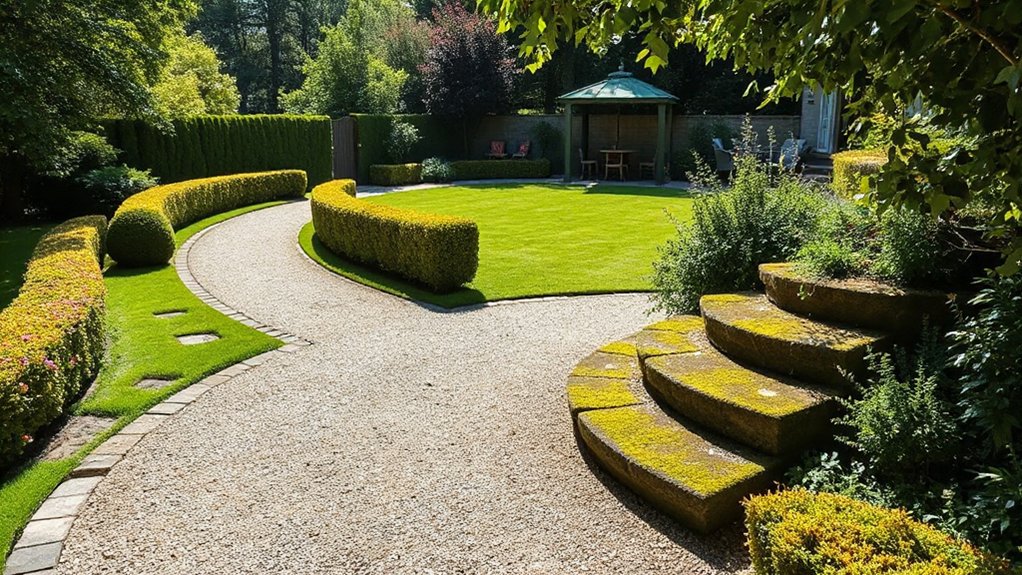
You’ll establish clear pathways that enable smooth flow through the garden, with sightlines and turning radii sized for your entertaining setups.
Guarantee access from all sides so guests and service tasks can move efficiently without congestion.
Define walking routes that guide movement, reduce collisions, and keep shifts between dining, prep, and lounging areas effortless.
Clear Pathways For Flow
Clear pathways are essential for seamless entertaining, guiding guests naturally from gathering zones to seating and service areas. You design with measured widths, turning radii, and surface consistency to minimize travel friction and clutter. Ensure sightlines remain unblocked, and changes between zones occur at grade alterations or thresholds without abrupt steps.
Align with plant selection and garden art to reinforce wayfinding, not impede it, by choosing low-lying decor and contrasting textures. Maintain clear zones around food service and seating to prevent congestion. Use durable, non-slip materials and unobtrusive edging to delineate routes.
Paths should be loopable, consider alternate routes for service staff, and reflect seasonal lighting.
- Define primary circulation axes
- Optimize width and turning space
- Use contrasting materials for visibility
- Integrate art and plant cues for wayfinding
Access From All Sides
Use a coherent grid or gentle radial layout so guests can move confidently without retracing steps. Define primary corridors wide enough for movement and service carts, then employ secondary passages for access to intimate spaces.
Place garden art at stops to cue progression without obstructing flow. Guarantee contrasts in material, color, and texture mark turns and junctions, reinforcing orientation while preserving aesthetics and safety across the entire site.
Defined Walking Routes
How can you guarantee pathways are intuitive and efficient for guests and staff? You design defined walking routes that emphasize clarity and purpose, guiding movement with minimal friction. Plan easy paths that align with sightlines, focal points, and entryways, reducing backtracking and delays.
Assure clear circulation by separating service and social routes where possible, improving safety and comfort for all users. Use uniform width, gradual slopes, and consistent materials to reinforce predictability. Regular maintenance keeps edges obvious and surfaces slip-resistant, sustaining garden flow across varied conditions.
Integrate signage at key decision points and map points to reinforce orientation without clutter. Prioritize accessibility, sightlines, and rhythm to sustain a welcoming, navigable environment.
- Map core loops and access points
- Standardize width, ramps, and surfacing
- Position milestones for orientation
- Test with real users for gaps
Layer Lighting for Ambience and Safety
Layer lighting should be planned in layers that balance ambience with safety, ensuring pathways remain visible while accenting focal plantings and seating areas. You’ll design primary, secondary, and task lighting to create depth and prevent dark spots along routes.
Use warm, color-accurate fixtures to render foliage textures without glare, then add downlighting to sculpt stairs and edges for safe navigation after dusk. Position fixtures at ground level or low elevations to minimize obtrusion while maximizing coverage, and verify alignment with plant growth and seasonal changes.
Implement safety illumination around entrances, exits, and seating progression, ensuring consistent lumen levels that guide movement. Document specifications, maintenance routines, and replacement schedules to sustain reliable layer lighting throughout the entertaining season.
Choose Low-Maintenance, Kitchen-Ready Plants
To guarantee year-round usability and minimal upkeep, select kitchen-ready plants that tolerate outdoor conditions, require infrequent watering, and resist common pests. Focus on varieties that thrive in container edges and edible borders, preserving garden aesthetics while keeping maintenance low. Choose options with compact growth, strong air circulation, and minimal disease susceptibility. Prioritize plants that tolerate partial shade and variable temperature swings to ensure reliable performance around entertaining zones.
Favor varieties with defined leaf structure and predictable flavor, simplifying harvest and prep. Integrate a cohesive palette to support visual cohesion and functional use. Maintain your plantings with lightweight mulch and smart irrigation to sustain soil moisture and reduce waste.
- Plant varieties suitable for containers and edible use
- Drought-tolerant options that tolerate sun
- Compact, disease-resistant cultivars with predictable yields
- Aesthetically coordinated, low-maintenance choices
Select Flexible Furniture for Varying Guest Counts
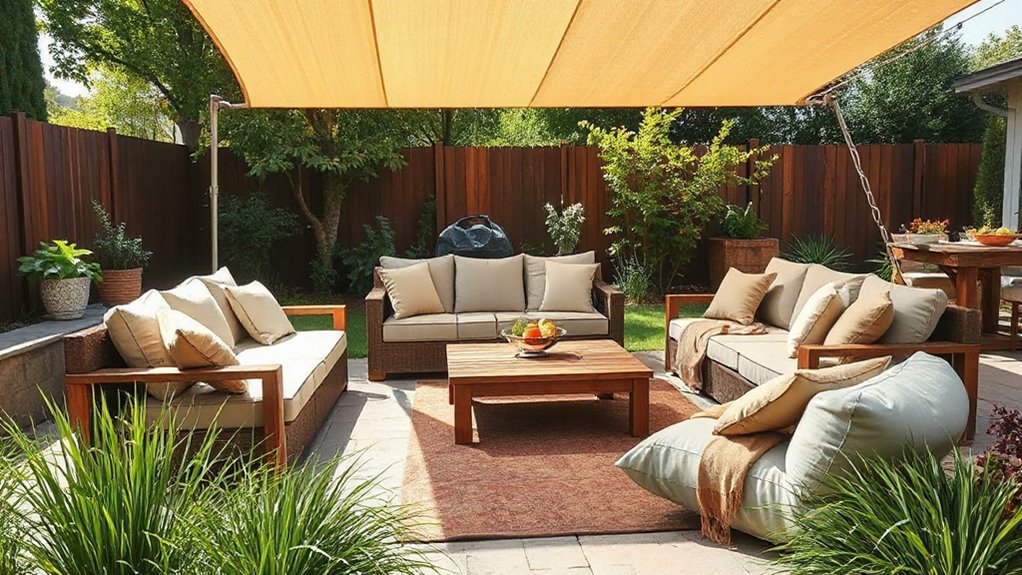
Flexible furniture selections should accommodate varying guest counts without sacrificing flow or safety. You want modular seating that reconfigures quickly, with clear anchor points, stable legs, and non-slip bases. Choose pieces with durable materials, weather resistance, and easy cleaning to maintain guest accommodation standards outdoors.
Prioritize seating options that mix height and depth, enabling comfortable dialogue zones and accessible pathways. Include compact tables that nest or fold, allowing expansion during peak arrivals without obstructing circulation. Communicate clear load ratings and guarantee consistent spacing for safe evacuation routes.
Use color and finish contrasts to delineate zones, aiding wayfinding. Document specifications for maintenance cycles and storage. This approach assures flexible furniture supports scalable guest accommodation while preserving garden usability.
Integrate Shade, Shelter, and Weather Resilience
To maximize guest comfort, assess Shade Strategy Optimization by aligning sun angles with seating layouts and traffic flows.
Efficiency in Shelter Placement guarantees protected zones near entertaining areas without obstructing sightlines or airflow.
Choose Weather-Resilient Materials that withstand wind, moisture, and UV exposure while minimizing maintenance and visual disruption.
Shade Strategy Optimization
Have you accounted for how shade, shelter, and weather resilience interact to protect guests and extend usable outdoor time? You’ll optimize shade strategy by aligning shade structure placement with sunlight management goals, seasonally adjusting coverage, and ensuring airflow around transitions.
Execute precise calculations for projected sun angles, peak heat periods, and wind vectors to sustain comfort during gatherings. Balance permanence with modularity to adapt shade intensity and coverage without obstructing sightlines or access.
Implement layered options that respond to changing conditions, including reflective surfaces and thermal breaks to reduce heat gain. Monitor performance against comfort metrics, then refine angles, heights, and anchoring for reliability under varied weather.
- Define sun paths and critical times
- Align shade structure with gathering zones
- Integrate ventilation and airflow considerations
- Test adjustments seasonally
Shelter Placement Efficiency
You map microclimates across zones to align shelter placement with sun paths, wind corridors, and precipitation patterns. You select durable, modular structures that can be reoriented, stacked, or folded to adapt to changing conditions without compromising circulation.
You evaluate load paths, drainage, and access routes to minimize clutter and guarantee clear egress during weather events. You integrate lightweight roofing, windbreaks, and permeable flooring to balance comfort and mobility.
You test for heat gain, shade depth, and airflow to sustain occupancy. Shelter placement supports weather resilience while maintaining aesthetic coherence and functional size.
Weather resilience informs anchor points and maintenance needs.
Weather-Resilient Materials
- Material durability and UV resistance
- Drainage and slip resistance
- Modular shade and shelter systems
- Integrated pests and maintenance planning
Balance Sound and Privacy Without Isolation
To balance sound and privacy without isolation, design outdoor spaces that buffer noise while maintaining social connectivity. You implement a layered approach: establish focal zones for conversation, dining, and lounging, then deploy acoustic buffers between them.
Use elevated planters, berms, and dense evergreen screens to absorb sound at its source and redirect reflections away from seating areas. Integrate soundproof barriers where proximity to pathways or hardscape is unavoidable, ensuring materials meet both aesthetic and performance criteria.
Privacy screens should be strategically placed to shield neighbor views without isolating guests, maintaining sightlines for supervision and engagement. Align vegetative, architectural, and groundplane elements to control flutter echoes and surface reverberation.
Measuring outcomes with simple sound level benchmarks can help verify perceived quiet and social clarity.
Pick Durable Materials and Finishes
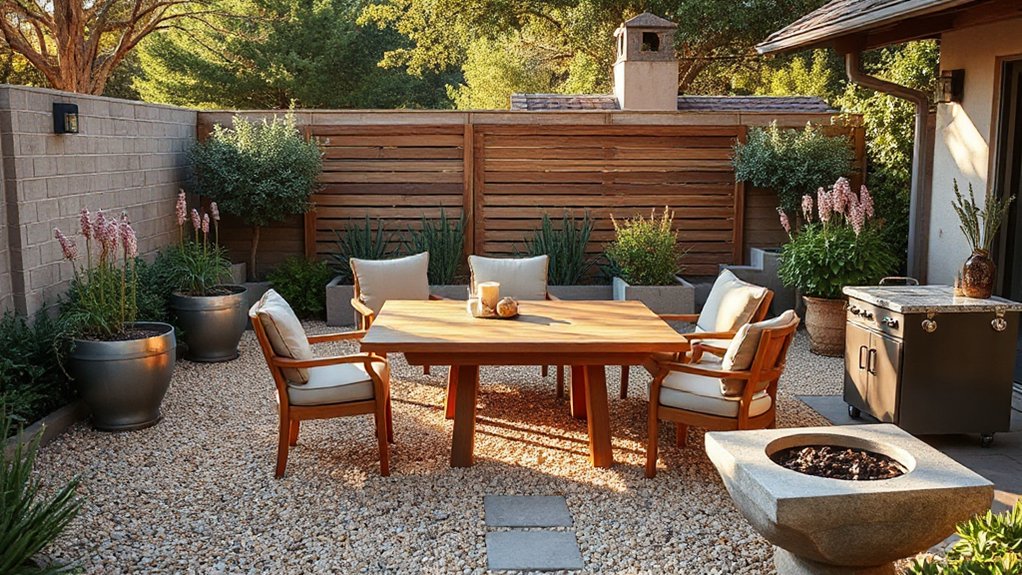
When you select durable materials, prioritize structural longevity and low maintenance for high-traffic garden zones.
Consider weather-resistant finishes that resist fading, moisture, and staining while keeping color and texture consistent over time.
This approach aligns with a purpose-built entertaining space, ensuring reliable performance under varied conditions.
Durable Materials Choices
Durable materials and finishes matter most in entertaining spaces, where frequent use, weather exposure, and easy maintenance drive choice. You’ll select substrates that resist wear while maintaining appearance, balancing cost, and lifecycle. Prioritize low-maintenance options with proven performance in outdoor conditions to minimize upkeep without sacrificing aesthetics.
Consider integration with features like Outdoor art and Water features, ensuring materials tolerate moisture, chlorides, and thermal cycling. Choose surfaces that resist staining, scratching, and fading, and finish with protective coatings designed for outdoor use.
Favor modular, repairable components to simplify replacements. Plan for anchoring and drainage to prevent movement or ponding. Sustainably sourced materials reduce environmental impact while meeting durability goals.
- Substrate resilience and load tolerance
- Moisture-compatible finishes
- UV-stable colorfast options
- Repairable, modular assemblies
Weather-Resistant Finishes
Selecting finishes that shrug off weather exposure is the next step after choosing durable substrates. You’re selecting weather-resistant coatings and materials that maintain form, color, and slip resistance under sun, rain, and temperature shifts.
Prioritize low-maintenance options with proven performance in outdoor conditions, such as powder-coated metals, sealed hardwoods, and UV-stabilized composites. Apply protective sealants only where they enhance longevity without altering appearance.
For garden art and Water features, guarantee finishes resist fading, corrosion, and algae buildup, and match expansion and contraction behaviors to substrates. Document gloss, texture, and color retention specifications for future maintenance cycles.
Integrate colorfast, non-slip surfaces at circulation paths. Use consistent hardware standards to minimize repaint intervals and assure cohesive, durable aesthetics across the entertaining spaces.
Optimize Breeze, Scent, and Sensory Balance
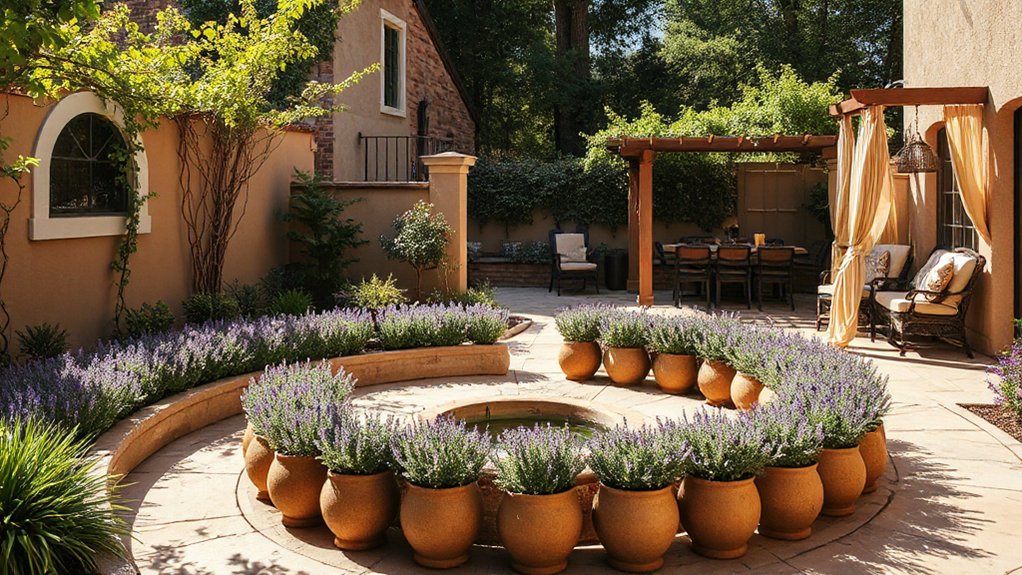
To optimize breeze, scent, and sensory balance, start by mapping airflow patterns, prevailing winds, and temperature changes across the garden relative to entertaining zones. You’ll identify how wind shifts affect comfort, then position seating, screens, and plantings to guide drafts away from guests while enabling gentle air flow.
Implement scent layering by layering complementary aromatics at differing heights, ensuring strong notes don’t overpower subtle ones as people mingle. Control noise and tactile cues with textured surfaces and responsive materials that respond to breeze without creating distractions.
Monitor microclimates to sustain even comfort during gatherings, adjusting as crowds shift. Breeze enhancement and Scent layering must harmonize with sightlines and accessibility.
- Map airflow to seating zones
- Align plant heights for layered scents
- Place screens to modulate drafts
- Test during peak entertaining times
Budget Smartly With Phased Upgrades
Smart budgeting for phased upgrades starts with a clear baseline and a prioritized plan that aligns spending with your garden’s function and entertainment goals. You map current assets, estimate replacement timelines, and assign cost categories to each phase.
Begin with essential improvements that preserve usability—lighting, seating, and access—then layer enhancements that elevate experience without bulk costs. Use a phased sequence to minimize disruption and maximize value per dollar.
Tie each upgrade to measurable outcomes: improved flow, durability, and guest comfort. Focus on Garden aesthetics during planning to confirm visuals align with mood targets, and apply Plant selection to ensure low-maintenance, high-impact specimens fit climate and reuse potential.
Track ROI and adjust scopes to avoid overinvesting before requirements change.
Maintenance Routine to Keep the Garden Inviting
A consistent maintenance routine keeps the garden inviting by ensuring paths stay clear, seating remains functional, and focal plants deliver ongoing visual impact. You implement a structured cadence, recording tasks and outcomes to sustain accessibility, safety, and aesthetics.
- Seasonal pruning: schedule before peak use, remove deadwood, shape ornamentals for airflow and plant health.
- Pest control: monitor for signs of infestation, apply targeted treatments, and rotate controls to prevent resistance.
- Path and furniture checks: inspect joints, tighten fasteners, clear debris, and reseal surfaces to preserve durability.
- Irrigation and soil management: verify emitters, adjust for weather, mulch to conserve moisture, and test soil pH quarterly.
Frequently Asked Questions
How Soon Can I Execute a Phased Entertaining Garden Plan?
You can start within weeks, phased by budget and space. Implement early garden lighting and durable outdoor decor first, then expand. Prioritize safety, permits, and drainage; document milestones and adjust timelines as you confirm soil, utilities, and access.
What Are the Best Low-Maintenance Plants for Guests?
First, you’ll notice that low-maintenance plans actually work—colorful blooms and aromatic herbs thrive with minimal effort. You’ll select drought-tolerant perennials, hardy grasses, and compact shrubs, ensuring year-round interest while you host effortlessly and comfortably.
Which Seating Arrangements Maximize Conversation and Accessibility?
You should center seating in small, connected clusters to maximize conversation and accessibility, using circular or semi-circular layouts. Add outdoor lighting along paths and privacy screens to channel sightlines and reduce distractions, enhancing comfort and flow.
How Do I Budget for Modular, Scalable Garden Upgrades?
You budget modular upgrades by forecasting scale, costs, and timelines, prioritizing garden lighting and outdoor decor needs, then phase expenditures with measurable milestones, review supplier quotes, and lock-in contingencies for future expansions while maintaining accessibility and performance.
What Safety Checks Ensure Year-Round Garden Usability and Comfort?
You should implement year-round safety checks: inspect lighting fixtures for IP ratings, secure wiring, and seasonal pest control plans. For example, case study: wired garden lighting, weatherproof switches; guarantee paths are clear, surfaces non-slip, and drains functional.
Conclusion
You’ll walk away knowing your entertaining garden isn’t a whim, it’s a system. You’ve mapped circulation, carved zones, and chosen durable finishes that forgive clumsy guests and stubborn weather. You’ve designed seating that nudges conversation, dining and prep that flow, and paths that don’t pretend they’re invisible. So yes, plan, test, and stage—then pretend you’re foolproof. Spoiler: you’re not. But with this blueprint, the garden will function almost like a well-oiled party favor—until it doesn’t, which is exactly the point.