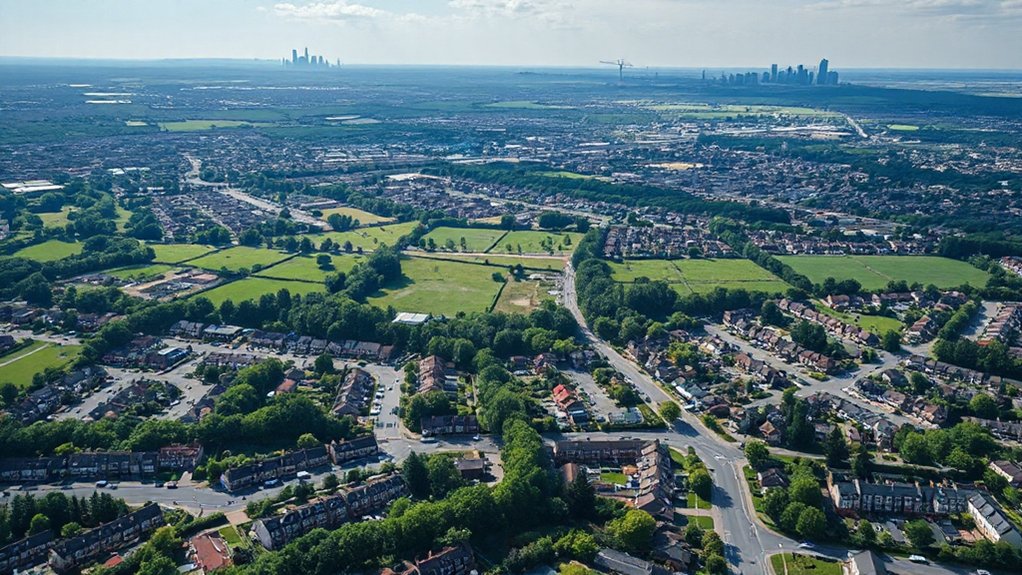
Emerging UK postcode hotspots cluster where momentum, liveability, and access converge. You’ll see durable growth mapped across multi-year trends, driven by strong transport links, dense amenities, and local economic strength. Assess growth signals like house price momentum, rental yields, turnover, and vacancy cycles, then weigh liveability factors—schools, safety, green space, transit access. Prioritize areas with sustained momentum, walkable cores, and clear development pipelines. If you keep exploring, you’ll uncover practical steps to target rising postcodes with confidence.
What Emergent Postcode Hotspots Really Look Like

Emergent postcode hotspots reveal clusters where activity, demand, or risk concentrate beyond what population alone would predict. You observe how maps illuminate density waves: high-velocity transactions, shifting rents, and footfall surges that defy simple population counts.
These patterns arise from a blend of Historical context and Cultural influences that shape desirability over time, not just current economics. You’ll see historic transport links, industrial legacies, and landmark developments imprinting persistent elevation in value and activity.
Spatial nuance matters: proximity to universities, parks, and nightlife alters diffusion; edge effects and neighborhood gradients reveal tipping points. You quantify signals with granular metrics—purchase velocity, vacancy compression, and amenity variety—then situate them within evolving urban narratives, avoiding generic causality and embracing context-driven interpretation.
How We Measure Postcode Growth and Liveability
Measuring postcode growth and liveability combines quantitative metrics with contextual nuance to map true performance. You’ll blend objective indicators—house price momentum, rental yields, vacancy rates, and amenity density—with qualitative context from residents and local planning signals.
Historical trends guide baseline trajectories, while seasonality and economic cycles reveal persistence versus volatility. You’ll weight safety, schools, transport accessibility, green space, and service availability to reflect lived experience, not just market signals.
Spatial analysis ties outcomes to geography, revealing cluster patterns, leakage, and spillovers between adjacent postcodes. Community engagement adds ground truth: surveys, focus groups, and participatory mapping uncover priorities that data alone can miss.
The result is a responsive dashboard that highlights where growth aligns with livability, and where misalignment warrants attention.
How to Rank UK Postcode Clusters for 2026
To rank UK postcode clusters for 2026, you’ll synthesize growth signals with liveability indicators and geographic context. You Bewert? No. You’ll align historical trends and demographic shifts with current market data, then weight criteria by resilience and scale.
Begin with a spatial framework: map clusters against regional GDP, employment density, and housing supply, ensuring geographic exposure is explicit.
Material inputs include house price momentum, rental yields, turnover, and vacancy rates, filtered by time horizon.
Integrate livability metrics such as schools, healthcare access, crime, and green space per capita, normalized across postcode areas.
Apply a transparent scoring rubric, using both absolute values and rate changes.
Validate rankings with cross-checks to avoid data leakage.
Prioritize clusters showing sustained growth momentum and favorable demographic shifts for 2026.
Historical trends strengthen projections, while demographic shifts calibrate longevity.
Transport Links and Amenities Driving Postcode Demand

Transport links and amenities are the primary engines of postcode demand, with proximity to reliable rail and motorway access, frequent bus services, and walkable access to hubs driving higher turnover and price momentum.
You’ll see clear spatial patterns: precincts adjacent to fast rail corridors outperform nearby baselines, while motorway-connected pockets sustain resilient price floors during volatility.
Data show higher turnover in areas with multiple arterial routes and dense amenity clusters, creating self-reinforcing demand.
Historical property trends reveal that snap increases align with new station openings and bus-rapid transit upgrades, not merely population growth.
Demographic shifts amplify some corridors, as younger households favor walkable cores with mixed-use facilities.
Translate these signals into postcode choices by weighting transit scores, amenity depth, and connectivity upcharges within pooled market analyses.
Local Jobs and Wages: Economic Signals by Postcode
You’ll compare local wage trends and job availability signals across postcodes to map economic heat and volatility.
By focusing on spatial patterns, you’ll identify where rising wages align with job openings and where mismatch persists.
This framework sets the stage for pinpointing emerging property hotspots driven by local labor-market dynamics.
Local Wage Trends
- Wage disparities across postcodes indicate concentrated higher earners near industrial or tech employment hubs.
- Salary benchmarks shift when you compare urban cores to peri-urban districts, revealing pockets of underutilization.
- Transparent, postcode-level data lets planners align incentives with affordability and growth targets.
These patterns guide interpretation of property risk and investment potential, underscoring how wage gradients influence housing demand, price resilience, and development feasibility.
Job Availability Signals
Compare job density with median wages to identify pockets where demand supports higher earnings, and note areas of underemployment despite proximity to growth corridors.
Spatial overlays show connections between transportation access, business incubators, and recruiting intensity, revealing how workforce demand travels along major corridors.
Consider community development when evaluating signals, as sustained hiring can fund services and schooling.
Also assess cultural amenities shaping retention, since employers increasingly favor areas with arts venues and leisure options.
Precise, data-driven interpretation helps forecast market resilience and informs investment decisions.
Price and Rent Trajectories: Early Postcode Indicators
You’ll start by examining how price trajectory signals and rent growth indicators vary across nearby postcodes, revealing localized momentum patterns.
In each area, compare recent monthly changes to neighbors to identify early movers and hotspots.
This spatially-aware view helps you spot where housing costs may rise fastest and where rents lag, informing targeted analyses.
Price Trajectory Signals
- Localized price-rent convergence patterns reveal where momentum consolidates
- Cross-referencing historical trends with current movement sharpens hotspot timing
- Demographic shifts help explain why certain corridors sustain upward trajectories
Rent Growth Indicators
Quantitative signals—monthly rent indices, price-to-rent gaps, and absorption rates—map spatial patterns, highlighting pockets of sustained demand versus temporary pullbacks.
When rents rise faster than prices, demand density remains stronger, suggesting upcoming zoning adjustments could release supply. Conversely, price outpacing rent may forewarn overheating in specific corridors.
Property taxation regimes and capital allowances shape purchase incentives, while zoning regulations influence construction velocity and unit mix.
Integrate these variables with geospatial layers to forecast post-2024 momentum and identify resilient hotspots.
Case Studies: Postcodes Lighting Up Quickly
Where are the fastest-rising postcodes, and what drives their brief bursts of activity? You’ll see sharp spikes centered around transport links, employment clusters, and refreshed housing stock, rather than broad regional shifts. Case studies reveal micro-dynamics: inflows of workers, new developments, and targeted incentives that compress timelines from listing to sale or rent.
- Historical migration reshapes demand hubs with transient spikes in price and turnover
- Cultural diversity fuels niche amenities, keeping neighborhoods vibrant and visible
- Spatial spillovers from nearby regenerations extend demand beyond core areas
You track each postcode as a data point in a wider map, noting timing, scale, and durability. The lesson is precise: rapid growth often sits at the intersection of mobility, opportunity, and place-specific identity.
How to Compare Postcode Hotspots You’re Eyeing
When you compare postcode hotspots you’re eyeing, start by aligning metrics across speed, scale, and durability of growth. You’ll weight historical trends to distinguish transient bursts from sustained momentum, anchoring decisions to multi-year data rather than quarterly blips.
Assess demographic shifts to understand who’s driving demand and how household formation, income trajectories, and mobility patterns shape future gains.
Map spatial spillovers: a hotspot rarely remains isolated, so measure connectivity to transit, employment nodes, and amenity clusters. Normalize for price baselines and vacancy cycles to avoid skew from price rallies alone.
Use outlier analysis to flag pockets with durable rent growth versus those vulnerable to rate shocks.
Combine granular micro-data with citywide forecasts to select hotspots with balanced, long-run upside aligned to your risk tolerance.
Risks That Could Slow Growth in These Areas

Even so, a range of macro and local factors could temper growth in these hotspots. You’ll weigh zoning regulations, infrastructure schedules, and housing supply against demand signals, while mapping exposure to environmental risks that could curb pace.
Spatial patterns show that pockets near planned transit may surge, yet nearby constraints can blunt gains if approvals stall. Market momentum hinges on affordable entry points, lender appetite, and school catchments, all varying by postcode.
You’ll monitor vacancy rates, price growth deceleration, and development pipelines to gauge risk.
- Zoning regulations and permit timelines that constrain new stock
- Environmental risks shaping construction costs and insurability
- Local planning shifts affecting density, amenities, and transit access
Practical Steps for Investors and Homebuyers
Steering through these emerging property hotspots requires concrete, data-driven action from both investors and homebuyers. You should map recent price momentum, rental yields, and planning approvals at the postcode level, then verify with local demographic trends and transport access.
Prioritize areas with transparent development pipelines and visible community engagement, ensuring projects align with environmental sustainability criteria. Assess occupancy rates, vacancy cycles, and school and health-service proximity to forecast stability.
Run scenario analyses for sensitivity to interest-rate shifts and supply tweaks, limiting exposure to overhyped micro-markets. Engage with residents and councils to identify long-term value drivers beyond short-term appreciation.
Document decisions with verifiable metrics, track performance, and recalibrate your portfolio or purchase plan as new data indicate shifting hotspot status.
A Quick-Screen Framework: Is Your Postcode Poised to Rise?
A quick-screen framework helps you judge whether a postcode is set to rise by combining real-time data and place-based context. You scan indicators that matter: growth momentum, amenity access, and spatial connectivity, then weigh signals against baseline demographics.
This method is precise, repeatable, and spatially aware, letting you compare postcodes on a like-for-like basis. Your goal is to detect early momentum without overpaying, so you privilege transparent metrics and observable trends like pedestrian flow, transit upgrades, and energy-efficient development.
- Postcode branding signals
- Cultural amenities access
- Transport and pedestrian connectivity
Frequently Asked Questions
What Unseen Factors Drive Emergent Postcode Hotspots?
Unseen factors include shifting Neighborhood dynamics and Cultural influences that you can’t ignore; you’ll see micro-trends in demographics, amenities, and transport access, and spatial clustering revealing how local networks attract investment and reshape demand.
How Do Data Biases Affect Hotspot Rankings?
Data accuracy directly shapes hotspot rankings, and sampling bias can tilt outcomes. You’ll see skewed priorities if data gaps exist, so you must account for spatial bias, corroborate with multiple sources, and quantify uncertainty in measurements.
Can Hotspots Reverse Quickly After a Downturn?
Yes, hotspots can reverse quickly after a downturn, but market resilience and redevelopment impact determine speed. You’ll see rebounds where demand stays strong, supply tightens, and targeted redevelopment improves accessibility and amenities, guiding spatially-aware recovery patterns.
Which Metrics Predict Long-Term Sustainability of Growth?
You’ll know long-term growth sustains when market stability steadys and infrastructure resilience strengthens, limiting volatility. You should track vacancy trends, transport and utility continuity, school quality, and planned investments—spatial patterns revealing diversified demand and robust, climate-ready infrastructure.
How Should Residents Benefit From Hotspot Signals?
You should leverage hotspot signals to maximize your benefits: engage with local residents and institutions, monitor infrastructure development, and participate in data-informed planning to improve amenities, transport, and services—creating resilient, inclusive community outcomes.
Conclusion
You’re tracking where postcode clusters surge, but don’t forget the subtler map: walkable links, rail fringes, and wage signals that pressure home prices upward. The theory you test—growth clusters align with transport spine and local job hubs—holds when data clusters tighten around stations, schools, and amenities. Picture a 3D lattice: population, wages, and access coalescing into rising demand. If the coordinates drift apart, so might the rise. Measure, map, act—then verify with the next data cycle.