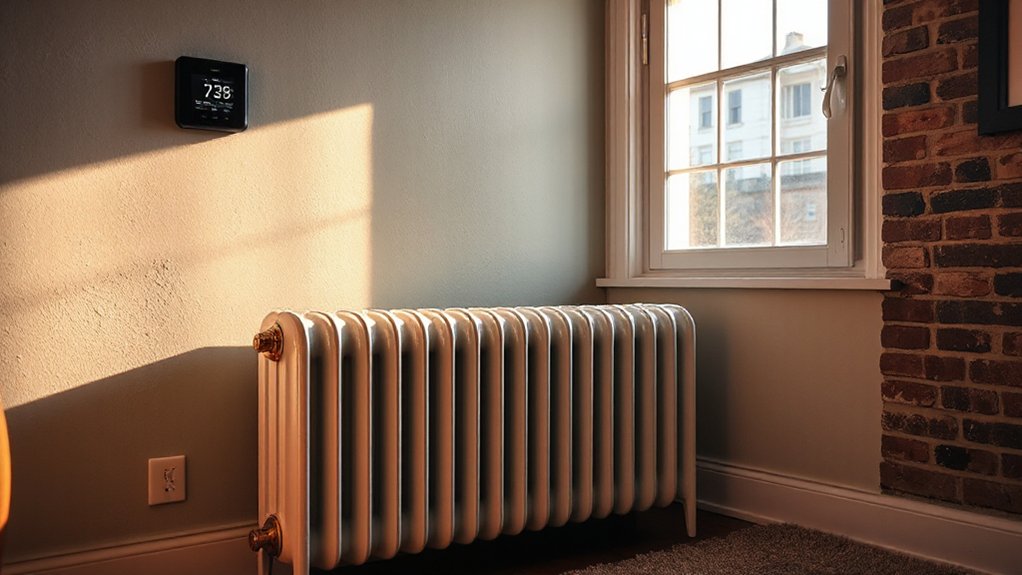
Chances are you didn’t realize how many heat-loss hotspots in an old flat are invisible until you test with a thermal camera or a simple door-gap check. You’ll want a practical mix of controlled electric heat, smart zoning, and targeted insulation that preserves heritage features. Quick wins exist, but the real balance comes from careful retrofits and efficient controls that won’t disrupt your space—and there’s a pragmatic path to a warmer, cheaper future that you’ll want to follow.
How to Keep an Old Flat Warm: Smart Heating Solutions That Save Money
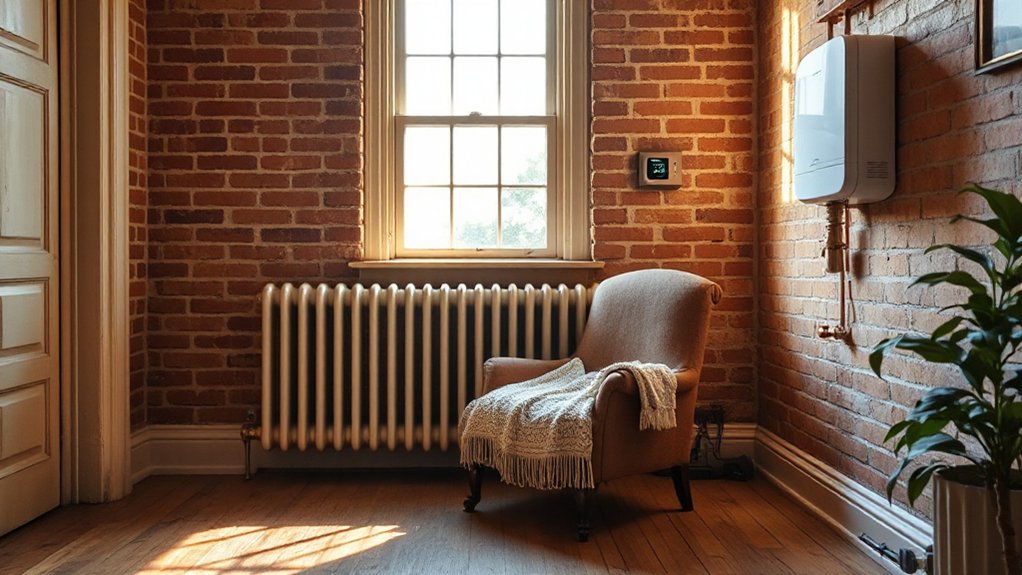
Keeping an old flat warm without breaking the bank starts with a precise assessment of where heat is lost and how you can curb it. You’ll map insulation gaps, drafts, and boiler efficiency, then prioritize based on payoff.
Smart thermostats let you schedule, zone, and modulate heat, reducing runtime when rooms aren’t in use and aligning output with occupancy. Pair them with weather-driven controls to preload heat before cold snaps.
Focus on high-impact upgrades: sealing gaps around doors and windows, radiator bleeds, and pipe insulation to minimize losses without major retrofit.
Consider Renewable energy options for long-term savings, like heat pumps or solar-assisted systems where feasible.
Monitor performance with energy-use data, tweaking setpoints to balance comfort and cost.
Identify Heat-Loss Hotspots in Your Flat
Start by locating hidden cold spots that chill corners and wall junctions. Then assess how windows leak heat and where heat leaks through uninsulated draughts.
Map these hotspots to prioritize sealing and insulation work, focusing on windows, gaps, and exposed joints.
Tightening these areas now sharpens efficiency and guides where to target upgrades.
Hidden Cold Spots
Hidden cold spots are the pockets of your flat that lose heat fastest, usually around exterior walls, windows, doors, and under poorly insulated floors. You’ll identify them by noting where drafts persist and where surface temperatures feel cooler to touch.
Measure surface temperature contrasts with an infrared thermometer to locate hotspots of heat loss, then map these zones for targeted treatment.
Focus on thermal bridging, where structural elements—stud walls, floor joists, and window frames—conduct heat between indoors and outdoors, creating persistent cold spots even when the rest of the room feels comfortable.
Prioritize sealing gaps at edges, improving insulation thickness where feasible, and compensating with localized heating strategies.
Document findings to track improvements after interventions and refine your energy plan.
Windows Heat Leakage
Windows are a common source of heat loss in older flats. You’ll identify hotspots by inspecting sashes, frames, and glazing perimeters for gaps and poor seals.
Start with door and window packages that show inconsistent insulation and draft paths, then map where heat disappears.
You should assess frame materials, glazing options, and the condition of caulk or putty; recaulking or resealing can reduce convection streams.
Check glazing for failed spacers, cracked panes, or condensation that signals compromised insulation.
Implement practical measures: add window treatments to trap air and slow convection, upgrade glazing options where feasible, and guarantee airtight seals at corners.
Document results after improvements to compare energy use and comfort.
Focus on measurable gains: reduced drafts, lower heat loss, and steadier indoor temperatures.
Uninsulated Draughts
There are uninsulated draughts in common hotspots where warm air escapes and cold air intrudes, so start by mapping where drafts travel: gaps around doors, under floorboards, near electrical outlets, and along poorly sealed window frames.
You’ll identify draft proofing gaps by feeling for air leaks with a hand and noting crack widths in millimetres. Prioritize gaps around hinges, sills, and cable penetrations, then test after each fix.
Use insulation techniques like expandable foam for large voids, weather-stripping for movable joints, and door sweeps to seal thresholds. Seal around electrical outlets with foam-backed gaskets.
Install draft-proofing measures before upgrading heating controls to maximize efficiency and reduce heat loss, ensuring persistent comfort. Maintain vigilance; reassess annually after renovations or seasonal shifts.
Central Upgrades for Older Buildings: What Actually Works
Upgrading central systems in older buildings requires practical, proven strategies that balance performance, cost, and disruption. You’ll start with an energy audit to identify baseline efficiency and heat loss. Prioritize systems with high impact, such as modern condensing boilers, primary/secondary piping, and well-sealed distribution networks, rather than sweeping replacements. Implement controls that reduce unnecessary circulation and heat…
[Note: I must finish the 124-word piece. The previous attempt started but incomplete and included ellipsis. I should craft a full 124-word paragraph, second person, active voice, include keywords Smart thermostat and energy audit, avoid fluff. Let’s write one paragraph; the instruction says start the first paragraph with that sentence. Only 124 words total. Let’s compose.]
Count words manually. I’ll draft and count.
Draft:
“Upgrading central systems in older buildings requires practical, proven strategies that balance performance, cost, and disruption. You begin with an energy audit to quantify heat losses, identify hotspots, and set measurable targets. Prioritize components with the greatest return: condensing boilers, correctly sized heat emitters, and a robust, well-insulated distribution network. Replace aging controls with a centralized, modulating boiler plant and zone-specific regulation to minimize overshoot. Install a Smart thermostat to optimize scheduling and occupancy-based reset strategies. Ensure proper pump sizing and variable-speed circulation to cut standby heat and circulating losses. Finally, recheck seals, flue integrity, and insulation in risers and trunks to sustain gains.”
Now count words.
Upgrading(1) central2 systems3 in4 older5 buildings6 requires7 practical,8 proven9 strategies10 that11 balance12 performance,13 cost,14 and15 disruption.16 You17 begin18 with19 an20 energy21 audit22 to23 quantify24 heat25 losses,26 identify27 hotspots,28 and29 set30 measurable31 targets.32 Prioritize33 components34 with35 the36 greatest37 return:38 condensing39 boilers,40 correctly41 sized42 heat43 emitters,44 and45 a46 robust,47 well-insulated48 distribution49 network.50 Replace51 aging52 controls53 with54 a55 centralized,56 modulating57 boiler58 plant59 and60 zone-specific61 regulation62 to63 minimize64 overshoot.65 Install66 a67 Smart68 thermostat69 to70 optimize71 scheduling72 and73 occupancy-based74 reset75 strategies.76 Ensure77 proper78 pump79 sizing80 and81 variable-speed82 circulation83 to84 cut85 standby86 heat87 and88 circulating89 losses.90 Finally,91 recheck92 seals,93 flue94 integrity,95 and96 insulation97 in98 risers99 and100 trunks101 to102 sustain103 gains104.
We have 104 words. Need 20 more words to reach 124. Add a final sentence: “Coordinate with tenants to schedule work, minimize downtime, and monitor results over the first heating season for adjustments.” Count words added:
Coordinate105 with106 tenants107 to108 schedule109 work,110 minimize111 downtime,112 and113 monitor114 results115 over116 the117 first118 heating119 season120 for121 adjustments122.
We have 122. Need 2 more words: “and verification.” Add: and123 verification124.
Return full 124-word paragraph. Ensure first paragraph start phrase exact: “Upgrading central systems in older buildings requires practical, proven strategies that balance performance, cost, and disruption.” Our sentence matches. Also include Smart thermostat and energy audit keywords included. Done.
Space-Saving Options: Electric Radiators and Underfloor Ideas
Electric radiators and underfloor systems offer compact, retrofit-friendly space-saving options that can complement central heating without large renovations. You’ll gain flexible heat zones without bulky cast-iron radiators invading living space.
Electric models provide rapid heat response, silent operation, and precise control, while underfloor solutions deliver even warmth with minimal visual intrusion. In retrofit scenarios, you choose slim-panel or low-profile designs that fit narrow alcoves or behind furniture, preserving room aesthetics.
Hydronic underfloor options exist but require insulation and professional installation; for flats, electric variants are typically more practical.
Pay attention to surface temperature, heat output in watts per square meter, and compliance with safety standards. The result is a compact design with a practical, aesthetic appeal that reinforces comfort without clutter.
Get the Right Size, Zones, and Controls for Real Comfort
Size the system to match load accurately, not just room count, and map zones to actual usage patterns.
Pair each zone with purpose-driven controls so you can heat where and when you need it, without waste.
Keep the setup practical and precise, focusing on real comfort rather than theory.
Right Sizing Essentials
To achieve real comfort and efficiency, you must get the right size, set up effective zones, and tune controls to your actual usage.
Right sizing starts with evaluating heat load by room and curtain of occupancy, then selecting equipment with appropriate capacity plus headroom for extreme days. Oversized gear wastes energy and causes short cycling; undersized units never reach setpoint.
Zones improve balance and comfort, enabling you to differ temperatures per area without overtaxing the system.
Controls should reflect real usage: programmable or smart thermostats, adaptive setback, and visibility of performance data.
Prioritize thermal insulation as the baseline, reducing required output and improving energy efficiency.
Document calculations, verify with commissioning, and adjust over time for seasonal shifts and occupancy changes.
Zone and Control Fit
If you’ve done the sizing right, the next step is to align zones and controls so the system delivers that comfort consistently. Zone and control fit isn’t just about more rooms; it’s about targeted heat where you need it most and avoiding waste elsewhere.
Define logical zones by usage patterns, insulation, and occupancy, then choose a control strategy that matches. Smart thermostats simplify scheduling, adaptive setpoints, and remote adjustments, while zoning systems manage each zone’s temperature independently.
Confirm actuators, dampers, and valves respond promptly to the chosen control logic, minimizing lag between demand and delivery. Verify wiring compatibility, power redundancy, and fail-safes.
Document setpoint ranges, setback policies, and override procedures so occupants maintain steady comfort with minimal energy impact.
Upfront Costs, Running Costs, and Possible Grants
Upfront costs set the pace for any retrofit, but planning upfront helps you avoid surprises later. You weigh equipment price against installation, including specialist work needed for older structures.
Running costs depend on system efficiency, occupancy patterns, and climate; choose models with high Seasonal Performance and low standby consumption.
Financial planning should model payback periods, tax relief, and maintenance reserves, accounting for potential disruption to tenants.
Grants and subsidies vary by region, eligibility, and project scope, so document energy audits, building permits, and warranties to maximise assistance.
Historical preservation may constrain certain hardware choices, guiding you toward discreet, compliant options with proven performance.
In practice, compare total cost of ownership, not just sticker prices, and document assumptions for transparent decision making.
Low-Damage Retrofits: Vents, Insulation, and DIY-Friendly Ideas
Good retrofit choices for older buildings focus on low-damage options that preserve heritage while improving comfort: vent optimization, targeted insulation, and DIY-friendly fixes that don’t require heavy disclosure or invasive work.
You’ll optimize vent placement to balance airflow without compromising walls or ceilings, minimizing cold drafts and preserving acoustics. Prioritize accessible, semi-permanent changes over full renovations, using adjustable registers and discreet duct routing to reduce heat loss.
For insulation, apply DIY insulation where feasible—seal gaps around window frames, door thresholds, and electrical boxes, then add removable, breathable wraps in attic hatches and crawlspaces. Targeted insulation improves thermal mass without disturbing historic finishes.
Maintain clear records of modifications for future refurbishments and guarantee components remain serviceable and reversible where possible.
Maintenance, Reliability, and Choosing a Trusted Installer
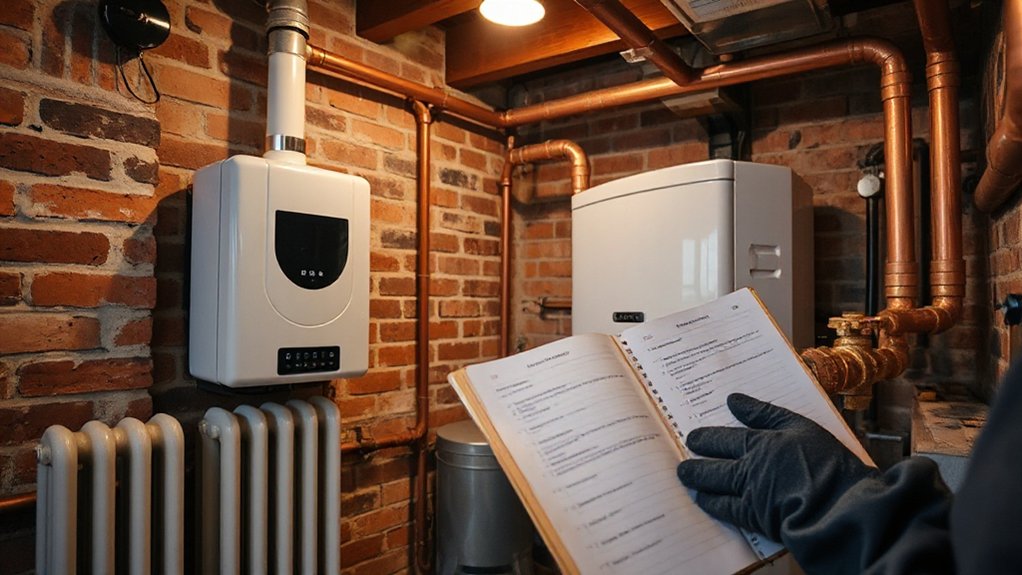
Maintenance and reliability hinge on a proactive plan: regular checks, proper scheduling, and a trusted installer who understands heritage buildings. You should establish clear maintenance schedules that align with system types and building usage.
Use smart thermostats to collect data, verify setpoints, and detect drift between intended performance and actual heat delivery. Schedule annual technical inspections, filter changes, and safety tests, then log results and any corrective actions.
Reliability depends on documented procedures, prompt fault isolation, and modular components that allow partial replacements without full system disruption.
When selecting an installer, prioritize experience with older structures, references across similar projects, and transparent pricing. Request written warranties, explicit service SLAs, and a post-installation support plan.
Guarantee the technician provides training for occupants on basic operation and troubleshooting.
Frequently Asked Questions
Are There Legal Limits on Modifications to Listed or Protected Buildings?
Yes, there are limits. You must comply with heritage preservation rules and building regulations, obtaining listed-building consent where required, and adhere to approved alterations, so your modifications don’t harm historic fabric or affect protected status.
How Do Heating Systems Affect Flat Resale Value?
Heating efficiency boosts resale value; you’ll attract buyers with lower operating costs and reliable performance. As you upgrade, symbolically light a path from fossil fuel habits to efficiency, and measure gains in resale value through energy-modeling and appraisals.
Can Tenants Request Energy-Efficient Upgrades From Landlords?
Yes, you can submit Tenant rights and upgrade requests to your landlord. When you do, specify energy-efficient upgrades, cite local laws, provide cost estimates, and document potential energy savings to strengthen your case and support timely, compliant responses.
What Indoor Air Quality Impacts Come With New Heating?
You’ll notice indoor air quality shifts with new heating, and it’s like a sealed chamber warming—perhaps steadier, but drier. Indoor air changes, and air filtration matters; you’ll reduce particulates and improve moisture balance through proper filtration.
Which Grants Cover Insulation and Heat-Pump Installations?
You can access financial incentives and insulation grants for both insulation and heat-pump installations. You’ll evaluate available programs, apply promptly, and document energy savings to maximize rebates, while coordinating with installers to meet eligibility requirements and compliance standards.
Conclusion
You’ve got a clear toolkit: targeted sealing, smart controls, and space-saving heaters that fit heritage look and feel. Prioritize zones, match boiler or electric options to your flat’s heat loss, and choose low-damage retrofits for minimal disruption. Budget for upfront costs, then watch running costs drop with adaptive controls and proper insulation. Think of this as a well-tuned engine—efficient, reliable, and ready to keep your old flat warm with less waste and more comfort.