
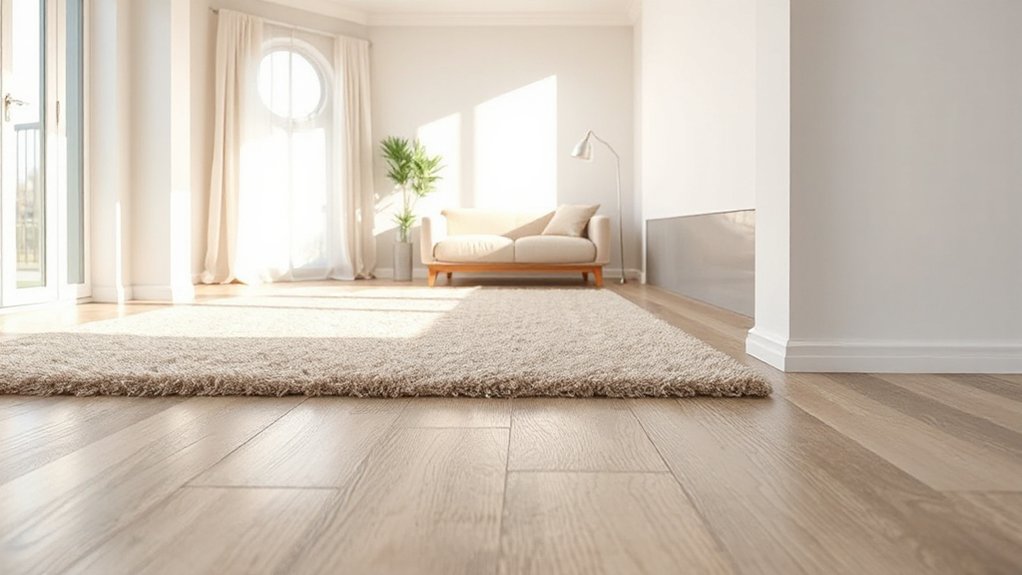
You’ve probably walked on a floor that echoed like a drum and felt the vibration travel through walls; in flats, noise sensitivity changes how you choose materials. You’ll want engineered wood with impact-absorbing cores, plush carpet with dense padding, or floating floor systems paired with quality underlayment to dampen steps and airborne sound. Each option has trade-offs in durability, comfort, and install complexity—and your next step hinges on how you balance performance with budget, space, and building constraints. Let’s compare these methods and identify the best fit for your setup.
Why Flats Need Quiet Floors: Key Noise Types to Fight
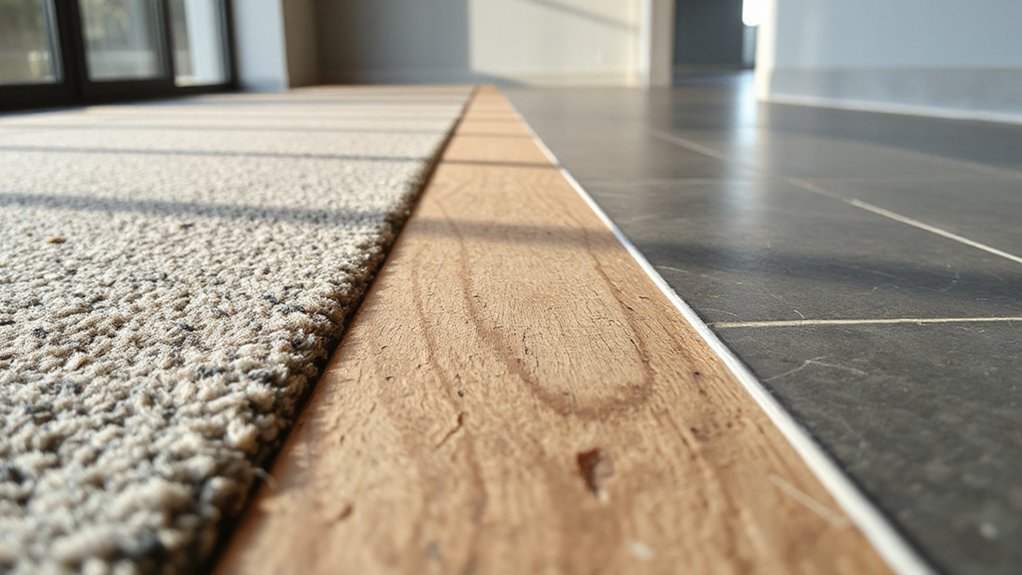
Sound floors matter in flats because noise transfers readily through structural paths and can disrupt neighboring units. You assess impact by identifying common noise types: impact sounds from foot traffic, dropped objects, and furniture movement; airborne noise from voices, TV, and HVAC; and structure-borne vibrations transmitted through joists and walls.
You quantify their effects on privacy, comfort, and sleep, noting that frequency ranges influence perceived loudness and annoyance. You consider how floor construction, substrate, and finishes alter transmission, while recognizing that decoupling or massing can mitigate echoes and tremors.
You also account for decorative patterns and color schemes as design elements that don’t compromise performance yet help customers visualize subtle sound-damping strategies. Your analysis remains technical, objective, and free of extraneous narration.
Core Criteria for Quiet Floors in Apartments
When selecting quiet floors for apartments, start with a clear set of measurable criteria that directly affect sound transmission and occupant comfort. You evaluate impact isolation, impact sound ratings (Ln and Ln,w), and muffling coefficients for airborne noise. Specify surface mass, acoustic reverberation, and floor–ceiling assemblies, plus transmission loss through walls and ceilings.
Define acceptable ranges for IIC, STC, and NR indices relative to building type and occupancy. Include measurable comfort metrics: vibration isolation, thermal coupling, and slip resistance. Material properties matter, but the criteria must translate into test procedures and pass/fail thresholds.
Consider decorative patterns and color schemes as aesthetic constraints independent of performance. Document installation tolerances, maintenance implications, and lifecycle acoustics to guarantee reproducible quiet outcomes across units.
Quiet Engineered Wood Options That Absorb Impact
Engineered wood products that absorb impact deliver lower transmitted sound by combining a resilient core with a dense, protective layer. You’ll want cores engineered for high density and low compressibility, paired with face veneers or laminates that resist indentation, while preserving stiffness for dimensional stability.
Impact reduction stems from a balanced mass–spring mechanism: a soft, resilient core dampens energy; a tighter top layer limits airborne transmission. Choose products with ISO-tested impact sound ratings or awaiting compliant lab proof, and verify underlayment compatibility for decoupling layers.
For added quiet, consider ancillary options like soundproof paint to seal gaps and reduce ceiling-to-wall flanking paths, and select acoustic window inserts where exterior noise intrudes, preserving overall ambience without altering floor structure.
Precision selection minimizes vibration, supports comfort, and preserves floor performance.
Plush Carpet and Padding for Footfall Comfort
Plush carpet provides notable footfall comfort through its dense fiber structure, delivering consistent impact attenuation when paired with underfoot padding.
You’ll want to evaluate padding effectiveness separately, as it directly influences overall noise reduction and underlay durability.
This section begins with comparing carpet benefits, padding performance, and their combined effect on noise transmission for flats.
Plush Carpet Benefits
Plush carpet, paired with an appropriate underlayment, reduces footfall noise more effectively than many hard-surface options, because its dense fibers and padding absorb impact energy before it propagates through the floor structure.
In this context, benefits are measurable: improved impact attenuation, enhanced thermal comfort, and maintained acoustic secrecy under typical apartment loads. You gain consistent acoustic performance across room zones, with reduced reverberation and footfall transients even during mid-frequency bands.
The material’s fiber density supports longer life under applied traffic, while backing systems contribute dimensional stability. Be mindful that decorative patterns should be selected to avoid pattern-induced glare while preserving wear resistance.
Color coordination with décor can optimize perception of space, reducing perceived dissonance without compromising measurable attenuation.
Padding Effectiveness
Padding under plush carpet plays a decisive role in footfall comfort by moderating impact energy before it reaches the subfloor. In this section, you evaluate padding effectiveness as a primary determinant of surface response to walking loads.
A properly selected pad reduces peak contact forces, lowers transmitted vibration, and improves resilience after repeated foot traffic. You should consider density, thickness, and shear stability—balances that shape both comfort and long-term performance.
When comparing products, measure how quickly the pad returns to shape after each step, and how consistently it preserves the carpet’s flush, stable surface. Acoustic insulation benefits accompany appropriate padding, with reductions in airborne and structure-borne sound transmission.
Choose a pad that meets the floor’s load requirement while maintaining substrate integrity and manufacturing compatibility.
Footfall Noise Reduction
Effective footfall noise reduction hinges on how plush carpet and its padding interact with the subfloor to damp both impact and airborne sounds. You select carpet with consistent pile height and dense tufts, then pair it with padding that matches anticipated load and room use.
A high-density polyurethane or synthetic fiber pad improves impact absorption, while a slightly lower thickness reduces springiness that can transfer vibration. Pay attention to seam integrity and underlayment moisture barriers, which prevent sound bridges and subfloor degradation.
Eco-friendly materials can provide comparable performance when manufactured with closed-cell foams or recycled fiber content, contributing to sustainability without sacrificing density.
Aesthetic considerations matter for room rhythm; choose neutral tones and uniform texture to minimize perceived noise. Guarantee installation follows manufacturer specs for optimum, durable footfall reduction.
Rubber-Backed Laminate: Balance Durability and Noise
Rubber-backed laminate offers a practical balance between durability and sound control for flats with noise sensitivity. You’ll benefit from a hard wear surface paired with a resilient layer that dampens impact sounds.
The rubber backing adds compressive mass, reducing footfall noise transmission into subfloors and walls, while enhancing dimensional stability under daily use. Choose products that specify a compatible Acoustic underlayment to optimize impact insulation and reduce hollow-sounding floors.
Installation should follow manufacturer guidelines, ensuring tight seams and full adhesion, as gaps compromise sound performance. Compare wear ratings, click-lock versus glued options, and the backing’s stated noise reduction value to gauge real-world performance.
Also verify moisture tolerance and substrate requirements, since imperfect installations undermine both durability and acoustics. In practice, this combination supports long-term comfort without sacrificing practicality or appearance.
Floating Floor Systems for Apartments: Pros, Cons, and Install Tips
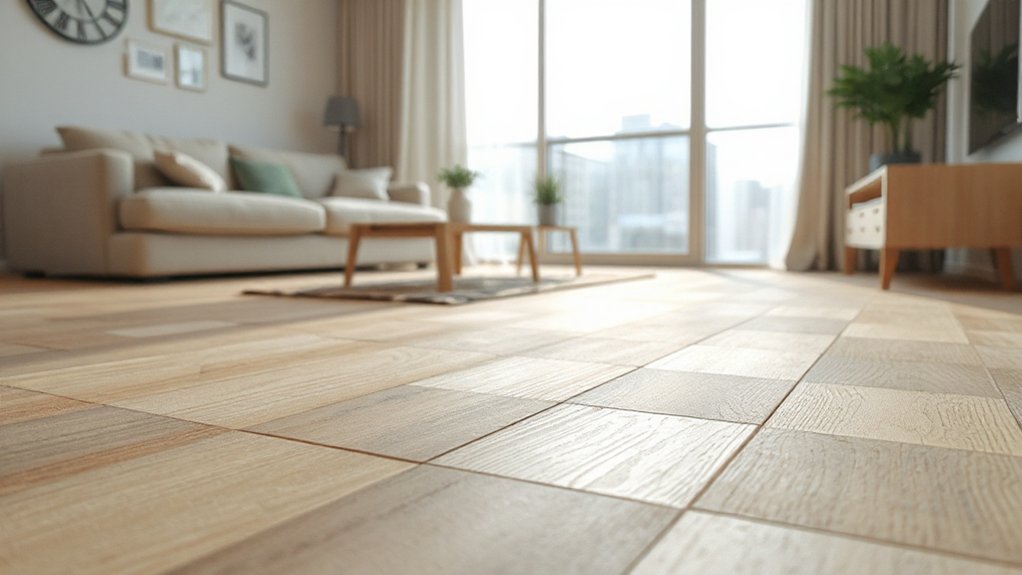
Floating floor systems are a practical choice for apartments because they decouple the floor from the structural slab, reducing sound transmission and simplifying repairs.
You assess suitability by evaluating joist spacing, breakfasting the space for displacement, and selecting a system with proven impact and airborne noise performance.
Pros include easier future replacement, quicker installation, and the ability to decouple vibration paths.
Cons involve higher initial cost, potential resilience under heavy furniture, and perimeter gaps that require careful detailing.
Install tips emphasize precise subfloor preparation, flatness, and alignment to minimize squeaks.
Confirm moisture barriers are integrated where moisture is a concern, and verify compatibility with the chosen floating system.
Plan for acoustic isolation at transitions to adjacent rooms to maintain performance.
Underlayment Essentials: Choosing the Right Dampening Layer
You’ll evaluate sound dampening materials for their effect on floor rigidity and impact insulation.
Consider subfloor compatibility tips to guarantee the layer performs as intended across moisture, temperature, and load scenarios.
Follow installation guidelines essentials to verify proper thickness, fastener compatibility, and edge detailing for consistent attenuation.
Sound Dampening Materials
Choosing the right sound-dampening underlayment is essential for flats, as it directly affects impact noise, footfall, and overall room acoustics. You’ll evaluate layer properties like density, compression resistance, and moisture tolerance to minimize vibration transfer from above.
Target products include mass-loaded vinyl, high-density EVA, and cork composites, selected for low stiffness and high damping. Pair underlayment with appropriate subfloor preparation to ensure uniform contact and predictable performance.
When modeling performance, you’ll compare impact insulation class (IIC) improvements and noise reduction coefficients (NRC) as concrete baselines shift. To reinforce treatment, consider combining discrete barriers with surface treatments.
For final rooms, you’ll integrate acoustic panels or lightweight, breathable options only where effective. You may also deploy soundproof curtains where doorways or windows admit leakage without compromising ventilation.
Subfloor Compatibility Tips
Subfloor compatibility starts with matching the underlayment’s stiffness, thickness, and moisture tolerance to your concrete or wood subfloor. You evaluate subfloor condition first: flatness, rigidity, and any concrete slab voids or joist irregularities.
Next, select an underlayment with sufficient compressive strength to resist deflection under traffic, while preserving decoupling benefits. For concrete, SCF ratings and moisture-tolerance specs guide you toward products with vapor barriers or integral dampening layers.
For wood, guarantee thickness and stiffness align with joist spacing and planned flooring. Prioritize compatibility with installed insulation and the anticipated moisture regime.
Check subfloor ventilation and moisture readings before installation, and confirm delamination risks are minimized. Document moisture remediation steps if readings exceed thresholds.
Subfloor moisture control remains essential for long-term performance.
Installation Guidelines Essentials
To guarantee effective vibration and sound control, select an underlayment with the right dampening layer for your subfloor and flooring type. Then verify compatibility with moisture barriers and insulation.
You’ll assess compressive strength, impact isolation, and shear resistance to prevent flex and bounce that transfer noise. Choose underlayment materials matched to your system: floating, nailed, or glued floors each demand specific thickness and density metrics.
Confirm installation tolerances, tackiness, and moisture-vapor transmission rates to avoid gaps, curl, or delamination. Ensure seamless substrate flatness, and use edge detailing that maintains continuous decoupling.
Plan decorative patterns and color coordination across rooms by selecting underlayment finishes that won’t telegraph seams. Document installation steps, cutting layouts, and fastener locations for repeatable, technically sound results.
How to Test Floor Noise: Ratings, Measurements, and What They Mean
When you test floor noise, you’ll rely on standardized ratings, measurements, and what those figures imply for real-world comfort. You’ll compare impact and airborne noise indices, such as L’nT,w and Lw, against building code thresholds and subjective quieting goals.
Measurements use controlled impact testers and sound level meters, yielding repeatable data you can benchmark across products. Interpret results by considering frequency bands, because low frequencies often drive felt disturbance, while mid and high bands affect speech and footsteps.
Floor finishing choices influence measured results; select materials with high damping and sufficient mass to improve acoustic insulation. Use ratings to guide product selection, but corroborate with field testing in your flat.
Document results for maintenance records and future refits.
Installing in Shared Walls: Practical Techniques for Nosy Buildings
Installing in shared walls requires careful attention to sound transmission paths and vibration isolation. You’ll control impact and airborne noise by detailing sealant joints, decoupling techniques, and resilient channel placement at shared surfaces.
Begin with precise material selection: choose rigid, low-porosity sublayers paired with damping layers to disrupt vibration transfer. Incorporate staggered or relieved drywall interfaces to reduce flanking paths, and guarantee all penetrations through studs are gasketed and fire-stopped.
Document installation sequences to maintain consistent acoustical performance across units. Prioritize airtight junctions around outlets, pipes, and vents, as gaps undermine mass and impedance strategies.
Verify Shared wall insulation specifications align with the project’s acoustic targets, and confirm building code compliance documentation before commissioning.
Maintain traceable QA checks to sustain long-term effectiveness and tenant satisfaction.
Frequently Asked Questions
Do Mats Reduce Noise From Upstairs Neighbors Effectively?
Mats help modestly but don’t fully stop upstairs noise. You’ll improve impact reduction by pairing them with Soundproof curtains and Acoustic ceiling tiles, which work together to curb transmitted sound and enhance room acoustics. Continuous installation matters for effectiveness.
How Does Flooring Affect Acoustic Privacy in Small Flats?
Flooring choices improve your acoustic privacy by adding mass and decoupling. You’ll benefit from soundproofing materials and effective underlayment, while considering acoustic insulation ratings to quantify performance and guarantee quieter living spaces.
What Maintenance Shortfalls Increase Floor Squeaks and Impact Noise?
Rattle-proof your floors: ignored fasteners, loose joists, and unsealed seams cause squeaks. You neglect, soundproofing materials deteriorate, and vibration dampening diminishes; performance drops. Tighten, seal, and inspect regularly to maintain quiet, precise sound control.
Can Underlayment Dampen Both Footfall and Airborne Noise?
Underlayment can dampen both footfall and some airborne noise, but its effectiveness depends on system design. You should deploy robust soundproof barriers and enhanced acoustic insulation for meaningful reduction across frequencies.
Are There Building Codes Limiting Noise Reduction Goals in Apartments?
Building regulations vary by jurisdiction, and some places impose noise restrictions that can limit achievable reductions. You’ll need to check local codes; if limits are strict, your insulation goals may be constrained by Building regulations and enforcement.
Conclusion
As you lay down a quiet, resilient floor, you’ll hear the difference like a soft hush after storm. You feel the bite of impact fade, footsteps veiled beneath plush padding, and even distant conversations dampened by decoupled layers. With engineered wood, rubber-backed laminate, or floating systems, your space becomes a controlled chamber of calm. The house no longer competes with your comfort—you command it, one precise layer at a time, turning noise into a tranquil, measured cadence.