
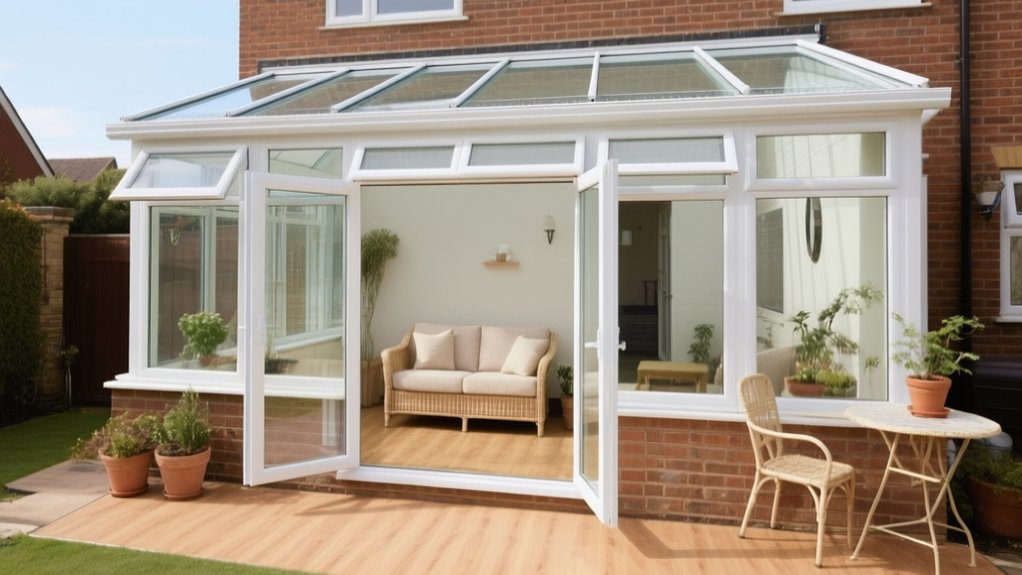
In 2026, you can add a genuinely usable conservatory for about £10,000–£25,000 by keeping the footprint small, choosing a simple lean-to or rectangle, and locking in glazing performance early (aim for whole-window U-values around ≤1.4 W/m²K). Build your budget in layers—base build, site works, finishes—and add 10–15% contingency for surprises like drainage, electrics, or plastering. Use thermal blinds, zoned heating, and smart furniture layouts to make it work year-round. Keep going to see the biggest cost traps and best-value upgrades.
What Does an Affordable Conservatory Cost in 2026?
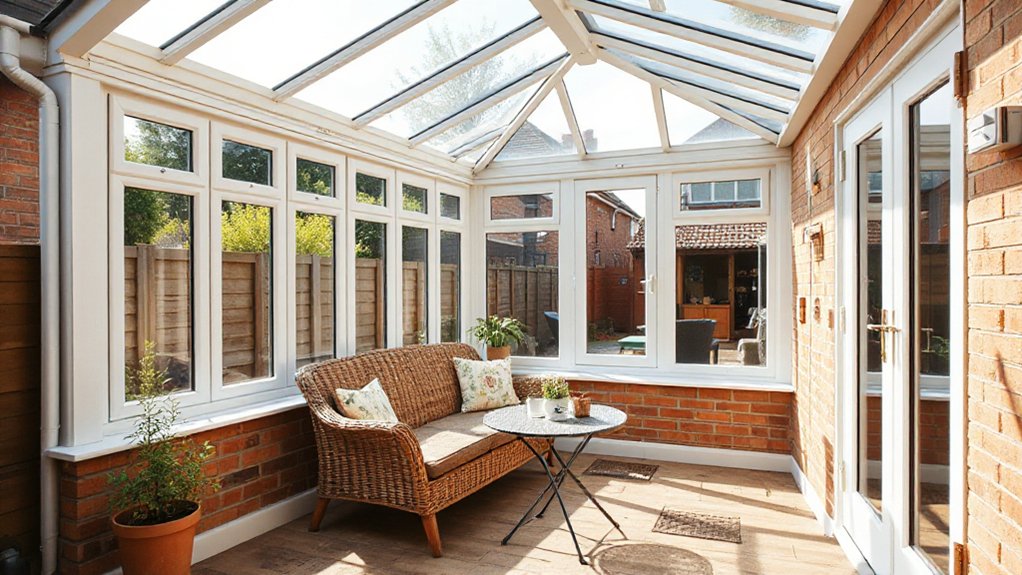
Because prices swing based on size, glazing, and how much work your site needs, an “affordable” conservatory in 2026 typically lands around £10,000–£25,000 installed** for a small-to-mid uPVC model** (roughly 3m x 3m).
While lean-to styles often sit at the lower end and Victorian/Edwardian shapes trend higher. You’ll pay more if you choose self-cleaning glass, triple glazing, underfloor heating, or a tiled “warm roof” that improves year-round comfort.
Expect add-ons for foundations, drainage tweaks, electrics, lighting, and plastering where you connect to the house.
Factor in performance upgrades that cut glare and overheating: Solar shading glass or roof blinds can materially change usability.
Finally, budget for fit-out: durable flooring and Garden furniture that suits humidity and temperature swings.
Set a Realistic Conservatory Budget (With Contingencies)
While it’s tempting to budget for the headline “installed price” alone, you’ll get a far more accurate figure if you build your conservatory budget in clear layers: base build (frame, glazing, roof), site and connection works (foundations, drainage, tying into the house), and finishes (electrics, heating, plastering, flooring, blinds, and furniture).
Then add a contingency so surprises don’t derail you; 10% suits straightforward jobs, 15% if access is tight or you’re upgrading services.
Control spend by pricing decisions early and locking scope before you request quotes. Prioritise value items first:
- fixed-price labour and clear payment stages
- glazing specification and roof insulation level
- heating/electrics allowances and unit rates
- Interior decor and Budget gardening line items
Check Planning Permission and Building Regs Costs
Before you finalise your conservatory design, you’ll need to confirm whether it falls under permitted development or requires full planning permission based on size, height, and proximity to boundaries.
You must also price in Building Regulations compliance for items like foundations, glazing safety, insulation, electrics, and any heating connection to the main house.
Add typical approval costs to your budget now—application fees, drawings, structural calculations, and inspections—so you don’t get hit with delays or surprise invoices later.
Planning Permission Basics
Even if your conservatory feels like a simple add-on, you still need to confirm whether it falls under permitted development or requires full planning permission. You should also budget for Building Regulations checks from the start.
Start by checking your property’s history: prior extensions or conditions can remove permitted development rights. Then assess scale and siting, because exceeding height, footprint, or proximity limits can trigger an application.
Match your design to the local context; strong Design aesthetics can reduce objections, while material durability supports long-term value.
- Check conservation area/listed status and any Article 4 Direction
- Measure height, eaves, and rear projection against local limits
- Ask your council about fees, drawings, and typical decision times
- Get written confirmation before ordering frames, glazing, or roof systems
Building Regulations Requirements
How do you know whether your conservatory needs Building Regulations approval, and what should you budget for it? You’ll usually need approval if you remove the external doors/windows to the house, install fixed heating, or create an open-plan link that makes the space part of the main dwelling.
If it’s separated by compliant doors and has an independent heating system, it may qualify as exempt, but you still must meet glazing and electrical rules.
Check key building codes on structure, foundations, roof loading, ventilation, drainage, and insulation, especially if you’re upgrading to a “warm roof.”
You’ll also need safety standards for toughened glass in critical locations and Part P certified electrics. Confirm requirements with Building Control before work starts.
Typical Approval Costs
Although fees vary by council and project complexity, you can budget a clear allowance for approvals by splitting costs into planning and Building Regulations: a lawful development/permit check typically runs from £0 (if you proceed under permitted development and just keep evidence) to about £100–£200 for a Lawful Development Certificate.
While a full householder planning application is commonly around £258 in England plus any local admin charges.
For Cost estimation, factor Building Control too: expect roughly £200–£800 for a small conservatory via a council fee or an approved inspector, depending on structure, glazing, and drainage.
Keep your approval process tight by pricing these items early:
- Pre-app advice (optional): £0–£150+
- Plans/drawings: £300–£1,500
- Building Control application/inspections: £200–£800
- Structural engineer (if needed): £300–£1,000
Pick a Simple Conservatory Shape to Save Money
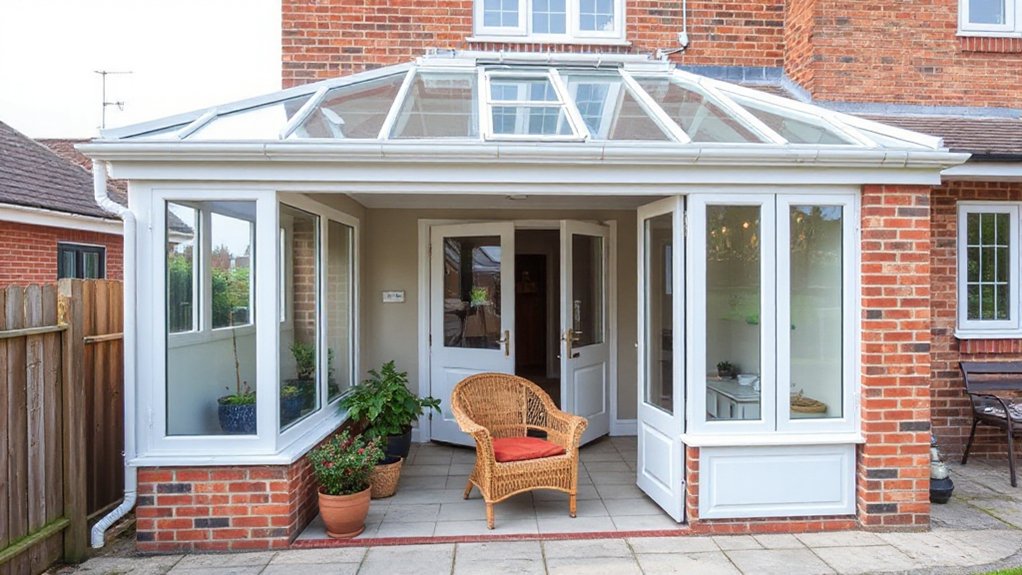
When you keep the footprint straightforward, you’ll cut both build time and material waste. Choose a lean-to or simple rectangular plan instead of faceted bays or curves; straight runs need fewer bespoke frames, fewer tricky junctions, and faster installation.
Keep the projection modest so you don’t require oversized beams or complex foundations. Align the new walls with existing doors and windows to avoid expensive structural alterations and awkward internal steps.
Standardize openings: one main door and a couple of matching window sizes reduce fabrication costs.
Inside, plan your layout early so your Garden furniture fits without custom joinery or dead corners.
Finally, select practical lighting options that work with a clean ceiling line, so wiring stays short, accessible, and inexpensive too.
Choose the Cheapest Conservatory Roof That Works Year-Round
A simple footprint keeps the frame cheap, but the roof choice decides whether you’ll actually use the conservatory in winter and summer.
Among Roof options, multiwall polycarbonate is usually the lowest upfront cost and installs fast, yet it can drum in rain and lose heat.
For better year-round comfort on a budget, choose an insulated solid panel system (often called a “warm roof”) with a light-coloured exterior to cut summer gain, and add roof vents for purge ventilation.
Your Material choices should prioritise U-values, solar control, and condensation resistance, not looks alone.
- Pick polycarbonate only if you’ll accept higher heating and noise
- Choose insulated panels for the best cost-to-comfort ratio
- Specify low‑E glazing on any roof lights for heat retention
- Add vents and blinds to prevent overheating and glare
Compare uPVC vs Aluminium vs Timber Frames
Because the frame governs rigidity, sightlines, maintenance, and long-term running costs, you should compare uPVC, aluminium, and timber on performance first, not just price.
uPVC usually wins on upfront cost and decent insulation, but it can look bulkier, offers fewer colour/finish options, and may soften or discolour over time in harsh sun.
Aluminium costs more, yet you’ll get slimmer profiles, excellent frame durability, and strong corrosion resistance; check for quality powder-coating and robust corner joints.
Timber can deliver the best character and repairability, but you must budget for periodic painting or staining, or your maintenance costs will climb fast.
If you’re coastal, prioritise aluminium; if you want traditional styling, choose engineered timber; if you need cheapest installed, stick with uPVC.
Budget Glazing That Still Stays Warm (U-Values Explained)
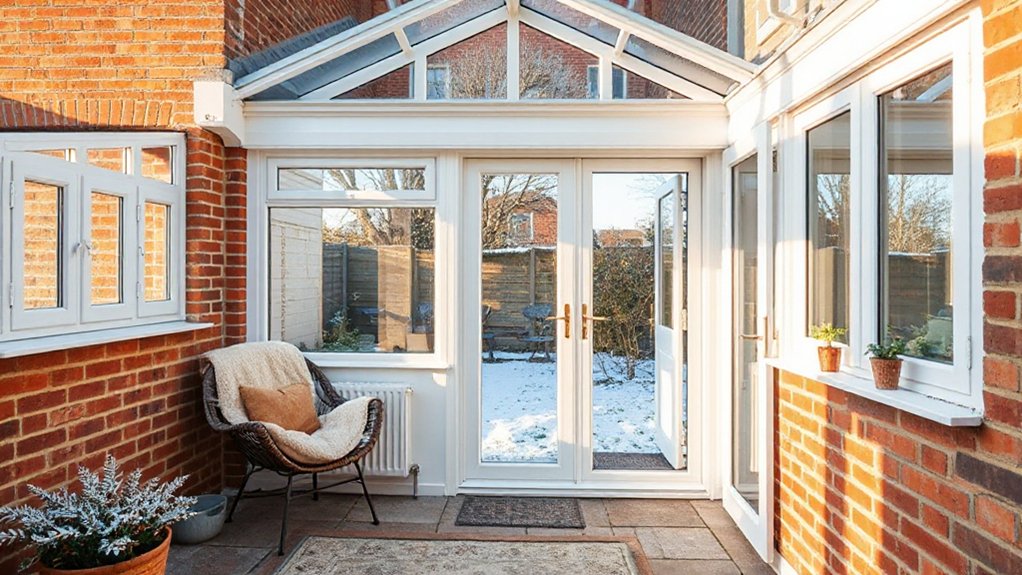
Even if you’re working to a tight budget, you can still spec glazing that keeps a conservatory comfortable—you just need to read the U-value properly. U-value measures heat loss: lower numbers mean better energy efficiency.
Don’t compare “centre-pane” figures; ask for the whole-window U-value (glass plus spacer and frame), because that’s what you’ll feel in real use.
For budget glazing options, you’ll usually choose between upgraded double glazing and entry-level triple glazing; both can work if the spec is honest.
- Target ≤1.4 W/m²K for double glazing where possible
- Choose warm-edge spacers to cut edge chill and condensation risk
- Pick low‑E coatings and argon fill as minimum sensible upgrades
- Confirm the stated U-value comes from certified testing data
Heat a Conservatory Cheaply (Without Huge Bills)
To heat your conservatory cheaply, you’ll start by stopping heat loss with insulation upgrades and tight draught proofing around frames, doors, and the roofline.
Next, you’ll use low-cost zoned heating—like a thermostatic electric panel heater or infrared heater on a timer—so you only warm the space when you’re actually in it.
Finally, you’ll treat sunlight as free heat by managing blinds and thermal curtains to capture daytime gains and lock that warmth in after dark.
Insulation And Draught Proofing
Where’s the heat actually escaping from in your conservatory? Most losses come from gaps, thin roof panels, and uninsulated dwarf walls, so tackle those first. Fit brush strips to doors and add compressible seals to opening windows; you’ll stop cold air infiltration fast.
Add insulated blinds or a cellular roof liner to cut radiant loss, and you’ll also improve Soundproofing. Don’t block Ventilation entirely—aim for controlled airflow, not leaks.
- Seal frames, thresholds, and glazing beads with the right mastic
- Add draught excluders and letterbox-style door curtains
- Insulate dwarf walls behind radiators and along knee walls
- Use thermal curtains or honeycomb blinds, night and day
Check for condensation after changes; adjust trickle vents accordingly.
Low-Cost Zoned Heating
How do you heat a conservatory cheaply without inflating the rest of your home’s energy use? Use zoned heating so you only warm the room when you’re in it. Fit thermostatic radiator valves to existing radiators, or add an electric panel heater with a built-in thermostat and timer.
Set a lower background temperature (around 14–16°C) and schedule short boosts to 18–20°C, instead of running heat continuously. Pair heating with cost-effective insulation you’ve already installed: keep doors shut, close lined curtains at dusk, and block floor-level draughts so heat stays in the zone.
For quick, targeted comfort, use an oil-filled radiator near seating and switch it off once the space feels stable.
Sunlight And Heat Retention
When does a conservatory feel warm without the heating on? When you capture daytime solar gain and stop it escaping after sunset.
Start by clearing glass and sealing gaps around frames and doors. Then manage glazing like a thermostat: open blinds to charge the room, close them early to trap heat.
- Fit thermal Window treatments (lined curtains, honeycomb blinds) tight to the frame
- Add removable secondary glazing film to cut draughts and convection
- Use dark rugs and a dense sofa throw to store and release warmth slowly
- Plan Plant placement away from glazing at night; cluster pots to reduce cold downdraughts
Finally, ventilate briefly at midday, not in the evening, so you don’t dump stored heat.
Ventilation Tricks to Stop Overheating on a Budget
Although a conservatory’s glass gives you that bright, airy feel, it can trap heat fast, so smart ventilation is your cheapest fix. Create cross-breezes by cracking opposite windows 2–5 cm and keeping internal doors ajar. Fit simple restrictors so you can vent safely without wide openings. Add stick-on draught excluder to stop warm air recirculating through gaps you don’t control.
Install a low-cost clip fan aimed up toward the ceiling to push hot air out through top vents; reverse it at night to pull in cooler air. Choose light, breathable blinds and keep them raised near openers to avoid blocking airflow.
Position indoor plants near openings so they benefit from fresher air, and keep lighting decor LED to reduce heat output.
Make a Small Conservatory Feel Bigger (Layout + Light)
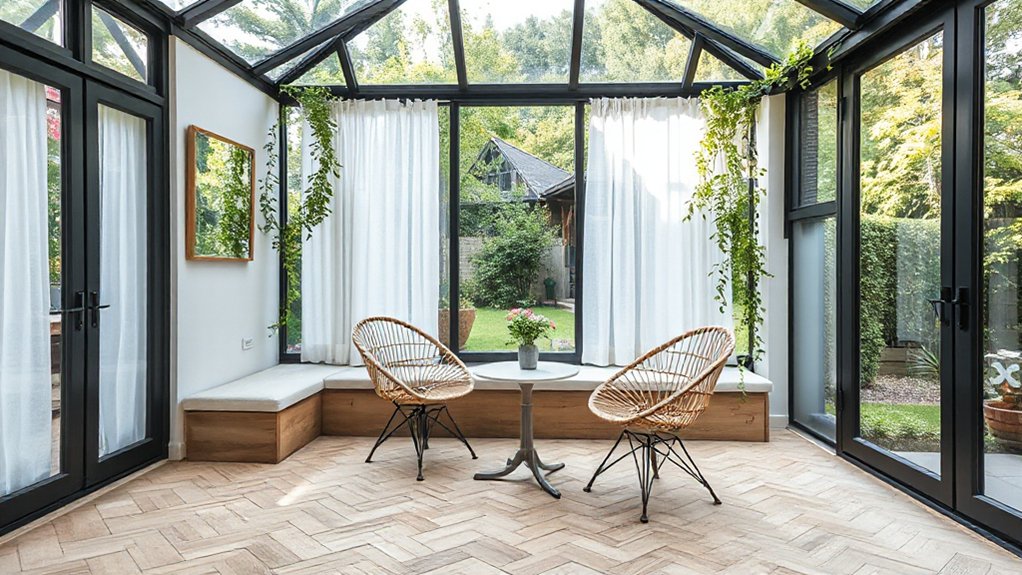
If your conservatory feels tight, you can make it read larger by controlling sightlines, furniture scale, and the way light bounces around the glass. Start by keeping the centre clear and pushing seating to the perimeter so your eye travels to the garden, not a cluttered walkway. Use armless, low-back pieces and a single slim table to avoid visual chopping.
Window placement matters: keep glazing unobstructed, mount blinds high, and choose sheer layers that diffuse glare without blocking depth. Then lock in smart Colour schemes—light walls, pale flooring, and one darker anchor to add contrast without closing the room.
- Float furniture off walls by 2–5 cm
- Hang curtains to the ceiling line
- Add one large mirror opposite glass
- Use warm-white LEDs to lift corners
Affordable Lean-To Conservatory Ideas for Tight Spaces
A small conservatory can feel bigger with smart layout and light, but tight footprints often call for a lean-to that keeps the build simple and the budget under control. Fix it to an existing wall to reduce framing, then choose standard-size glazing panels to avoid custom costs. Keep the roof pitch shallow but compliant, and specify polycarbonate where privacy or heat control matters.
Plan your footprint around circulation: leave a clear 800–900mm walkway and push seating or storage to the side wall.
For Garden design, align doors with a narrow path, raised planters, or a vertical trellis to pull the eye outward.
For interior decor, use a built-in bench with lift-up storage, slimline blinds, and pale flooring to reflect light and hide wear.
Cheap Victorian Conservatory Ideas With Classic Detail
If you want a Victorian conservatory on a budget, you’ll get the biggest impact from ornate trimwork that’s simple to install and easy to paint. Choose lightweight mouldings, bracket-style corbels, and ready-made cresting to frame doors, eaves, and posts without custom carpentry costs.
Then lock in the period look with affordable window details—stick-on glazing bars, arched-top film, and traditional hardware—so your frames read authentically without replacing the units.
Budget Ornate Trimwork
How do you get that unmistakable Victorian conservatory character without paying for custom millwork? You fake it smartly: use stock ornate trimwork and paint to unify every joint. Choose primed MDF or finger-jointed pine for straight runs, then reserve pricier profiles for focal points like door surrounds and beam wraps.
Layer decorative moldings—backband plus casing, then a slim panel molding—so the build reads bespoke. Cut miters with a simple miter box, and lock gaps with paintable caulk before you prime.
- Buy off-the-shelf profiles in long lengths
- Stack two thin trims instead of one thick piece
- Use corner blocks to avoid tricky miters
- Paint everything one satin color for cohesion
Affordable Period Window Details
While custom sash and leaded glass can blow the budget fast, you can still give your conservatory that crisp Victorian window character by upgrading the details you *can* control: muntins, trim, hardware, and paint.
Use applied muntin grids on standard glazing to mimic divided lights; align grid spacing with your home’s period architecture so it reads intentional.
Add narrow ogee or lamb’s-tongue casing, then cap it with a simple backband for depth without custom millwork.
Swap in oil-rubbed bronze or lacquered brass latches, pulls, and sash lifts; keep profiles small and squared.
For a window restoration look, strip bulky vinyl stops and replace with painted wood stops where code allows.
Finish with high-gloss enamel in off-white or deep green.
Low-Cost Edwardian Conservatory Layouts That Work
Although Edwardian conservatories look refined, you can keep the layout low-cost by choosing a simple square or rectangular footprint, aligning doors and pathways to your existing room openings, and planning furniture zones before you commit to glazing.
Stick to standard panel sizes, reduce corner posts, and keep the ridge line centered to simplify fabrication. Place the main walkway along the house wall so you don’t waste usable floor area.
Choose compact garden furniture that nests or folds, letting one zone do double duty without custom joinery.
Use a single circuit for lighting fixtures and position switches at the existing doorway to avoid rerouting cables.
Prioritise these layout rules:
- Square plan, minimal angles
- Central ridge, standard rafters
- Clear 800–900mm circulation path
- One utility wall for power and storage
Budget Conservatory Dining Area Ideas
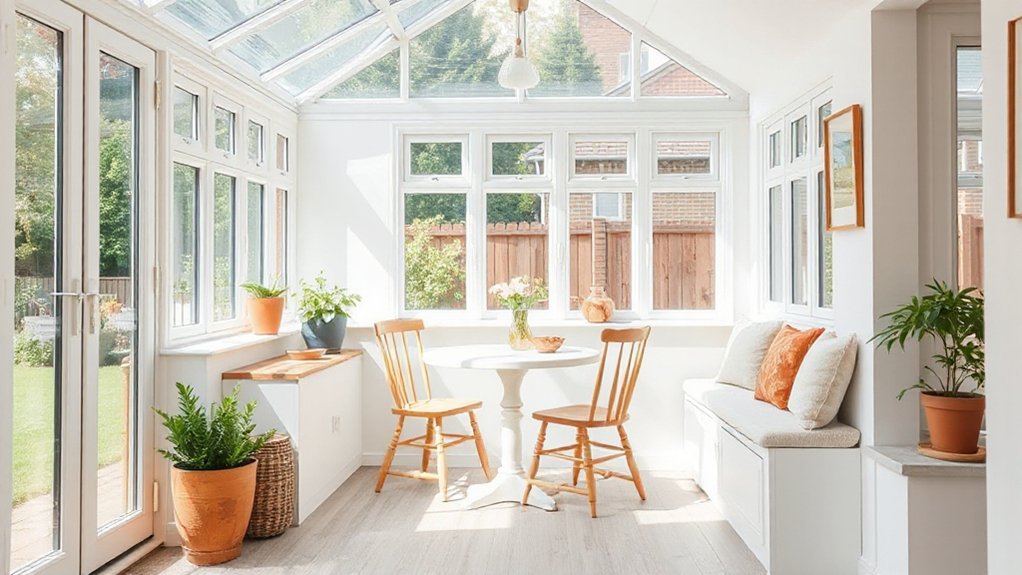
If you plan the dining zone before you buy furniture, you can create a comfortable conservatory eating area on a tight budget without crowding the room.
Start with Furniture placement: keep a 90 cm walkway to doors and windows, and center the table under the brightest roof panel to reduce lighting costs.
Choose a round drop-leaf table or narrow extending table so you can scale seats up for guests.
Use a storage bench on the coldest wall to add seating and hide table linens.
For color schemes, stick to two neutrals plus one accent drawn from garden views; it’ll make mismatched chairs look intentional.
Add washable indoor-outdoor rugs to define the zone and soften echoing glass surfaces.
Keep clutter off.
Budget Conservatory Home Office Setup Ideas
Where should you start when turning a conservatory into a home office on a budget? Begin by controlling glare and temperature, because productivity drops fast in a hot, bright room. Fit thermal blinds, add a low-cost draft strip, and position your desk perpendicular to the windows to reduce reflections.
Prioritize upgrades that pay back daily:
- Use a secondhand desk and an ergonomic chair, then add a lumbar cushion.
- Choose eco-friendly materials like bamboo desktop organizers and recycled-fabric pinboards.
- Install smart technology: a plug-in thermostat, smart plugs, and motion-sensor LED lighting.
- Run cable trunking and a surge-protected power strip to keep wiring safe and tidy.
Finish with a compact filing unit and wall shelves to free floor space. Keep it uncluttered.
Cheap Conservatory Reading Nook Ideas (Cozy Upgrades)
Before you buy anything new, turn your conservatory’s brightest corner into a reading nook by fixing the comfort basics on the cheap: manage heat and glare with lined curtains or thermal blinds, then add a draught excluder at the door to stop cold air pooling around your feet.
Next, nail your furniture arrangement: angle a compact armchair toward the view, keep a small table within arm’s reach, and place a low shelf behind the chair to store books without crowding walkways.
Layer warmth with a washable throw and a flatweave rug that won’t trap damp.
Add decorative lighting using a plug-in wall sconce or LED floor lamp with a warm bulb (2700K) for evening reading.
Finish with a cushion lumbar support for longer sessions.
Avoid the Biggest Conservatory Cost Traps + Get Better Quotes
Before you sign, you need to spot the hidden fees that inflate a “cheap” conservatory quote—groundworks, waste removal, electrics, glazing upgrades, and building-control paperwork.
You’ll get better pricing when you compare like-for-like quotes by matching materials, U-values, roof type, ventilation, and what’s included in installation and warranties.
Time your request for off-peak slots, ask for itemised costs, and negotiate on upgrades or lead times so you don’t pay more for the same build.
Hidden Fees To Watch
Even if the headline price looks competitive, hidden extras can inflate your conservatory bill fast—so you’ll want to pinpoint what’s included, what’s “optional,” and what triggers extra charges. Ask for an itemised schedule and confirm who pays when site conditions change.
Budget for practical aftercare too: garden maintenance around new footings and drainage, plus any layout tweaks caused by furniture placement and access.
Watch these common add-ons:
- Groundworks, spoil removal, and skip permits
- Upgraded glazing, roof vents, and trickle vents
- Electrics, heating tie-ins, and certification fees
- Planning drawings, building control inspections, and sign-off
Get every allowance in writing, including rates for unforeseen work, delivery charges, and call-out fees.
If a quote says “by others,” assume it’s on you and price it upfront.
Compare Like-For-Like Quotes
Although two quotes may share the same headline price, they’re rarely pricing the same conservatory, so you need to force a like-for-like comparison that exposes cost traps and vague allowances.
Ask each contractor to quote from the same written spec: footprint, base type, insulation targets, glazing performance, and finishes.
Pin down Roof styles (lean-to, Victorian, solid tiled) because structure, ventilation, and engineering vary hugely.
Specify Window placement and opening types, plus trickle vents, restrictors, and any obscured glass.
Demand itemised totals for groundwork, drainage, electrics, heating tie-ins, plastering, decorating, and waste removal.
Replace “PC sums” and “provisional” lines with named products, quantities, and labour.
Finally, confirm who handles drawings, Building Control, warranties, and snagging so you’re not paying twice later.
Timing And Negotiation Tips
If you time your enquiries and negotiate with a clear brief, you’ll cut out the most common conservatory cost traps and get sharper, more comparable quotes. Use timing strategies: request quotes in late autumn or early winter, and book installations for quieter weeks to access capacity discounts.
Keep your scope fixed (size, glazing spec, roof type, electrics, heating) so installers can’t lowball then upsell. Use negotiation tactics that focus on value, not vague haggling—ask for itemised pricing, confirm lead times, and trade flexibility for savings.
- Get a written inclusion/exclusion list (foundations, drainage, waste).
- Ask for price validity and a staged payment schedule.
- Request alternatives: uPVC vs aluminium, polycarbonate vs glass.
- Hold a final call-off meeting before ordering materials.
Frequently Asked Questions
How Long Does an Affordable Conservatory Typically Take to Install?
You’ll typically install an affordable conservatory in 2–6 weeks, depending on groundwork, conservatory materials lead times, and design options. You’ll move faster with modular frames and simple glazing; you’ll wait longer for bespoke finishes.
Can I Build a Conservatory in Stages to Spread the Cost?
Yes—you can, like a telegram delivered by drone. You’ll phase foundations and glazing first, then roofing and finishes. Keep Design flexibility in plans, choose Cost effective materials early, and schedule inspections each stage.
What Insurance Changes Do I Need After Adding a Conservatory?
Tell your insurer immediately; you’ll need Insurance requirements reviewed and Coverage adjustments to reflect higher rebuild value and contents. Confirm storm, glass, and liability cover, update security details, and keep receipts, plans, and completion certificates.
Will a Conservatory Increase My Home’s Resale Value in 2026?
Yes, it’ll likely boost your 2026 resale value, like sunlight turning space into gold. You’ll win most with energy efficiency upgrades and smart design options. You should keep permits, warranties, and comparable sales ready.
How Do I Reduce Noise From Rain and Neighbours in a Conservatory?
You’ll cut rain and neighbour noise by upgrading to acoustic laminated glazing, adding insulated roof panels, and sealing gaps. Use soundproofing options like heavy curtains, rugs, and wall absorbers. These noise reduction tips also include dense planting.
Conclusion
You don’t need a grand build to gain a brighter, bigger home in 2026—you need a smart plan. Set a firm budget with a contingency, confirm planning and regs early, and keep the shape simple to cut labour and materials. Choose a roof that won’t turn your space into a greenhouse in summer or an icebox in winter. Furnish it with multi-use dining, office, or reading-zone pieces. Get detailed quotes, and sidestep hidden extras.