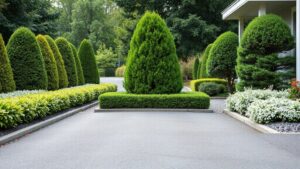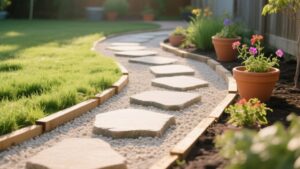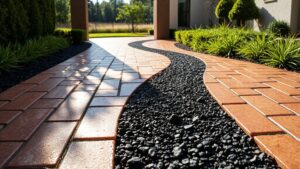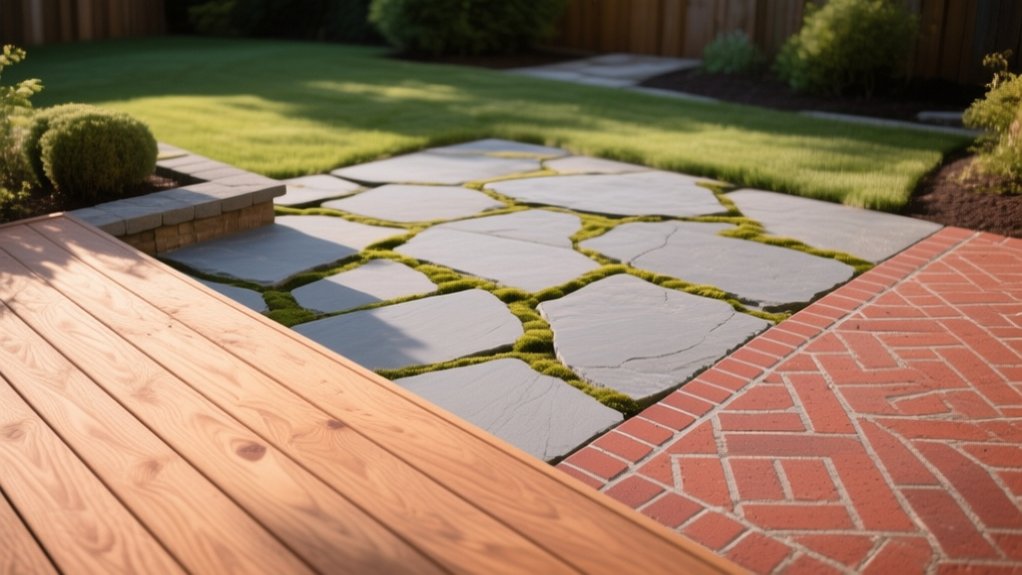
Choose stone or clay brick for load-bearing patios and high-traffic walkways because they deliver high compressive strength, low absorption, and stable performance over a compacted granular base. Use brick or dense stone for steps, edges, and seat walls to limit movement and freeze–thaw spalling. Reserve wood for decks and light borders where fastening and adjustability matter most. Prioritize textured finishes, proper slope, and drainage to reduce slip risk and maintenance. Continue for cost and climate tradeoffs.
Quick Picks: Best Hardscaping Material by Use
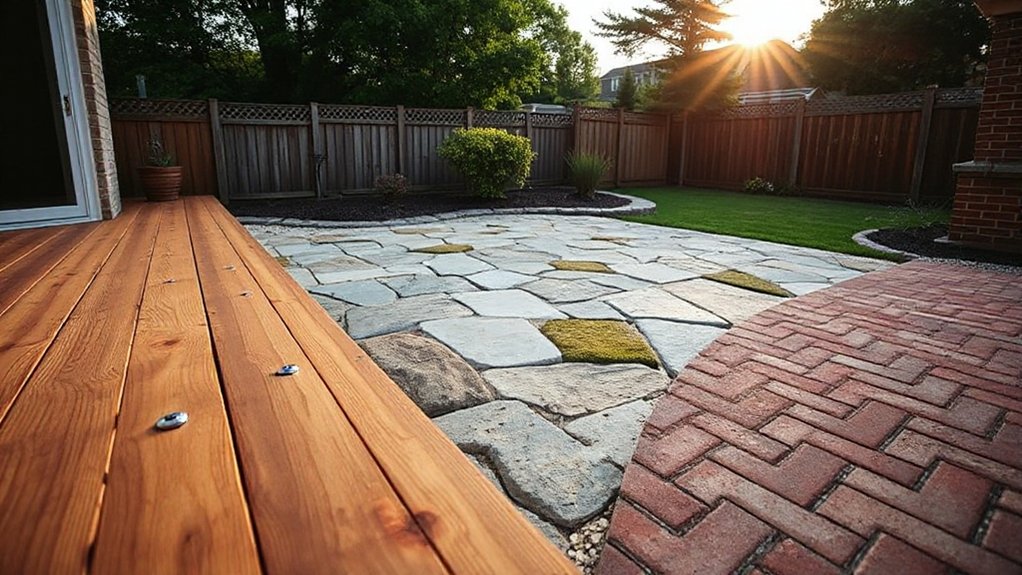
If you’re deciding between hardscaping materials, start by matching each option to its primary use-case rather than its appearance alone.
For load-bearing patios and high-traffic walkways, you’ll get the most dimensional stability from dense stone pavers or clay brick, installed over a compacted granular base for consistent support.
For retaining edges, steps, and seat walls, you should prioritize stone or brick units with high compressive strength and low water absorption to limit freeze–thaw spalling.
For decks, screens, and lightweight borders, you can specify wood where fastening and field adjustability matter, but you must control decay with species selection and detailing for drainage.
For Innovative design, you’ll combine materials to separate structure from finish while improving material sustainability through reclaimed brick or locally quarried stone.
Hardscaping Cost: Material vs. Installed Price
You should separate material unit pricing (e.g., $/sq ft, $/linear ft, $/ton) from total installed cost to compare hardscaping options accurately.
You can then itemize material price drivers—grade, thickness, finish, reinforcement needs, and regional supply or freight—to build a consistent baseline across pavers, stone, and concrete.
You’ll also account for installed cost factors such as excavation depth, base and drainage design, edge restraint, cutting complexity, access constraints, labor rates, and permits, which often exceed the raw material spend.
Material Price Breakdown
Although material pricing often looks straightforward on a receipt, it rarely reflects the true hardscaping budget once installation variables enter the scope.
For wood, you’ll typically price by board-foot or linear foot, with pressure-treated lumber lowest and hardwoods higher. Additives, kiln-drying, and grading shift unit cost.
Stone is commonly sold by the ton or square foot. Thickness, finish (thermal, honed, tumbled), and quarry origin drive variability, while manufactured stone offers tighter pricing bands.
Brick is usually quoted per brick or per square foot. Color blends, firing method, and absorption rating affect premiums.
You should also quantify Material sustainability and Environmental impact: certified wood, locally quarried stone, and recycled-content brick can carry higher purchase prices but reduce embodied carbon and sourcing risk.
Installed Cost Factors
While material takeoffs anchor your baseline budget, installed hardscape cost rises or falls on labor, equipment, and site-condition variables that receipts never capture. You’ll pay for excavation depth, haul-off, base compaction, geotextile, drainage, edge restraints, and accurate grading tolerances.
Access limits drive mini-excavator time, handwork, and staging logistics. Subgrade soils, frost depth, and slopes determine base thickness and reinforcement, especially under stone and brick.
Wood decks shift cost into footings, hardware, flashing, and code-required connections. Innovative installation techniques—polymeric sand, pedestal systems, and permeable assemblies—can cut time yet require trained crews and QA.
Environmental impact considerations add line items for erosion control, low-VOC sealers, and responsible disposal, but they reduce callbacks and lifecycle risk.
Climate Durability: Freeze-Thaw, Heat, and Rain
How well a hardscape survives year after year depends on its response to cyclic freeze–thaw expansion, sustained thermal loading, and prolonged moisture exposure.
In cold climates, you’ll see wood cup and check unless you maintain sealants; specify rot-resistant species and ventilated substructures to limit trapped water. You can select dense, low-absorption stone to reduce scaling and spalling, and you’ll need proper base drainage and edge restraint.
In high heat, you’ll manage wood’s UV degradation with coatings, while stone and brick tolerate radiation but can expand; you should provide joints to accommodate movement.
Under frequent rain, you’ll prioritize capillary breaks, geotextiles, and permeable bedding where feasible.
For Eco friendly options, choose locally sourced stone or reclaimed brick.
For DIY installation tips, control slope and compaction precisely.
Slip Resistance: Safest Patio and Walkway Surfaces
To specify the safest patio and walkway surface, you’ll compare traction by material type, since concrete, brick, natural stone, and porcelain pavers exhibit different static and dynamic friction characteristics.
You’ll then evaluate textures and surface finishes—broomed, tumbled, flamed, honed, or glazed—because microtexture and macrotexture directly control slip resistance under foot.
Finally, you’ll account for wet weather safety factors such as drainage slope, surface contamination (algae, oils, leaf tannins), and freeze-related glazing, since water films can sharply reduce available traction.
Traction By Material Type
Because slip hazards often originate at the surface level, you should evaluate traction by material type before you compare aesthetics or cost. Wood decking typically delivers predictable grip when you maintain drainage and control biofilm; however, wear patterns from foot traffic can reduce friction.
Stone varies widely: dense granite often performs better under clean, dry conditions, while polished marble can become hazardous when wet. Brick pavers usually provide reliable traction because joints interrupt water films, yet moss growth can undermine performance.
During material installation, you should confirm slope, joint spacing, and edge restraint, since movement can create slick, uneven planes. Surface texture still matters, but prioritize material-specific wet-friction behavior and maintenance burden.
- You’ll avoid a sudden, painful fall.
- You’ll protect kids and older guests.
- You’ll reduce liability and anxiety.
- You’ll feel confident in bad weather.
Textures And Surface Finishes
Material choice sets your baseline wet-friction performance, yet texture and finish determine whether that performance holds when water films, grit, and biofilm build up. You improve grip by specifying microtexture (fine asperities) and macrotexture (larger relief) that maintain contact under partial lubrication.
On wood, you’ll get higher traction from pronounced grain, wire-brushing, or shallow kerf cuts; avoid glossy sealers that flatten peaks.
On stone, you should favor thermal flaming, sandblasting, bush-hammering, or honed-with-texture profiles; highly polished faces reduce asperity engagement.
On brick, you’ll prefer wire-cut or tumbled faces over smooth, molded units, and you can use Texture contrast to cue foot placement.
Select a Surface treatment that preserves relief after abrasion and cleaning cycles.
Wet Weather Safety Factors
When rainwater, irrigation overspray, or morning dew creates a thin lubricating film, you need hardscape surfaces that maintain measurable slip resistance under wet, contaminated conditions. Specify textured stone, wire-cut brick, or broom-finished concrete; avoid polished flagstone and sealed wood when algae and fines are likely. Verify wet COF or DCOF data, and plan drainage solutions—positive slope, trench drains, and permeable joints—so water doesn’t pond where you step.
Detail nosings and transitions to prevent edge skids, and maintain joints to limit biofilm. In exposed patios, wind resistance matters: gust-driven rain increases surface wetting and debris loading, reducing traction and visibility. You’ll feel safer when you control these variables.
- You avoid that sudden, breath-catching slip.
- You protect kids, guests, and pets.
- You preserve confidence on dark, rainy nights.
- You prevent costly, painful injuries.
Maintenance by Material: Sealing, Staining, Cleaning
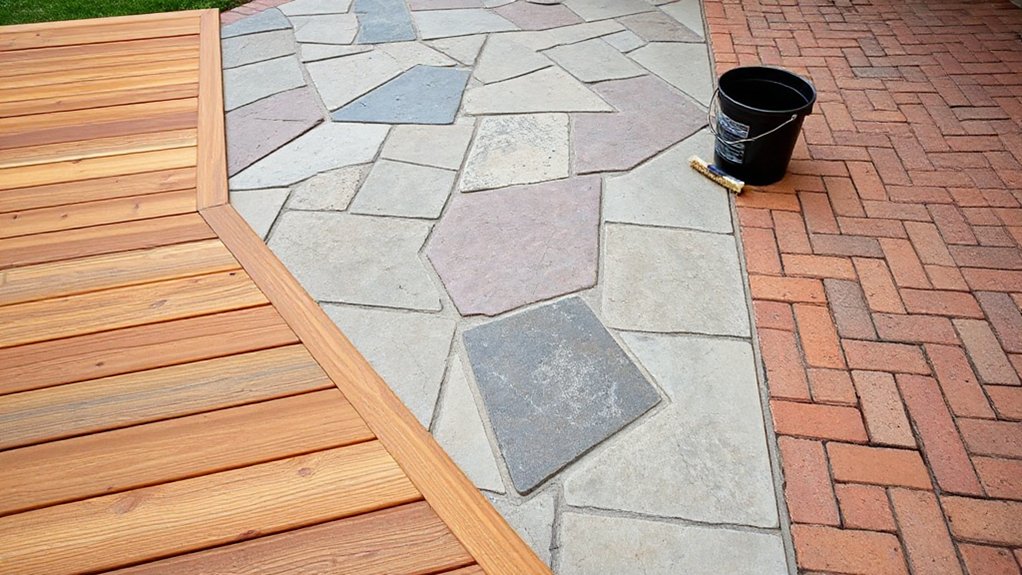
Even though hardscape surfaces look durable, each material responds differently to UV exposure, moisture intrusion, de-icing salts, and abrasion, so your maintenance plan should align with the specific substrate.
You’ll extend service life by selecting compatible Sealing techniques, staining methods, and cleaning protocols based on porosity and joint design.
For stone, you should use penetrating sealers on absorptive units to reduce chloride uptake while preserving vapor transmission; reapply after water no longer beads.
For brick and mortar, you shouldn’t trap moisture with high-build films; instead, use breathable repellents and keep joints tooled, not open.
For all surfaces, you should remove organics with low-pressure rinsing and pH-neutral detergents, then spot-treat efflorescence using buffered acids and immediate neutralization.
You should avoid metal tools that scratch.
Wood Hardscaping: Warmth, Lifespan, Upkeep
Maintenance choices don’t stop at masonry—wood introduces a different failure profile driven by moisture cycling, UV oxidation, and fastener corrosion, so you’ll get better performance by treating it as a managed system rather than a “set-and-forget” surface.
You can leverage wood’s low thermal mass for underfoot comfort, and its Wood texture for tactile grip, but you must control water and sunlight. Specify durable species or treated lumber, maintain drainage gaps, and isolate metal with coated fasteners to slow galvanic attack.
Expect service life to hinge on finish renewal and joint detailing; skip either and cupping, checking, and rot accelerate. Done right, you’ll preserve Warmth and ambiance without surprises.
- You’ll feel confident in every step
- You’ll avoid sudden, costly failures
- You’ll keep gatherings comfortable
- You’ll protect your investment year-round
Stone Hardscaping Materials: Types and Sealing Needs
Although stone reads as “permanent,” its real-world performance depends on mineral composition, porosity, and how you manage water and staining at the surface. You’ll choose among dense igneous stones (granite, basalt), porous sedimentary stones (limestone, sandstone), and fissile metamorphic stones (slate).
Granite durability suits high-traffic patios because low absorption limits freeze–thaw spalling and deicing-salt attack. Limestone and sandstone need more protection; their capillary uptake promotes efflorescence and oil staining.
Marble aesthetics can elevate courtyards, but calcite etches under acidic rain, fertilizers, and food spills, so you’ll specify a penetrating, breathable sealer. Apply sealers to clean, dry stone, then recoat on a performance schedule, not a calendar. Test repellency and darkening beforehand.
Brick Hardscaping: Classic Looks and Easy Repairs
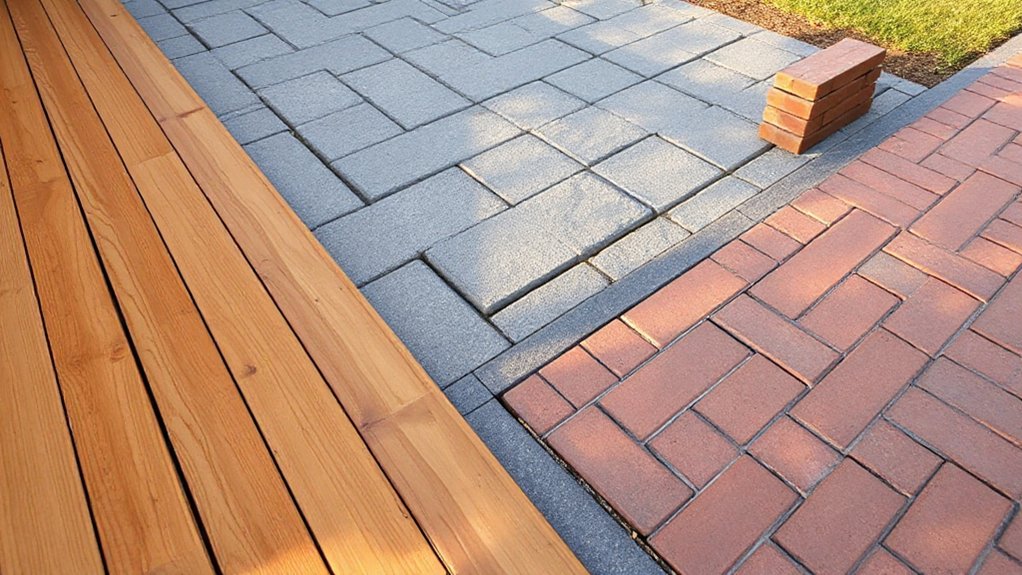
Because fired clay units come in standardized sizes and predictable strengths, brick hardscaping gives you a classic surface finish with controllable performance and straightforward repairability. You can set brick on compacted aggregate with sand-set joints, or use mortar over a stable base where freeze–thaw cycling is severe.
If settlement occurs, you can lift, regrade, and relay units without visible patch lines, preserving tight tolerances and drainage slope. Historical influences guide bond patterns and color ranges, while material sustainability improves when you specify reclaimed brick, regional sourcing, and low-waste modular layouts.
- You’ll feel confident with repeatable dimensions and joint control.
- You’ll appreciate the quiet dignity of time-tested surfaces.
- You won’t dread repairs; you’ll isolate and replace single units.
- You’ll take pride in reuse that reduces embodied impacts.
Match Hardscaping Materials to Home Styles
When you match hardscaping materials to your home’s architectural style, you create visual continuity while keeping scale, texture, and color temperature under tight control.
For Craftsman or cottage forms, you’ll specify warm-toned brick or timber, aligning grout, stain, and joint patterns with window trim.
For modern homes, you’ll favor honed stone or large-format concrete pavers with tight tolerances and linear bond layouts.
For traditional colonials, you’ll use clay brick, tumbled stone, and formal edges that mirror symmetrical façades.
Reference your Home interior finishes: coordinate exterior hues to dominant flooring, cabinetry, and metal hardware.
Guarantee landscaping integration by matching paving modules to step risers, porch proportions, and drainage planes, so transitions read intentional and perform reliably year-round.
Frequently Asked Questions
What Permits Are Required for Building a Patio or Retaining Wall?
You’ll typically need a zoning approval and a building permit for patios or retaining walls; you may also need grading, stormwater, and utility clearances. Check local DIY regulations, and document Environmental impact for wetlands, setbacks, drainage.
How Long Does Hardscaping Installation Typically Take From Start to Finish?
Expect 3–14 days start-to-finish—why wait longer? You’ll spend 1–3 days on excavation/base, 1–7 on installation, 1–4 on curing. Landscaping materials and maintenance considerations can extend scheduling, staging, and inspection timelines.
Can Wood, Stone, and Brick Be Mixed Without Causing Drainage Issues?
Yes, you can mix them without drainage issues if you design proper slope, base, and jointing. Guarantee landscape integration and material compatibility by matching elevations, adding permeable joints, and installing edge restraints plus subdrains where needed.
What Sub-Base Thickness Is Needed for Heavy Outdoor Furniture or Grills?
Sturdy, stable, stress-tested surfaces start with 6–8 inches of compacted crushed stone for heavy outdoor furniture, and 8–12 inches for grills. You’ll guarantee sub base preparation and load bearing capacity by adding geotextile, and compaction.
How Do Hardscape Choices Affect Property Resale Value and Curb Appeal?
You’ll boost resale value and curb appeal by selecting durable hardscapes that reinforce landscape integration and signal quality workmanship. You’ll also protect value through maintenance considerations—stain sealing, joint stabilization, and drainage control—minimizing deterioration and liabilities.
Conclusion
You’ve compared wood’s warmth, stone’s mass, and brick’s modularity, and you’ve found the same pattern repeating across cost, climate, traction, and upkeep. As freeze-thaw cycles crack weak joints, sealing closes pores; as heat bakes surfaces, texture preserves grip; as rain drives staining, cleaning restores finish. Coincidentally, the “best” choice keeps aligning with your use-case: wood for comfort, stone for durability, brick for repairability—and your home style.