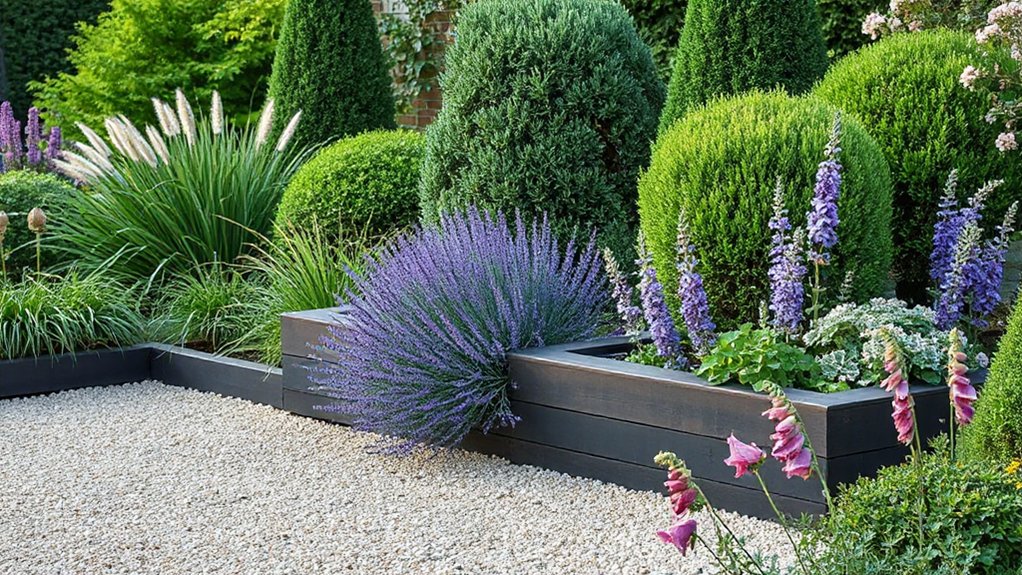
A modern UK garden begins with an evergreen backbone—compact, controlled shrubs and structural evergreens that provide year-round cohesion. Add architectural grasses and bold-perennial silhouettes to create clean lines, layered height, and shifting textures. Prioritize drought-tolerant, UK-suited choices and low-maintenance perennials for reliable color with minimal effort. Use containers and small-scale plantings to maximize urban space, and plan for microclimates with well-drained substrates. If you keep exploring, you’ll uncover detailed plant lists and placement strategies.
Design Criteria for a Modern UK Garden
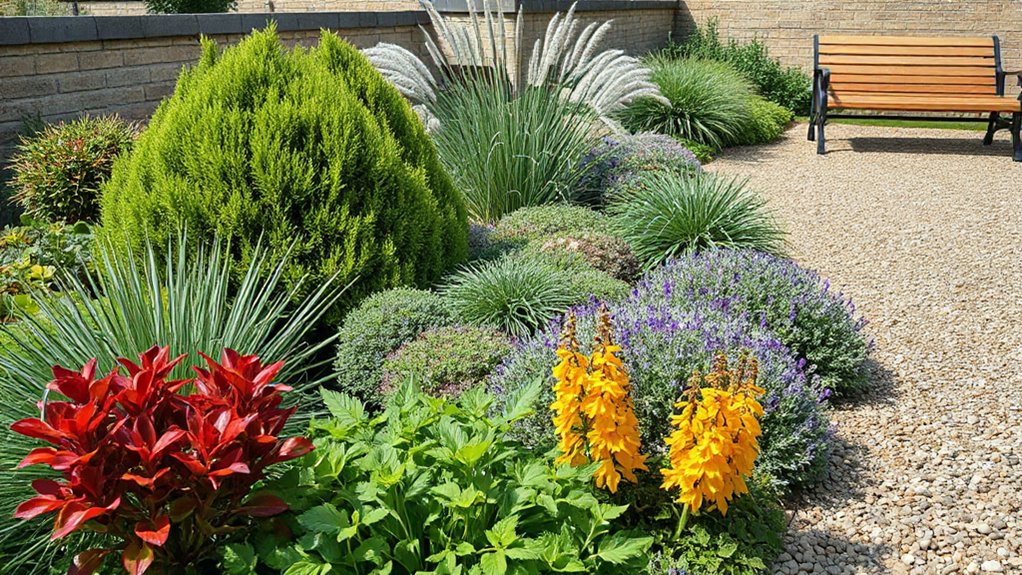
Prioritise durable materials suitable for wet winters and dry summers, with slip-resistant finishes and low-maintenance coatings.
Elevation changes should be graded to manage runoff, while planting palettes emphasize seasonal interest and native tolerance.
Consider microclimates—sun exposure, wind patterns, shade—to optimise plant selection and seating comfort.
Integrate garden furniture and water features as functional focal points, sized to proportionate plots and user needs.
Assure lighting complements safety and ambience, using energy-efficient options.
Finally, specify maintenance access, irrigation efficiency, and modular layouts adaptable to evolving ownership.
Evergreen Backbone Plants for Year-Round Structure
Evergreen backbone plants provide structure and year-round cohesion for a modern UK garden, anchoring both the planting beds and sightlines through all seasons. You select evergreen shrubs with controlled growth and reliable canopy, ensuring immediate vertical definition without overpowering focal features.
Prioritize species offering Year round foliage, so you maintain form from winter silhouettes to summer texture. Consider a mixed evergreen ensemble arranged in coherent modules: a central backbone of tall, scale-rich specimens, flanked by mid-height shrubs for layered depth, with low groundcover to suppress weeds and define edges.
Choose cultivars with compact habit and predictable pruning needs to preserve proportions across beds. Maintain contrast through leaf color, texture, and seasonal pruning windows, aligning backbone plants with structural hardscape for a disciplined, low-maintenance framework.
Architectural Grasses and Perennials for Clean Lines
Architectural grasses and perennials create crisp, linear silhouettes that reinforce a modern UK garden’s geometry. You select species with strong vertical presence to maintain clean planes between structural elements. Use blades and inflorescences that align along sightlines, avoiding excessive branching that softens edges.
Emphasize low, mid, and tall strata to establish a clear rhythm; plantings should anchor hardscape corners and frame views without crowding them. For contrast, pair subdued foliage with textural accents in winter, ensuring year-round readability.
Integrate Wildflower meadows sparingly as focal swathes to preserve the architectural language while providing seasonal interest. Consider Vertical gardens as accent features rather than dominant walls, ensuring they complement, not compete with, the primary linear geometry.
Select drought-tolerant, UK-suitable cultivars certified for architectural use.
Low-Maintenance Evergreens for Small Courtyards
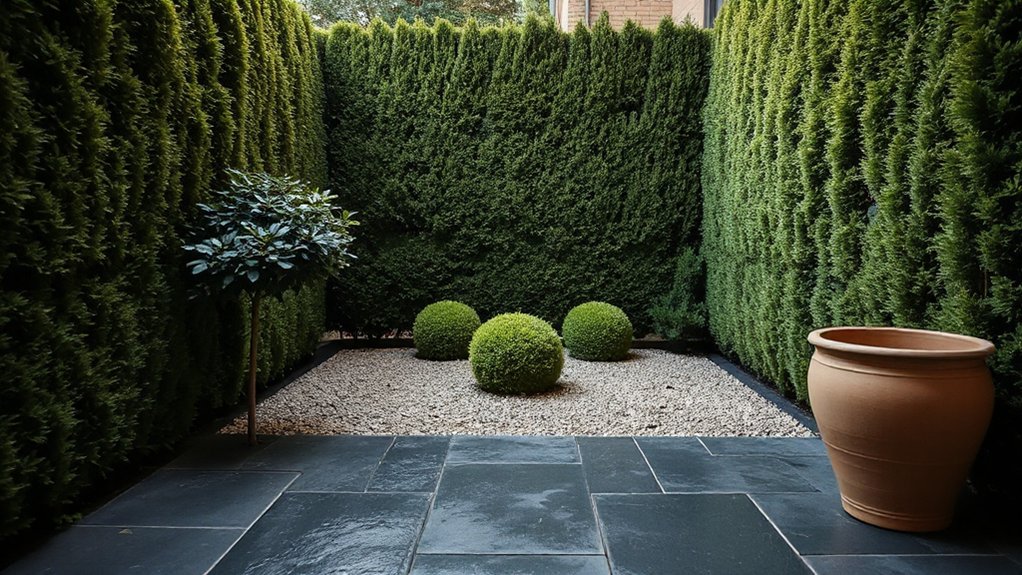
Small courtyards benefit from compact, resilient evergreens that deliver year-round screening and structure without demanding high maintenance. You select species with proven performance in UK microclimates, prioritising dense, evergreen foliage and slow growth to preserve outdoor space.
Consider columnar or multi-stem forms that minimize pruning while maximizing vertical occupancy. For simplicity, choose rigid, mildew-resistant textures and clean silhouettes that pair with contemporary materials.
Root systems should be shallow and non-invasive, enabling efficient container or bed integration. In design terms, guarantee consistent leaf colour and seasonal interest, using evergreen tonal contrasts rather than flamboyant seasonal display.
Include succulent succulents and tropical plants as accent textures; place them where microclimates offer sun reliability and drainage without compromising overall evergreen integrity.
Maintain through light pruning and routine checks for drought stress.
Bold Foliage Perennials for Drama With Ease
When you want standout impact with minimal effort, select perennials whose foliage carries texture and color across seasons, delivering dramatic presence without frequent replanting.
Bold foliage forms the backbone of structure, providing mass and silhouette that anchor contrasting textures. Choose compact forms for front borders and taller selections for mid-ground drama, ensuring layered depth.
Prioritize varieties with evergreen or semi-evergreen leaves for year-round impact, and pair with crisp, low-maintenance floral accents to punctuate the foliage without overpowering it.
Favor strong color relationships—chartreuse, bronze, and deep blue-green—to maximize sun exposure and shadow play.
Consider herbaceous options that persist through frost, supporting seasonal cycles.
For maintenance, apply strategic division and mulch; water deeply at establishment, and monitor for drought stress.
Bold foliage delivers reliable drama with floral accents, efficiently.
White and Neutral-Toned Plants for Calm Palettes
White and neutral-toned plants soften modern landscapes by amplifying light, elevating texture, and creating a serene backbone for other elements. In this palette, you’ll prioritize species with refined form, compact growth, and reliable evergreen structure to maintain year-round balance.
Select whites, creams, and pale grays with subtle undertones to avoid visual clashes while preserving contrast against architectural materials. Focus on leaf texture, bloom timing, and stem architecture to build rhythm across borders and edges.
Incorporate native and adaptable specimens that support wildlife habitats without compromising restraint. Plan edible plants that align with the neutral scheme, using variegated herbs or pale fruiting varieties to deliver function and form.
Guarantee irrigation and soil preparation reinforce plant health, reducing maintenance while sustaining visual calm.
Texture Play: Pairing Smooth and Prismatic Leaves
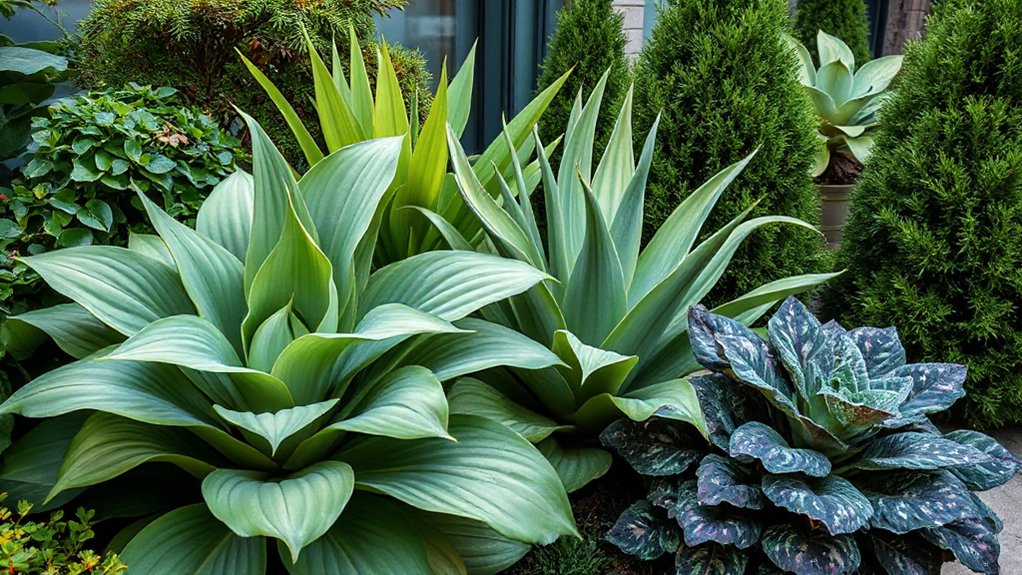
Texture in a modern palette thrives on deliberate contrast between smooth and prismatic leaves. You balance surface qualities to create focal points and rhythm across beds, borders, and containers.
Prioritize a limited palette of leaf textures that repeat at varying scales to enhance legibility—use broad, glossy leaves alongside narrow, angular prisms. Aim for clear lines where light alters sheen rather than hue, so the interplay remains legible at garden distance.
Consider leaf variety to avoid monotony: pair opposite textures within evergreen foundations and seasonal accents to sustain texture through the year.
Maintain proportion by aligning plant height with leaf surface area, ensuring glassy surfaces don’t overwhelm architectural elements.
The outcome is a cohesive, texturally layered scheme with pronounced textural contrast. Textural contrast, Leaf variety.
Shade-Tolerant Options for North-Facing Plots
Shade on north-facing plots demands plants that tolerate low to dappled light while preserving structure and color. You’ll prioritise forms that retain seasonal silhouette as light shifts, selecting specimens with strong leaf architecture and reliable foliage year-round.
In north facing gardens, shade loving plants excel when paired with reflective surfaces and cool hues to maximize perceived light. Favor dense canopy contrasts, leveraging variegation or subtle variegated textures to maintain visual interest without overgrowth.
Choose species with moderate to slow growth to sustain clean lines, and implement layered planting to guarantee gradual transitions from understory to mid-canopy.
Emphasise soil compatibility, moisture resilience, and pest resistance, documenting performance across seasons for enduring, design-focused outcomes.
Prioritise cultivars proven in UK shade trials and adapt to microclimates.
Sunny Borders: Drought-Tolerant, Modern Staples
In sunny borders, you’ll prioritize drought-tolerant staples that align with a modern palette and clean lines.
Consider contemporary plant choices that offer texture, color, and structure while minimizing maintenance—think sculptural grasses, hardy perennials, and low-water shrubs.
These essentials set the framework for a resilient, design-focused border that thrives with efficient irrigation and reduced inputs.
Drought-Tolerant Staples
Sunny borders that embrace drought tolerance rely on a concise palette of tough, water-wise perennials and grasses. You select durable forms with low fertilizer inputs and predictable maintenance, prioritising structural size, leaf texture, and seasonal interest.
Begin with clump-forming grasses for contrast and wind resilience, then place succulent varieties and evergreen succulents to anchor beds with color permanence.
Pair mid-height mounding perennials that flower in shifting, subtle palettes to avoid late-season surges in irrigation needs.
Align planting density with soil depth and sun exposure, ensuring good drainage for xeriscape principles while avoiding root competition.
Prefer compact, drought-resilient species that respond well to mulching and limited irrigation.
Document performance, refine combinations, and maintain a modular framework for future upgrades within the drought-tolerant framework.
Modern Plant Choices
Drought resilience comes from deep rooting, reduced leaf surface, and efficient water use, so you favor drought-adapted genera with proven performance in UK sun. Implement crisp, repeating modules to maintain visual rhythm across the border, ensuring accessibility for maintenance and irrigation planning.
Incorporate garden art as focal accents that thread through plant architecture without overpowering it. Choose varieties with staggered flowering windows to sustain interest through multiple seasons while preserving bed density.
Sunny Border Essentials
Achieve a compact, drought-tolerant border by selecting architectural, low-input staples with strong root systems and predictable growth, guaranteeing crisp repetition and easy maintenance across the bed. You’ll establish a structured silhouette using drought-resilient perennials and short, upright grasses that provide year-round form.
Favor stones and subtle textures to reinforce geometry without clutter. In plant choices, prioritize low water use, high texture, and modular spacing that allows clean alignments along paths. Include evergreen leaf color and seasonal flowering to sustain visual interest with minimal intervention.
Integrate Garden art as focal points that echo the bed’s architecture, and design for a Wildlife habitat by providing varied nectar sources and shelter. Assure pruning is precise, not cosmetic, to preserve the modern, restrained aesthetic.
Seasonal Interest Across the Year
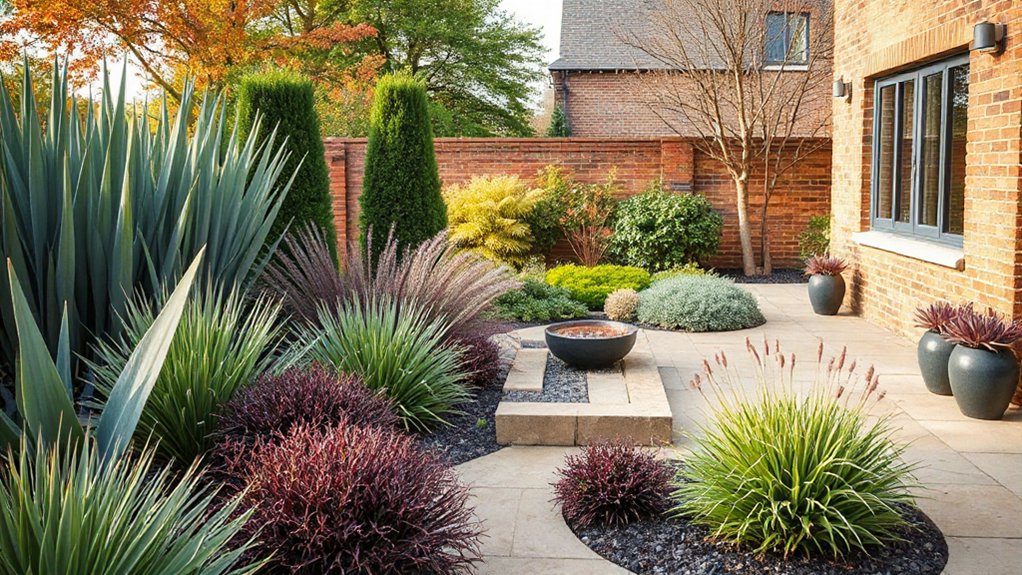
- Structural backbone plants for winter
- Textural contrast through foliage and bark
- Timed flowering for continuous color
- Nectar-rich, wildlife-friendly species
- Thoughtful spacing and access for maintenance
Low-Water Plants That Perform in UK Summers
Succulent, drought-tolerant perennials and hardy subshrubs form the core of low-water planting for UK summers, delivering reliable color and structure with minimal irrigation. You select species with proven drought resistance and compatible growth forms to fit contemporary borders and gravel beds.
Prioritize plants that consolidate canopy early, reducing soil evaporation and enabling water conservation during peak dry spells. Use a structural palette—architectural grasses, cymes, and evergreen mats—to maintain year-round form with sparse maintenance.
Size and spacing should balance visual impact with air circulation, minimizing disease risk and irrigation needs. For success, group by water needs, implement mulches, and tailor irrigation to established plantings.
This approach delivers durable color, low maintenance, and measurable water conservation benefits.
Quietly Fragrant Picks to Enhance Livability
Quietly fragrant plants offer a subtle layer of livability without dominating the palette. You’ll select species that release aroma with minimal maintenance, guaranteeing sensory relief without overpowering design lines. Focus on placement near seating, entry routes, and windows to maximize impact while preserving sightlines.
Scented herbs provide utilitarian value and seasonal interest; position them for easy harvest and deliberate scent trails. Fragrant shrubs deliver longer-season cues, contributing structure and a quiet signature to borders and screens. Choose cultivars with controlled bloom periods to avoid scent clash and ensure consistent rhythm across the year.
Maintain healthy, well-drained soil and prune to keep fragrance concentrated where you want it most. Balance scent intensity with visual calm for livable, modern UK gardens.
- Scented herbs
- Fragrant shrubs
- Coastal lavender
- Rosemary and thyme compact forms
- Sweet alyssum and nemesia combos
Pairing Hardscape With Plant Structure
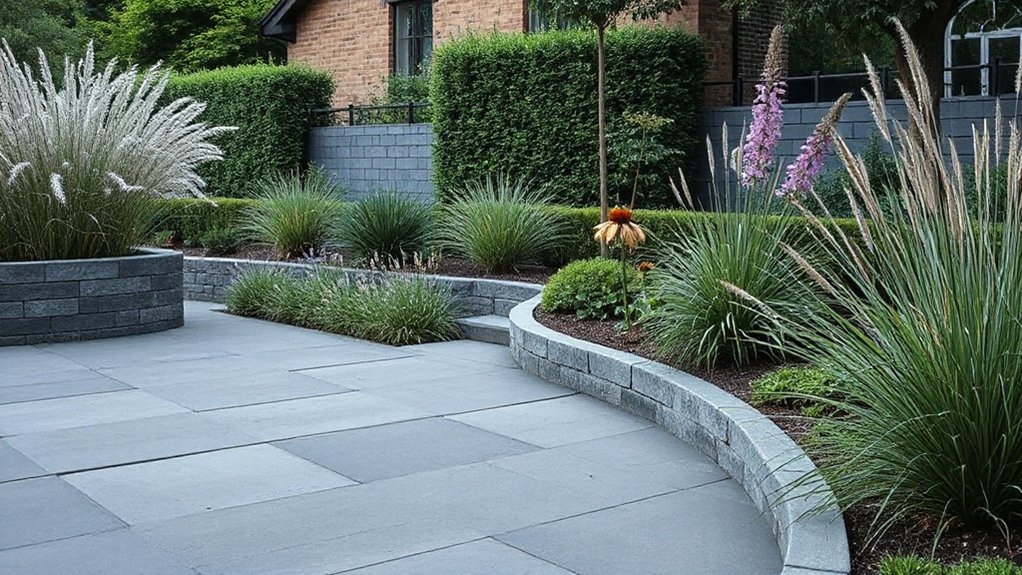
You coordinate the structure of pathways, seating, and walls with the plant forms you select, ensuring that foliage reinforces the built elements rather than competing with them.
Texture and form integrate by pairing bold, architectural leaves with clean, restrained hardscape lines to create a cohesive silhouette.
Coordinating Structure And Foliage
- Align plant canopy with longitudinal hardscape axes for cohesive movement.
- Use columnar or upright forms to echo vertical garden art elements.
- Pair low groundcovers to soften edges without interrupting sculptural lines.
- Integrate leaves and stems that reflect material color and sheen.
- Design around water features to frame reflections and enhance clarity.
Texture And Form Integration
Texture and form must align with hardscape geometry to maintain legibility and rhythm throughout the garden. Pairing plant silhouettes with linear paving, walls, and water features creates a cohesive reading of space. You assess plant height, massing, and profile to echo edge-to-edge lines, ensuring scaffolded rhythm without clutter.
Use restrained foliage to reinforce architectural intent, selecting species with clearly defined shapes—upright columns, horizontal canopies, or sculptural accents—to mirror wall planes and paths. Integrate Minimalist water features as reflective punctuations that read through foliage without overpowering structure.
Employ Vertical garden techniques where appropriate to extend green into vertical planes, balancing density and airiness. Prioritize seasonal translucence and texture, tuning leaf texture, stem density, and color swaps to maintain composition throughout the year.
Colour Restraint: Building a Timeless, Modern Palette
Colour restraint is the backbone of a timeless, modern palette in a UK garden design. You balance hues with discipline, using a limited but intentional spectrum to support structure, texture, and light. You apply color psychology to guide focal points and seasonal progression, ensuring mood shifts align with intended garden layout.
Precision in plant selection yields cohesion, readability, and visual calm across borders and built elements.
- Establish a limited color set anchored by cool neutrals and restrained accent tones
- Use foliage as the primary color carrier to reduce bloom-driven chaos
- Place high-contrast specimens at entry points for wayfinding without overwhelm
- Schedule seasonal interest through texture and form rather than shifting color
- Test scale, proportion, and light interaction before planting decisions
Containers and Small-Space Planting for Urban Gardens
Small spaces demand precise planning that complements a restrained palette while leveraging vertical and modular strategies. You approach urban planting with measured efficiency, prioritising high-impact species and compact forms that thrive in containers.
Container creativity becomes a core design tool, enabling seasonal rotation and microclimate management without sacrificing sightlines or access. Choose stacking, troughs, and modular shelves to extend rooting volume while preserving movement in tight footprints.
For durability, select weather-tolerant substrates and well-drained mixes; guarantee irrigation is controlled by drip or capillary systems to reduce waste. Pair foliage with short-stature perennials for year-round texture, and insert flowering accents at eye level to guide circulation.
Emphasise scale, contrast, and repetition to read as a cohesive, contemporary urban garden through Small space solutions.
Troubleshooting Common UK-Climate Plant Challenges
When steering UK-climate plant challenges, start with a precise diagnosis of site-specific stress factors—soil drainage, microclimate, and exposure—before selecting resilient species or bespoke interventions. You’ll optimize selection, cultivars, and maintenance to sustain form, health, and longevity under variable conditions.
- Assess drainage patterns and amend where waterlogging risks exist, prioritizing root-zone aeration.
- Map microclimates—sun, wind, shade—and align plant choices to tolerance and habit.
- Implement drainage-first fixes (risers, trenches, soil amendments) before routine fertigation.
- Integrate pest management with resistant varieties, monitoring for pressure and resistance breakdown.
- Schedule intervention windows to minimize disruption, aligning pruning, mulching, and irrigation with local climate cycles.
Native Species That Fit a Contemporary Aesthetic
Native species can underpin a contemporary UK garden by delivering reliable structure, year-round form, and low-maintenance appeal without sacrificing ecological integrity. You select native taxa that emphasize clean silhouette, restrained color palettes, and dense canopy or clumping habit to anchor sightlines and scale.
Prioritize species with predictable phenology—early-season foliage, mid-summer texture, and winter structure—to maintain continuity across seasons. Integrate evergreen or semi-evergreen accents for winter presence while avoiding invasive spreading habits.
Use native grasses and structural perennials to create rhythmic horizontals and vertical punctuations that read as modern rather than wild. For biodiversity, establish patches of Wildflower meadows to support pollinator habitats, ensuring succession management from establishment through maturation.
Pair with durable, site-specific soils, drainage, and microclimate-informed placement for enduring, low-input horticulture.
How to Design Your Planting Plan: A Step-by-Step Approach
A planting plan follows a clear sequence: assess the site, define the design intent, and translate that into a practical arrangement of species, textures, and forms. You’ll approach each step with measured criteria, ensuring coherence between function and aesthetics.
Begin with plant placement principles that guide sightlines, scale, and microclimates, then detail seasonal interest and maintenance needs.
Soil preparation precedes planting, so evaluate soil texture, drainage, pH, and amendments to optimize root development.
Document a species palette that supports structure, texture, and colour rhythm, pairing focal accents with supporting mass plants.
Execute the plan through staged installation, monitoring, and adjustments as growth confirms or challenges assumptions.
- Assess microclimate and sightlines for placement
- Define structural backbone with evergreen and architectural forms
- Schedule soil amendment and drainage improvements
- Select a palette balancing texture, colour, and seasonality
- Implement, monitor, and refine through establishment
Frequently Asked Questions
How to Choose Plants for a Modern UK Garden on a Budget?
To choose plants on a budget, plan a simple garden layout, prioritize hardy perennials, and mix affordable annuals. Use plant container ideas for versatility, cluster in focal masses, and select low-maintenance species to reduce ongoing costs.
What Are the Best Soil Amendments for Modern Plantings?
Soil improvement is essential; you should incorporate organic fertilizers to boost nutrient density while enhancing microbial activity. Use layered amendments, monitor pH, and tailor results to plant needs for precise, design-focused, long-term performance.
How to Ensure Year-Round Interest With Minimal Maintenance?
Keep seasonal interest low-maintenance with discreet pruning, hardy perennials, and smart plant pairing. You’ll master container gardening and vertical planting, ensuring year-round texture through staggered bloom, evergreen structure, and graceful color shifts across seasons.
Which Drought-Tolerant Species Thrive in UK Summers?
You’ll find xeriscape plants and drought resistant shrubs thrive in UK summers, offering resilience under heat; select hardy, low-water species, design with soil-moisture control, and monitor irrigation. Prioritize rainwater harvesting to sustain performance and longevity.
How to Combine Color Restraint With Seasonal Drama Effectively?
Color harmony comes from careful contrast and restraint, you’ll blend textures and tones. Use seasonal layering to pace drama, pairing evergreen anchors with flowering accents. You’ll balance hues, repeat motifs, and implement precise, durable plant placements.
Conclusion
You’ve designed with precision, balancing evergreen backbone, architectural grasses, and bold foliage for drama that lasts year-round. By pairing low-maintenance evergreens with native accents and smart container tactics, your modern UK garden stays crisp through seasonal shifts. The step-by-step plan guides you from concept to planting with confidence. Think of your planting schedule as a well-tuned mechanism—each element clicks into place, delivering structure, texture, and easy care in a single, enduring statement.