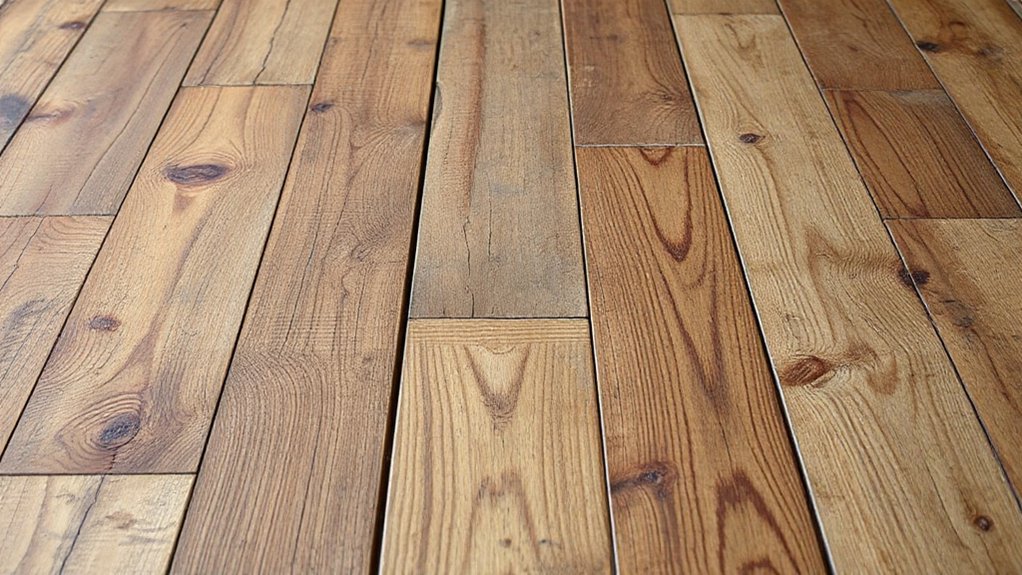
Reclaimed wood flooring is vintage-grade lumber salvaged from decommissioned structures, then milled into planks with verified provenance and a distinct patina. You’ll get character through grain variation, knots, and surface wear, while performance hinges on stable moisture, low VOC finishes, and sound stabilization. Each plank reflects its history, era, and exposure, influencing durability and color. You’ll prioritize authentic cues over surface refinishing to preserve its heritage, yet still achieve modern install quality and seamless grain flow—discover more below.
What Qualifies as Reclaimed Wood Flooring
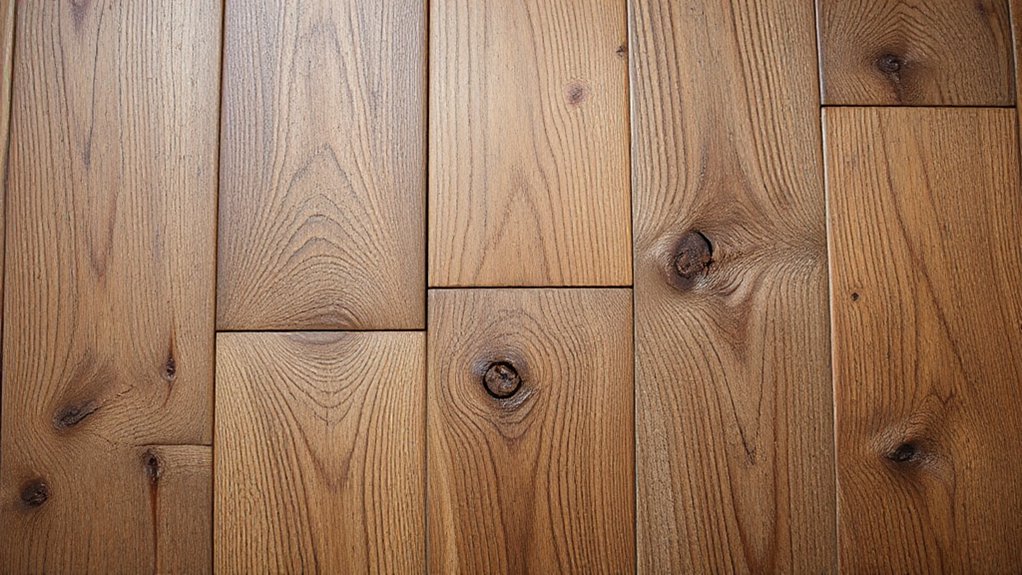
Reclaimed wood flooring encompasses boards saved from existing structures, decommissioned buildings, or salvaged timbers repurposed for new installations. You evaluate material lineage through provenance, species, and condition, ensuring each plank meets project specs.
Defining reclaimed flooring hinges on treatment history, mechanical integrity, and dimensional stability, not only origin. You prioritize boards with minimal finishing layers, verified desorption of contaminants, and compatible wear-layer profiles for intended finish systems.
You assess indoor air considerations by requiring low or no volatile organic compounds, stable moisture content, and documented remediation when applicable. For pest control, you favor intact grains, absence of hidden infestations, and effective post-extraction treatments that align with code standards.
You document inspection results, performance expectations, and installation parameters to guarantee durability, aesthetic coherence, and long-term environmental benefits.
Where Reclaimed Wood Comes From
Where reclaimed wood originates shapes its character and performance. You track sources by history, geography, and construction era, translating those factors into durability and aesthetic. Material provenance informs color variation and structural behavior, guiding your design decisions with precision.
You evaluate timbers by species mix, vintage usage, and prior environmental exposure, understanding how each element influences performance in flooring applications. The provenance also affects knot density, grain pattern, and planing tolerances, shaping installation tolerances and long-term stability.
You prioritize traceability, sustainability certifications, and reuse potential to maintain design integrity over time. Color variation and knot density become design cues, not defects, allowing you to craft cohesive spaces.
- Regional quarries, mills, and urban reclamation sites
- Historic buildings, barns, and industrial facilities
- Reused structural timbers and decking
- Variation in finish history and weathering potential
How Reclaimed Wood Is Processed and Prepared
Processing reclaimed wood begins with careful assessment and cleaning, then moves to stabilization and conditioning to guarantee stable, installable flooring. You then verify species, grain, and dimension consistency, selecting planks that meet design intent and performance criteria.
The next phase focuses on surface preparation, including de-nailing, contaminant removal, and moisture balancing to minimize dimensional change after installation.
Manufacturing processes are optimized to reduce waste, utilize non-destructive treatments, and ensure durability without compromising character. In this stage, you apply controlled drying, acclimation, and conditioning to achieve target moisture content and uniform hardness.
Post-dry screening removes irregulars, while edge trimming refines exposure and alignment.
Environmental impact considerations guide finishing options, dowelling, and sealing choices, balancing aesthetic goals with long-term environmental responsibility.
How to Tell Real Reclaimed Wood From Refinished Wood
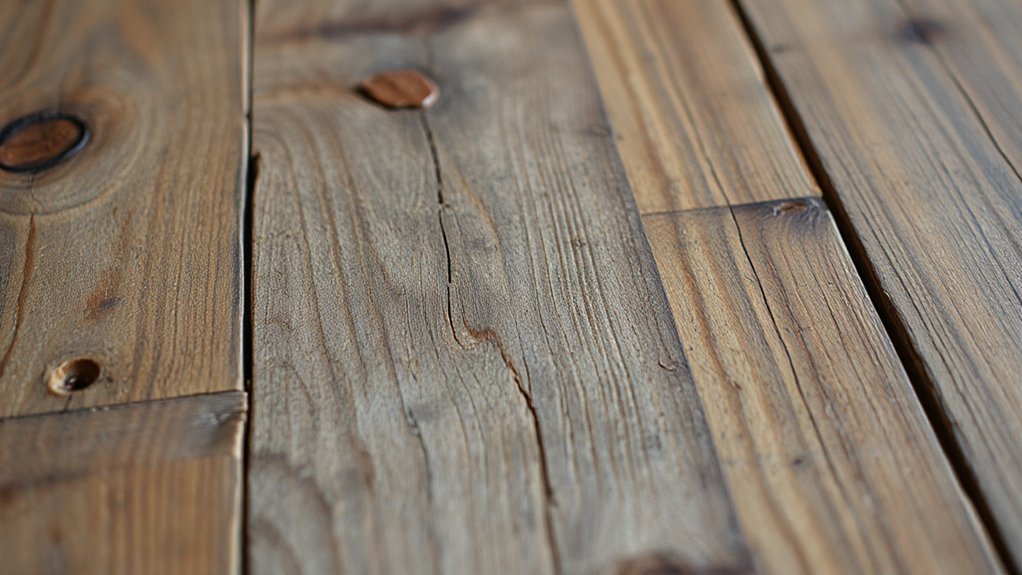
You’ll compare authentic reclaimed marks with modern refinishing cues to distinguish provenance, focusing on texture, grain irregularities, and nail or tool impressions.
Surface clues reveal patina and board-level wear, while structural cues highlight original joinery, density, and seasoning that refinishing rarely alters.
Restoration versus refinishing indicators help you assess authenticity by noting planed edges, masterful curvature, and match to historic specs.
Identifying Reclaimed Marks
- Color variation across boards and within boards
- Knot patterns that reflect species history
- Subtle patina and mineral deposits
- Era-consistent tool marks and joinery cues
Surface vs. Structural Clues
Surface clues distinguish authenticity from refinished wood by focusing on what lies beneath the surface. You examine grain depth, edge chamfers, and tool marks that indicate original sawing patterns or historic joinery, not merely cosmetic resurfacing.
Surface texture reveals proof: authentic reclaimed boards show irregular pitting, varied plane heights, and residual nail divots that align to old construction practices. In contrast, refinished stock typically exhibits uniform texture, smoother gradations, and rail-jill inconsistencies erased by sanding.
Assess color variation as a structural cue, noting authentic boards carry uneven, weathered patina across planks rather than a single, even hue. You should verify that color shifts correspond to documented aging, not uniform stain.
Together, texture and color variation guide you toward genuine reclaimed material rather than refinished.
Restoration vs. Refinishing Indicators
Restoration and refinishing indicators hinge on identifying authentic aging versus post-process alteration. You’ll distinguish real reclaimed wood by inspecting texture, nail patterns, and patina that proofs centuries of service rather than a factory finish. Look for inconsistencies in grain depth, mineral deposits, and tool marks that signal genuine use.
- Patina depth that remains after surface sanding
- Nail and screw patterns matching historic construction
- Weathering that respects original board curvature
- Finish wear that aligns with prior traffic and moisture exposure
These cues support Historical significance and guide Modern applications, ensuring design decisions honor provenance while meeting contemporary performance.
In practical terms, you’re evaluating whether the floor preserves legacy details or merely imitates them, influencing durability, maintenance, and aesthetics in your project.
Common Wood Species Used in Reclaimed Flooring
Reclaimed flooring commonly features species with both durability and character, such as oak, maple, pine, and chestnut, selected for their workability and distinctive grain. You assess each species for density, hardness, and dimensional stability to guarantee long-term performance in your project.
Oak provides pronounced grain and tannin response; maple offers a tight texture with consistent color; pine brings warmth and larger growth rings; chestnut delivers aging luster and pronounced ray fleck. You also consider variability from vintage sourcing, including sapwood content and insect patterns, to target desired Reclaimed aesthetics.
For Modern applications, you blend species to achieve balance between durability and visual depth, align with substrate constraints, and plan finish strategies that highlight authentic character. Select materials that meet performance, installability, and design intent without compromising structural integrity.
What Gives Reclaimed Wood Its Patina and Grain
You’ll see patina form from exposure, oxidation, and surface wear, all shaping color depth and finish compatibility.
Grain patterns arise from species, growth rings, and historical milling, influencing how light interacts across planks.
Age and weathering modulate contrast and texture, linking historical conditions to today’s design performance.
Patina Formation Factors
Patina in reclaimed wood develops from a combination of surface wear, environmental exposure, and resin or tannin content that alters color and sheen over time. These factors interact with wood species, milling methods, and finish choices to create a distinctive grain pattern.
You’ll evaluate how wear depth, UV exposure, and humidity drive hue shifts, while resin pockets subtly tint dark. You’ll also consider how tannins react with liners and coatings to deepen contrast, shaping decorative accents and overall mood.
Manufacturing techniques influence texture and depth, guiding your design decisions toward durable, authentic surfaces. Keep these factors in view when selecting boards and finishes to *guarantee* cohesion with your space.
- Surface wear as an accent driver
- Environmental exposure shaping color
- Resin/tannin interactions informing depth
- Finish and milling choices defining grain texture
Grain Pattern Origins
Grain patterns in reclaimed wood arise from growth rings, cut direction, and historic milling practices, then crystallize through wear, exposure, and finishing choices. You’ll notice that growth rings create concentric or wavy lines, while cutting direction emphasizes flecks and cathedrals depending on board orientation.
Historical milling often produced irregular thicknesses and mixed resin pockets, which contribute asymmetry in the grain flow. Finish layer decisions lock in contrast between heartwood and sapwood, enhancing depth and optical movement.
For design application, map grain variance across plank runs to avoid visual clashes and to achieve intentional rhythm. When pursuing DIY installation, align boards to emphasize dominant grain direction for a cohesive field.
Cleaning techniques should respect surface patina, avoiding aggressive abrasives that obscure grain detail.
Age and Weathering Effects
Age and weathering drive the distinct patina and grain character of reclaimed wood by progressively altering color, texture, and openness of the grain. You’ll observe subtle shifts in hue as tannins oxidize, while surface abrasion reveals varied mineral content and board-to-board contrast.
Weathering accelerates color depth, creates micro-scratches, and emphasizes growth-ring density, guiding your design intent with measured texture and depth. The patina reflects environmental exposure and usage history, informing structural decisions and finish choices.
Consider environmental impact and historical significance when selecting material, since finish choices can preserve or erase legible provenance. Your plan should balance durability, aesthetic restraint, and accessibility.
- Color evolution from amber to tobacco
- Texture from smooth to weathered
- Grain openness increasing with wear
- Provenance cues guiding restoration decisions
Benefits of Reclaimed Wood: Sustainability, Durability, and Style
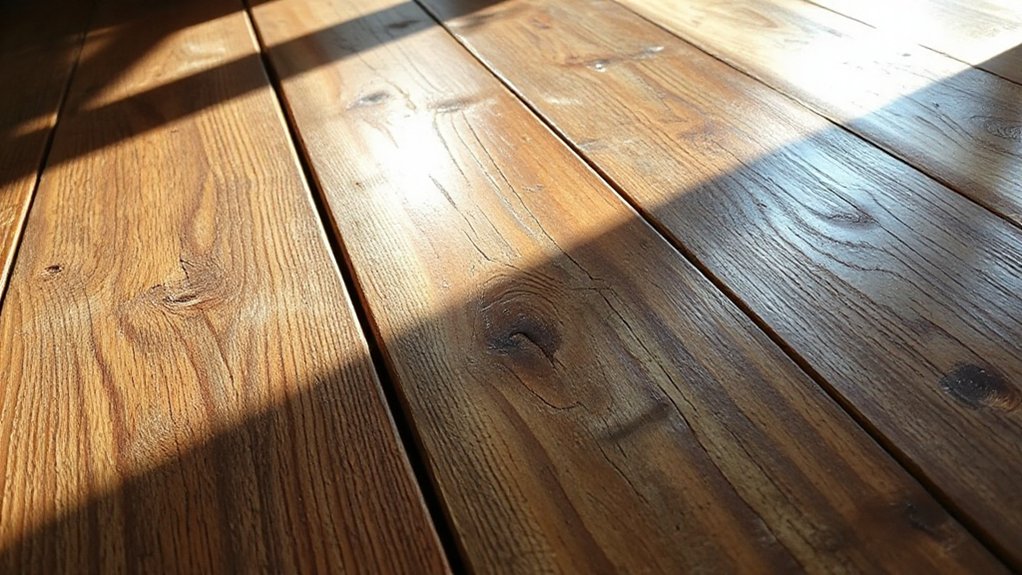
Reclaimed wood offers clear benefits in sustainability, durability, and style, making it a pragmatic choice for design-focused projects. You evaluate material life cycles, minimizing new resource extraction while maximizing existing timber value.
Sustainability is quantified by reduced embodied energy and diverted waste, with processing tailored to preserve structural integrity. Durability derives from mature, slow-growth fibers and stable moisture content, yielding dimensional stability and long service life when properly installed and acclimated.
Style emerges through historical provenance and distinctive grain patterns, delivering aesthetic versatility across contemporary and traditional interiors. You optimize finish systems to protect sensitive surface patinas without erasing character.
Selection criteria emphasize board straightness, load-bearing capacity, and compatibility with underfloor assemblies. Historical significance informs provenance notes, while aesthetic versatility expands pairing options with metal, glass, or stone elements.
Key Trade-Offs When Choosing Reclaimed Wood
When selecting reclaimed wood, you must balance cost, performance, and provenance to meet project goals. You weigh material quality, milling compatibility, and stability against budget and availability, then factor environmental impact into every decision.
- Aged patina that informs interior design while masking irregularities and blemishes
- Structural integrity and dimensional stability that reduce surprise maintenance
- Provenance clarity that guides sourcing legality and lifecycle expectations
- Finish compatibility and coating durability aligned with foot traffic and climate
Trade-offs emerge in durability vs. cost, ecological benefit vs. supply risk, and authentic look vs. processing needs. You optimize by prioritizing design intent, performance specs, and environmental impact, ensuring the final floor supports both style and function.
This approach keeps your project precise, repeatable, and resilient.
How to Assess Quality Before You Buy
Begin by verifying Material Provenance: trace the origin, harvesting date, and any restoration notes to guarantee you’re sourcing authentic reclaimed planks.
Next, assess Board Condition Indicators and Stability And Uniformity Metrics, looking for warp, cracks, nail holes, and consistent thickness across the batch.
This upfront scrutiny sharpens your design outcomes by aligning provenance, condition signals, and dimensional stability with your project requirements.
Material Provenance Check
Material provenance checks guarantee you’re selecting reclaimed wood that’s traceable, compliant, and fit for purpose. You verify supply chain integrity to assure vintage charm and material authenticity align with design intent.
- Traceable source documentation that links timber to origin, era, and mill
- Compliance records confirming species, treatment, and reuse allowances
- Chain-of-custody stamps showing custody at each transfer point
- Independent audits validating sustainability and reclaimed status
This approach minimizes risk, informs performance expectations, and preserves provenance-driven aesthetics. You’ll assess site-recovery methods, age proxies, and historic usage clues to forecast durability and finish behavior.
Board Condition Indicators
Evaluating board condition before purchase protects design intent and performance. You’ll inspect for warp, twists, cupping, and bowing, noting recent repairs and evidence of past water exposure.
Check end-grain moisture indicators and edge integrity to gauge stability over time. Look for straight, uniform boards with tight interlocks, minimal checking, and sound nail/hole patterns that align with original texturing.
Assess finish wear patterns to distinguish natural aging from abuse, ensuring consistency with your project’s aesthetic.
Evaluate thickness variation and milling marks to predict installation behavior in your space. Consider how condition affects decorative accents and the potential for furniture restoration work, ensuring you won’t compromise the floor’s character.
Document condition findings to guide procurement, budgeting, and future maintenance.
Stability And Uniformity Metrics
- Consistent thickness and width across boards
- Minimal length deviation for tight edge pairing
- Flatness and cupping resistance under acclimation
- Hidden fastener compatibility and edge stability
Installation Considerations for Reclaimed Wood Floors
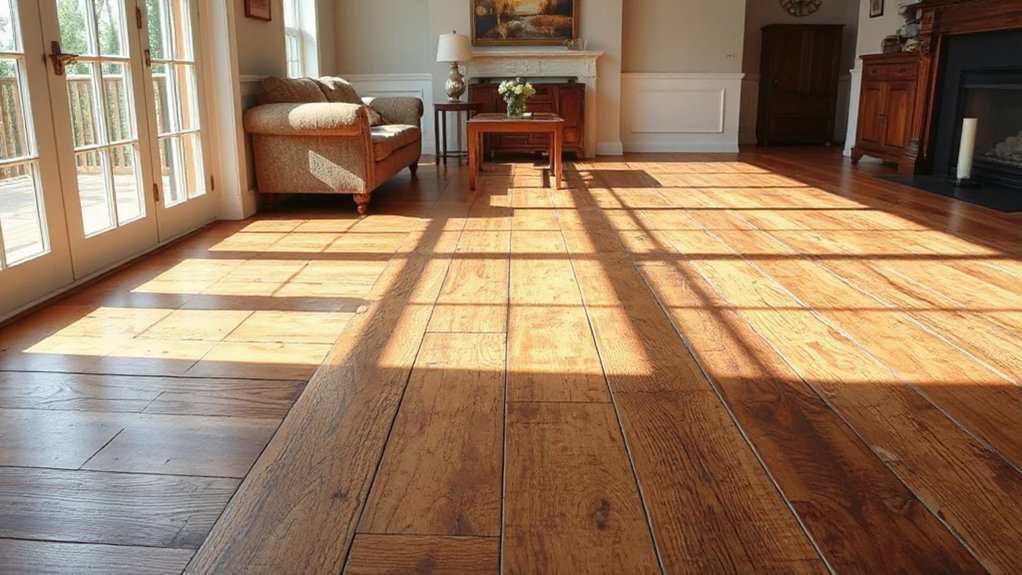
When installing reclaimed wood floors, assess each plank for structural integrity, alignment, and hidden defects before laying a single row. You’ll verify species, thickness, and grade consistency, then map patterns to minimize waste and maximize grain continuity.
Subfloor conditions must be flat, dry, and clean; use a moisture barrier and appropriate fasteners for long-term stability.
Acclimation should occur in situ to accommodate seasonal moisture shifts, reducing warping risk.
Align boards to accentral seams, preserving historical character while meeting modern design requirements.
Consider nail-down, glue-down, or floating methods based on substrate, profile, and finish goals.
Seal with a low-VOC finish to protect the surface without masking patina.
Prioritize historical preservation without compromising install quality, balancing authenticity with practical performance for contemporary spaces.
Maintenance Tips to Preserve Reclaimed Wood’s Look
- Dust with a microfiber cloth to avoid micro-scratches and preserve the board’s character.
- Wipe spills promptly with a damp, not soaking, cloth to avert staining.
- Refinish selectively in high-traffic zones to retain patina elsewhere.
- Choose breathable sealers that allow micro-movements while guarding against moisture.
Schedule periodic checks for gaps, checking boards for movement or splinters.
Real-Life Examples: Spaces That Shine With Reclaimed Wood
Real-life spaces demonstrate how reclaimed wood can balance warmth with modern clarity. In these case studies, you’ll see how material provenance informs aesthetic decisions without compromising performance.
You observe alignment of grain, knot patterns, and texture with architectural lines to create cohesive environments. Color matching across adjacent woods, cabinetry, and stone ensures a unified palette, while selective contrast adds visual interest where needed.
Finish options play a decisive role: matte emulsions emphasize dialogue with natural patina, whereas low-gloss, UV-cured coatings preserve color stability under illumination.
You’ll notice seam tolerances and installation layouts that minimize site disruption while maximizing continuity of grain flow. Overall, these spaces prove reclaimed flooring can deliver both timeless warmth and contemporary clarity when design parameters are precisely executed.
Frequently Asked Questions
How Long Does Reclaimed Wood Flooring Typically Last?
Reclaimed wood flooring can last 50 to 100 years or more with proper maintenance. You’ll enjoy aesthetic versatility and historical appeal, plus stable dimensions. Seal and refinish periodically, and use appropriate fasteners to preserve structural integrity.
Can Reclaimed Wood Be Used With Radiant Floor Heating?
Yes, you can. With radiant floor heating, reclaimed wood can perform, though you must respect installation considerations. Eco friendly benefits shine when you choose compatible species, moisture content, and underlayment. Suspense builds as precise, design-focused specs guide your decision.
Is All Reclaimed Wood Responsibly Sourced and Certified?
Not necessarily; you should verify, since not all reclaimed wood is responsibly sourced. Seek materials that meet certification standards and sustainable practices, and confirm traceability, supplier transparency, and third-party audits before selecting any reclaimed wood for projects.
How Does Price Compare to New Hardwood Floors?
Price varies; you’ll often pay more upfront for reclaimed wood, but tradeoffs include durability and rarity. Cost comparison depends on sourcing, condition, and finish. You gain aesthetic appeal and long-term value, though installation may require specialized expertise.
Are There Allergen or Mold Concerns With Reclaimed Wood?
Allergen presence and mold risk can be minimized with proper sourcing and remediation. You’ll mitigate concerns by selecting kiln-dried, treated reclaimed wood, testing for moisture, and ensuring you have a certified install to maintain long-term indoor air quality.
Conclusion
You now know what reclaimed wood flooring is, where it comes from, and how it’s processed, so you can evaluate options with a designer’s eye. Prioritize authenticity, structural integrity, and finish compatibility, and verify sourcing and QA practices. Think of it as crafting a living, storied deck for your interiors, like a craftsperson tuning a vintage instrument. With precise selection and proper maintenance, your space will age gracefully while preserving character and performance.