

To set the right asking price, build a disciplined, data‑driven framework around recent comparable sales. Define your market area, gather recent, relevant data, and filter outliers that skew results. Normalize comparables by key features and adjust for condition, upgrades, and lot specifics. Translate these into a confident price range anchored to objective metrics like price per square foot and days on market. Communicate your strategy clearly, and stay ready to reassess as conditions shift—there’s more to uncover ahead.
Define Your Pricing Framework Using Comparables

To set a solid asking price, start by defining a pricing framework around comparable sales. You’ll map recent sale prices, days on market, and condition-adjusted values to a structured window that reflects your property’s position.
Use Pricing psychology to anticipate buyer responses—recognize how perceived value shifts with visible features, timing, and disclosures.
Partition the audience through Market segmentation: identify likely buyers, their priorities, and budget ranges, then weight comparables accordingly.
Establish a benchmark range, not a single point, to accommodate margins for negotiation.
Document how adjustments are applied for differences in square footage, lot size, or amenities.
Maintain objectivity by citing data sources and sale dates.
Finally, test the framework with sensitivity checks to guarantee it remains robust across market shifts.
Set Your Market Area for Accurate Comparisons
Define your market area by your local boundaries and the markets you compare, so you’re using genuinely relevant data.
Keep the scope tight to avoid distorted benchmarks from unrelated areas. This sets the stage for accurate, apples-to-apples comparisons.
Define Local Boundaries
Where should you draw the line for accurate comparisons? Define local boundaries with purpose, not intuition. You should select a market area that reflects price formation forces: proximity, similarity, and data reliability.
Start by mapping nearby neighborhoods that share characteristics in housing stock, age, and lot sizes, then assess how demand flows across them. Use objective criteria to justify boundaries, such as transportation access, school districts, and commercial amenities that influence pricing.
Consider parcel-level comparables to confirm boundary stability over time. Document decisions to guarantee reproducibility and defendability.
Include Neighborhood boundaries as a concept to guide scope, and integrate Local zoning to anticipate potential value shifts from regulatory changes.
Avoid overgeneralization; keep boundaries tight enough to prevent irrelevant outliers and broad enough to capture meaningful trends.
Align Comparable Markets
Focus on Market segmentation to guarantee you’re comparing like-with-like properties, not distant substitutes. Assess price trends, sales cadence, and inventory within each zone, then weigh results by volume and reliability.
Consider Neighborhood dynamics, including amenities, schools, and accessibility, so adjustments reflect lived experience rather than abstract averages.
Exclude outliers that distort the pattern but document why they’re excluded.
Reconcile multiple sources—MLS, public records, and recent listing activity—to confirm consistency.
Establish a final market area that minimizes bias while maximizing representativeness, enabling precise, defendable pricing decisions.
Gather Recent, Relevant Comparable Sales Data
To set an accurate asking price, start by gathering recent, relevant comparable sales data that mirrors your property in key aspects such as location, size, condition, and features.
You’ll compare sale prices, days-on-market, and sale-date recency to verify alignment with current market momentum. Focus on entries with similar zoning, amenities, and lot characteristics, then note price per square foot and any concessions or non-cash terms.
Document adjustments for differences like newer kitchens or added storage, so you can translate those gaps into an adjusted value range. This process anchors your pricing in objective benchmarks rather than conjecture.
Throughout, consider pricing psychology and potential negotiation tactics, using data-driven thresholds to frame your asking price, making your position credible and resilient in early discussions.
Filter Outliers That Skew Comparables
You identify anomalous data points and review their context to determine if they distort the set of comparables.
Then you apply consistent criteria to filter outliers, ensuring the remaining data reflects typical market conditions.
This keeps your analysis precise and focused on the true range of price outcomes.
Identify Anomalous Data
Outliers can distort the comparables used to price a property, so identifying and addressing anomalous data is essential. You assess each sale’s context, ensuring alignment with property type, location, timing, and feature set.
Look for data discrepancies that could skew conclusions, such as inconsistent lot sizes, renovation levels, or vacancy status. Mark any sale that diverges markedly from typical market patterns as a potential anomaly, then verify against primary sources or corroborating records.
Distinguish genuine market anomalies from misentered figures or clerical errors, and document your rationale for exclusion or adjustment. Maintain a transparent trail for later review, and emphasize that anomalous data can bias valuation if left unchecked.
This disciplined scrutiny strengthens price accuracy without overreacting to rare outliers.
Filter Outliers Effectively
When outliers appear in your set of comparables, you must filter them with criteria that reflect market reality rather than personal judgment. You should apply transparent thresholds and consult credible data sources to avoid distorting pricing signals.
Prioritize recent sales, verify condition parity, and exclude transactions with unusual financing or incentives that distort true value. Use statistical methods to test sensitivity and document rationale for each exclusion.
This keeps your pricing reasoning aligned with market dynamics and Pricing psychology, ensuring you’re not chasing outliers.
- Exclude sales with atypical financing or concessions
- Favor recent, condition-matched comparables within a stable market
- Verify data integrity and reason for any exclusion to justify adjustments
Align Comparables by Key Property Features
Aligning comparables by key property features guarantees apples-to-apples analysis. When you select comps, you compare attributes that truly influence value, not merely proximity or price.
Focus on structural essentials (bedrooms, bathrooms, lot size, year built) and site factors (orientation, frontage, access). Confirm each property shares similar zoning, land use, and setbacks to reflect market realities.
Consider neighborhood demographics and Property zoning to gauge demand drivers and regulatory constraints that affect value trajectories.
Exclude properties with incompatible features that distort metrics, such as unusual additions or atypically modified layouts.
Document feature-alignment criteria clearly, and apply them consistently across all comps. This disciplined approach reduces bias, improves comparability, and strengthens your price rationale with transparent, replicable reasoning.
Adjust for Size, Condition, and Upgrades
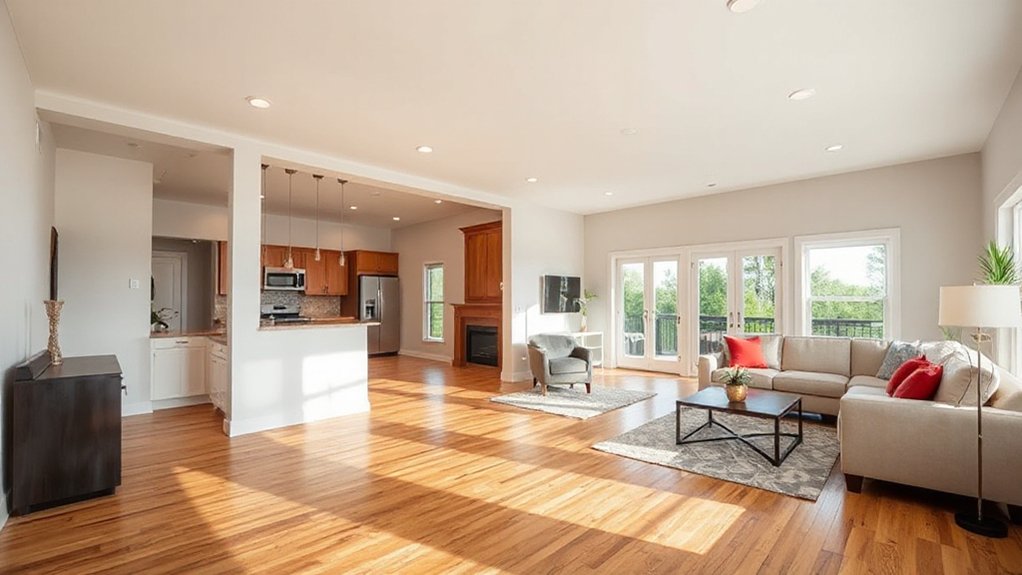
You adjust for size variance by comparing the floor area and footprint of each property, then normalize price per square foot to guarantee apples-to-apples comparisons.
Condition variations are weighed by noting functional obsolescence or improvements, and you apply a consistent downgrade or upgrade multiplier across all comps.
Upgrades are valued by their impact on resale, so you separate cosmetic changes from structural or energy-efficiency improvements to refine adjustment precision.
Adjust For Size Variance
Adjusting for size variance is essential because even small differences in square footage can meaningfully shift value. When you compare properties, you must normalize for size so valuations reflect comparable living space. This supports more accurate market segmentation and property valuation, preventing over- or underpricing based on raw totals rather than proportional value.
Street-facing lots, layout efficiency, and usable square footage influence price per square foot, which can mislead if not adjusted. Use units like price per square foot or per-room equivalencies to standardize comparisons.
Then, apply the adjusted figures to estimate the target home’s value relative to its peers.
- Normalize comparisons with price per square foot
- Account for inefficiencies in layout or usable space
- Reconcile discrepancies across comparable sales data to refine value
Appraise Condition Variations
Condition and upgrade differences can meaningfully shift value, so you must normalize not just for size but also for the home’s condition and any improvements.
When you appraise condition, you compare unit levels, finish quality, and functional obsolescence across sales. Subtract penalties for dated systems and cosmetic neglect, or credit upgrades that increase desirability.
Upgrades should be weighed by cost effectiveness and market appeal, not just installed quantity. In practice, you adjust the comps for condition disparities to avoid inflating or deflating value.
This careful adjustment supports accurate property valuation and reduces bias in pricing. Document the rationale for each adjustment, linking it to observable features and market reactions.
The result is a transparent, defensible asking price grounded in rigorous comparable sales analysis.
Apply Time-Based Adjustments for Market Trends

Time-based adjustments quantify how market conditions shift over holding periods, ensuring the asking price reflects current momentum rather than past norms. You assess time as a variable, recognizing faster sales indicate strength and slower turnover signals caution.
Translate this into price by applying directional shifts to comparables, not sweeping overhauls. Track current market fluctuations and adjust multiples modestly to reflect momentum, avoiding overreaction.
Pricing psychology informs how buyers perceive timing, so you present a balanced, data-driven stance that preserves credibility.
- Use disciplined, data-backed deltas to reflect trend strength
- Align adjustments with observed sale-to-list durations and price trajectories
- Communicate clearly why timing affects value without overpromising
This approach remains precise, objective, and concise, guiding you toward a fair, market-aligned asking price.
Consider Subdivision, Street, and View Impacts
Subdivision, street appeal, and view quality shape how buyers perceive value and risk in a price range. You’ll want to compare homes within the same subdivision and street tier to isolate the impact of location and aesthetics.
This sets a baseline for adjustments when evaluating comparable sales and determining an asking price.
Subdivision Influence On Value
Neighborhood context matters because subdivision quality, street access, and view potential collectively shape perceived desirability and market value. You’ll assess how each element steers price ceilings and buyer willingness to pay, aligning with buyer expectations and current market segmentation.
- Subdivision influence alters perceived safety, amenities, and future development potential.
- Street access affects traffic exposure, parking, and walkability within the segment.
- View potential distinguishes premium pricing within a given market niche.
Your analysis should quantify this impact, linking subdivision attributes to comparable sales and price per square foot. Focus on objective metrics, avoid subjective hype, and ensure consistency across properties within the same segment.
This approach clarifies how subdivision factors drive pricing decisions and supports more accurate asking-price recommendations. Subdivision influence and market segmentation guide pricing strategy.
Street Location And Appeal
Street location strongly influences value, as subdivision context, street pattern, and view orientation shape buyer perception and price ceilings. You assess how the street hierarchy, access ease, and proximity to amenities affect demand, incorporating street layout and curb visibility into value estimates.
Street appeal matters beyond footprint; it signals safety, maintenance, and desirability, which buyers weigh against competing lots or homes. Curb appeal sets initial impressions, influencing perceived condition and future upkeep costs, and can adjust after-sale negotiation ranges.
Consider subdivision characteristics, such as mature trees, sidewalks, and traffic noise, because these factors constrain price ceilings. View orientation—frontal exposure, slopes, or water/cityscape views—modifies attractiveness and risk.
You document these nuances, separating subjective impressions from measurable indicators, to refine comparable adjustments and support logical asking-price recommendations.
Use Price Per Square Foot When It Applies
Price per square foot is a useful metric when the property type and market have uniform sizing, allowing you to compare homes quickly. When it applies, you’ll normalize differences in lot size and layout, enabling a cleaner price signal across comparable sales. Use it to refine value ranges and test pricing psychology against observed buyer behavior, rather than relying on volume alone.
Consider market segmentation to target price bands with higher confidence, then corroborate with per-square-foot spreads from recent sales.
- Apply only when dwelling types resemble each other in size and finish
- Cross-check with overall price trends to avoid mispricing
- Use as a supporting metric, not a sole determinant
This approach preserves analytical rigor while guiding your pricing decisions.
Include Non-Price Factors That Drive Value
Non-price factors often drive why buyers value a property beyond its sticker price. You should quantify how features influence perceived value, then weigh them against comparable sales.
Market trends affect appetite for upgrades, location desirability, and demand momentum, so note whether scarcity or rising rents elevates premiums.
Buyer psychology shapes willingness to pay for renovations, schools, curb appeal, and future growth prospects.
Distinguish tangible attributes (condition, amenities, lot size) from subjective appeal (view, noise, neighborhood prestige) and assign evidence-based adjustments rather than intuition.
Use objective data: recent upgrades, time on market, and comparable sale adjustments, ensuring consistency across properties.
Document assumptions, test sensitivities, and maintain a conservative stance to prevent overpricing while reflecting value-added attributes.
Build a Buffered Asking-Price Range

To capably reflect both market data and non-price factors, establish a buffered asking-price range that accommodates typical buyer willingness to pay and potential shifts in demand. You’ll anchor the range around recent comparable sales, then widen it slightly to absorb market fluctuations and pricing psychology effects.
A well-defined buffer reduces negotiation friction and signals seriousness without overpricing.
- Establish a lower bound near the median comparable price after adjustments.
- Set an upper bound that allows for demand surges while protecting value.
- Document rationale for both bounds, linking to data and non-price considerations.
This approach balances empirical evidence with buyer sentiment, maintaining credibility while preserving flexibility.
Run Scenarios: Best, Base, and Worst Case
You’ll run three scenarios—best case, base case, and worst case—to test how a buffered asking-price range holds under different market dynamics.
In each scenario, you measure likely outcomes using objective inputs from comparable sales, current demand signals, and inventory velocity.
The best case assumes strong demand, tighter spreads, and quick absorption, tightening your range without sacrificing perceived value.
The base case reflects typical buyer behavior, modest competition, and average time on market, keeping pricing psychology balanced between attractiveness and realism.
The worst case accounts for softer demand, higher negotiation leverage for buyers, and longer marketing cycles, potentially widening the range and introducing contingencies.
Throughout, apply Market segmentation to tailor messaging and adjust expectations, preserving credibility and precision.
Validate Your Range Against Active Listings and Absorption
Active listings and absorption rates provide the reality check for your price range. You compare your range to current inventory and turnover to gauge feasibility, not just appeal. By analyzing market saturation, you identify where demand meets supply and where it lags, avoiding overpricing or underpricing missteps.
Absorption indicates how quickly homes move at different price points, shaping your realistic ceiling and floor. Use this data to test pricing psychology: does your range attract time on market or attract competing offers? Align expectations with observable dynamics, not anecdotes.
- Compare days-on-market and price reductions across comparable segments
- Assess the gap between list prices and final sale prices
- Monitor new listings versus pending and sold activity to confirm momentum
Translate Comparables Into a Confident List Price

By anchoring your list price to what comparable sales actually achieved, you translate market reality into a confident starting point. You convert observed sale prices, days on market, and price adjustments into a data-backed anchor, then align your asking with that baseline.
This translates data into a precise price band that reflects true value, not aspiration. Incorporate pricing psychology insights to set a frame that appeals to buyers without overreaching, acknowledging how perception influences offers.
Use objective metrics—adjusted price per square foot, lot value, condition, and recent maintenance—so your price communicates fairness. Your negotiation tactics should rest on transparency about comparables, clearly explaining why your price sits where it does.
The result is a credible, competitive listing that attracts qualified inquiries and feasible offers.
Common Pitfalls to Avoid in Comparable Analyses
When using comparable analyses to set an asking price, pitfalls can distort the data and mislead decisions. You must protect against misaligned comparables, insufficient sample size, and overreliance on recent deals. Subtle biases, like anchoring on list prices or neglecting market timing, can skew conclusions. The goal is objective consistency, not intuition or emotion.
- Pricing psychology: buyers react differently to perceived value than to objective measures, so adjust expectations accordingly.
- Market timing: seasonal or cyclical shifts can create apparent gaps; normalize data to current conditions.
- Selection bias: guarantee comparables truly reflect property features, location, and condition, not just convenience.
Careful screening, transparent methodology, and explicit limitations keep analyses reliable and actionable.
Reassess and Adjust as the Market Shifts
As market conditions change, reassess your comps and adjust asking prices accordingly to reflect new data and evolving buyer behavior. When market fluctuations emerge, revisit active comparables, updated sale prices, and time-on-market trends to verify whether your initial premium or discount remains justified.
Track shifts in demand segments, financing conditions, and liquidity, then calibrate pricing using a disciplined framework rather than emotion. Maintain pricing flexibility by outlining a range or stepping-down schedule that aligns with observed velocity and residual value.
Document rationale for adjustments, citing concrete data points such as price-per-square-foot changes and days-on-market movement. This iterative process helps you preserve competitiveness without overshooting, ensuring your strategy adapts promptly to real-time signals while staying anchored to objective benchmarks.
Communicate Your Price Strategy to Buyers and Agents
After aligning your price with comparable sales, you must clearly communicate that strategy to buyers and agents. You’ll frame pricing decisions with pricing psychology and emphasize how your net outcome aligns with market realities, not emotion. Be precise about which comps informed the price and why features or timing matter to buyer perception. Present data-backed rationale, avoid hedging, and invite questions to align expectations.
- Explain the logical basis for the price using objective metrics and comparable indicators.
- Describe how features and market conditions influence buyer perception and demand.
- Outline the communication plan for feedback, timing, and potential counteroffers to maintain transparency.
Frequently Asked Questions
How Often Should I Refresh My Comparables During a Market Shift?
You should refresh comparables weekly during market volatility, shifting to twice-weekly if volatility accelerates. This maintains valuation strategies accuracy, helping you model trends, detect outliers, and adjust pricing promptly with data-driven, objective insights.
What if My Property Lacks Recent Comparable Sales?
If your property lacks recent sales, you improvise with alternative valuation methods and market trend analysis, then justify pricing through data, not guesswork; you’ll compare rents, comps from nearby niches, and adjust for timing, quality, and condition.
Which Adjustments Have the Biggest Impact on Price?
Adjustments with the biggest impact include condition, size, lot premium, and location; market trends and appraisal techniques influence weighting. You should quantify effects, apply standardized multipliers, and revalidate against recent comps to refine your price target.
How Should I Price When Active Listings Are Few?
You should price conservatively when active listings are few, using a sizing-down from comps as your pricing strategy while you perform market analysis. Satire starts strong, but your goal remains analytical, precise, and objective in every decision.
When Is Price per Square Foot Misleading?
Price per square foot is misleading when luxury homes or commercial properties have unique features, sparse comps, or premium locations. You should adjust for quality, amenities, and market segment rather than relying solely on SF figures.
Conclusion
You’re mapping a market’s heartbeat, not guesswork, by treating comparables as compass and clock. Each sale is a thread in the fabric of value, revealing where your price sits in the weave. Filter noise, align features, and translate data into a confident list price you can defend. As the market breathes, reassess, adjust, and maintain clarity with buyers and agents. Your price becomes a precise instrument, calibrated through discipline, not luck.