When you choose kitchen flooring, you’re balancing moisture resistance, durability, and maintenance in real-world use. You’ll weigh vinyl plank against porcelain tile, engineered wood versus solid wood, and the options within laminate and luxury vinyl. Each has trade-offs for foot traffic, spills, and comfort underfoot. Start with your lifestyle and budget, then gauge how easy it is to clean and how it ages. The best choice awaits your specifics—but you’ll need to compare options first.
The Kitchen Flooring Decision: Criteria That Matter
Choosing the right kitchen flooring starts with clear criteria: durability, maintenance, safety, and compatibility with your budget and lifestyle. You approach the selection by evaluating how each option supports daily use, from high-traffic mornings to heavy cookware moments.
Durability guides your tolerance for wear, scratches, and moisture exposure, while maintenance determines cleaning frequency and product compatibility.
Safety governs slip resistance and warmth underfoot, especially around sinks and stoves.
Budget and lifestyle shape long-term cost and convenience, influencing installation complexity and replacement intervals.
Consider how the flooring integrates with kitchen design and contributes to aesthetic appeal, ensuring cohesion with cabinets, countertops, and lighting.
You’ll prioritize options that balance performance with visual harmony, delivering a coherent, functional space.
How to Compare by Moisture, Comfort, and Durability
To compare flooring options, focus on moisture handling and comfort underfoot first. Then assess durability for long-term performance.
Consider how each material resists spills, humidity, and cleaning cycles. Also, think about how it feels underfoot during standing tasks.
Use these factors to balance practical needs with comfort, so you choose a surface that lasts and feels right in daily use.
Moisture Handling
Moisture handling is the key to flooring longevity in kitchens. You’ll compare options by their moisture resistance, install methods, and performance under realistic exposure.
Prioritize materials with proven moisture barriers and compatible underlayments that seal against spills, vapor, and staining agents. Evaluate substrate preparation requirements; a sound concrete or wood base matters as much as the top layer.
For durability, verify dimensional stability under humidity fluctuations and temperature changes, plus resistance to water intrusion at seams, connections, and penetrations.
Humidity control matters too: select products with low moisture absorption and maintain room RH within recommended ranges to prevent warping, cupping, or delamination.
Document warranty terms for moisture-related failures and confirm contractor adherence to moisture mitigation protocols during installation.
Comfort Underfoot
Comfort underfoot matters just as much as moisture resistance, because how a floor feels affects long-term satisfaction and wear. You evaluate comfort by how material density, cushioning, and surface texture translate to daily steps. Consider ergonomic design: a floor that reduces fatigue supports prolonged cooking sessions and improves posture.
Assess resilience, rebound, and tread consistency to guarantee steady footing across high-traffic zones. Footwear compatibility matters too; choose textures and hardness that pair with common kitchen shoes and slippers to minimize slips and impacts.
Compare underfoot feel with real-world tests—moderate softness should resist indentations yet return quickly. Balance against durability, maintenance, and cleaning ease. Informed choices yield safer, more productive kitchens and fewer tired feet over time.
Vinyl Plank for Busy Kitchens: Pros, Cons, and Scenarios
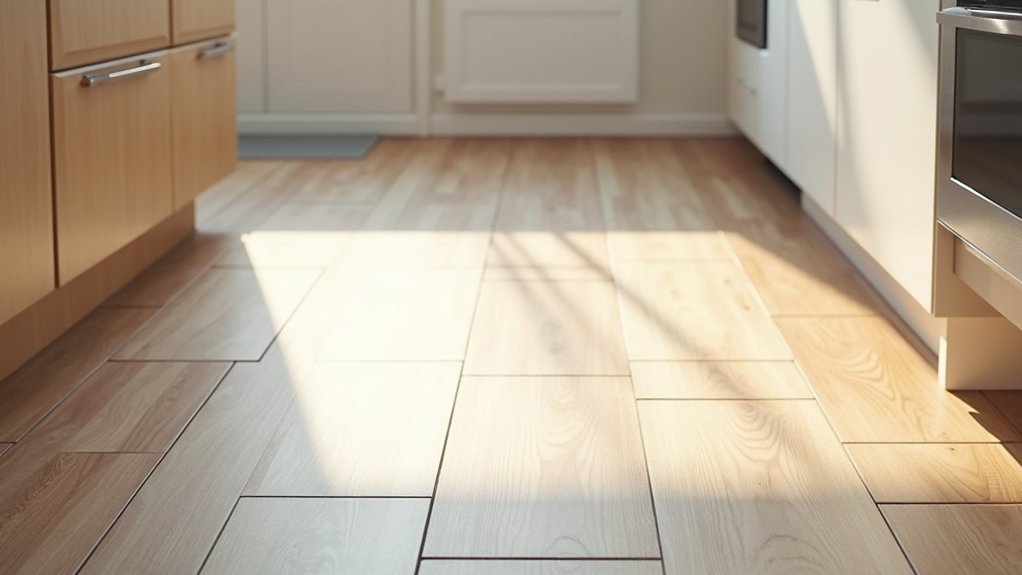
Vinyl plank stands up to traffic with solid durability, making it a reliable choice for busy kitchens.
Its waterproof and spill-resistant core minimizes damage from accidents, while straightforward maintenance keeps it looking sharp with minimal effort.
For everyday use, focus on proper installation, prompt spill cleanup, and routine surface care to maximize longevity.
Durability Under Traffic
Durability under foot traffic is where vinyl plank shines in busy kitchens: it resists dents and scuffs better than many alternatives while offering easy maintenance. In practice, you’ll notice dimensional stability under constant use, with planks staying tight and minimizing seam telegraphing.
The wear layer determines longevity against high-traffic patterns, dragging furniture, and dropped utensils, so choose options with a thicker wear layer for long-term resilience. You’ll benefit from sound underfoot and quick spot repairs, which keeps downtime to a minimum.
For kitchen decor, select colors and textures that hide minor abrasions yet align with your style, while ensuring appliance integration remains seamless with matching profiles and progressions. Maintenance remains straightforward, preserving both appearance and resale value without sacrificing performance under everyday activity.
Waterproof and Spill Resistance
Even when spills happen, waterproof vinyl plank keeps moisture from soaking through, protecting subfloor with a robust core and tight seams. You’ll gain dependable moisture resistance due to this construction, enabling real-world spill scenarios to stay above the surface.
In a Kitchen renovation context, choose planks with a القOS core and locking or glueless joints for watertight performance during daily cooking tasks. The material’s surface wear layer resists staining and abrasion, maintaining color integrity under foot traffic.
For flooring installation, guarantee precise acclimation and proper expansion gaps to prevent buckling in humid environments. Consider waterproof ratings and warranty coverage to match your kitchen’s moisture exposure.
This option pairs well with fast installation timelines, maximizing usable space without compromising long-term durability.
Easy Maintenance Tips
Keeping up with a busy kitchen is simpler when you understand vinyl plank maintenance. You’ll implement a disciplined cleaning routine that minimizes downtime and preserves appearance.
Establish cleaning routines that prioritize quick-drying, non-abrasive methods; use a microfiber mop and a mild, pH-neutral cleaner to avoid dulling the surface. Wipe spills promptly to reduce moisture exposure and prevent potential warping or staining.
For routine maintenance, avoid steam or high-pressure sprays that can seep into seams. Use felt pads under appliances and mats at entry zones to limit grit ingress.
To maximize longevity, rotate high-traffic zones and reseal joints only when manufacturer guidance requires. Focus on stain prevention by blotting, not rubbing, and selecting compatible cleaners specified for vinyl plank.
Porcelain Tile for Waterproof Longevity: What to Know
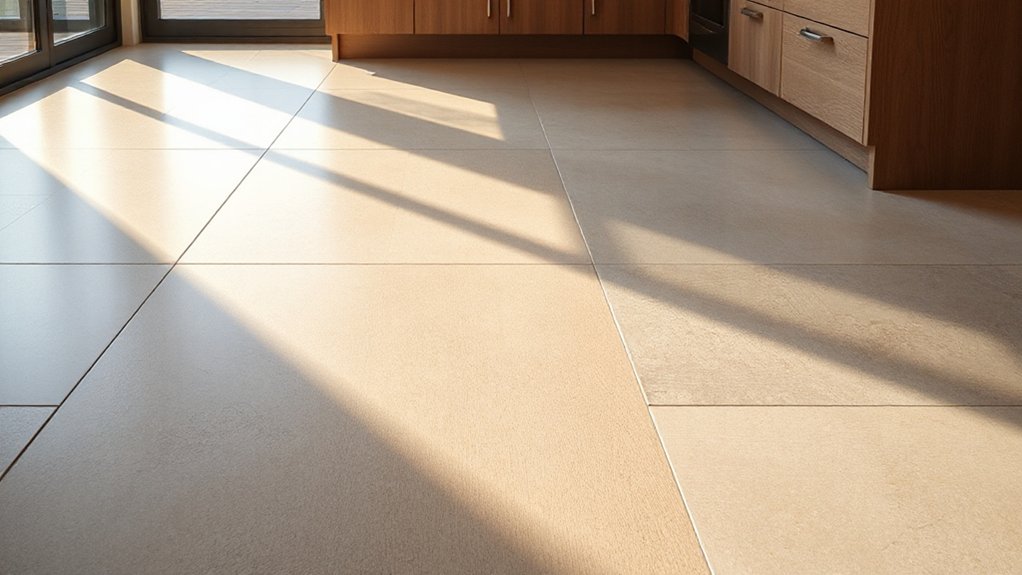
Porcelain tile stands out for waterproof longevity due to its low porosity and dense composition, making it an ideal choice for bathrooms, kitchens, and basements. You’ll gain a reliable, long-lasting surface with minimal water absorption, reducing staining and swelling. Focus on porcelain durability and a waterproof design that resists VOCs and chemical cleaners without compromising integrity.
- Tight grout lines minimize moisture intrusion
- Certified moisture resistance supports high-humidity areas
- Proper installation ensures constant, even waterproof performance
To maximize longevity, verify substrate preparation, use quality thinset, and seal only where recommended. Choose full-body or through-bodied porcelain for uniform wear. Regular cleaning with pH-neutral products preserves finish.
If you need durability guidance, consult a licensed installer for thickness, pareto-optimized formats, and compatible underlayment options.
Laminate vs Luxury Vinyl Tile: Cost, Wear, and Maintenance
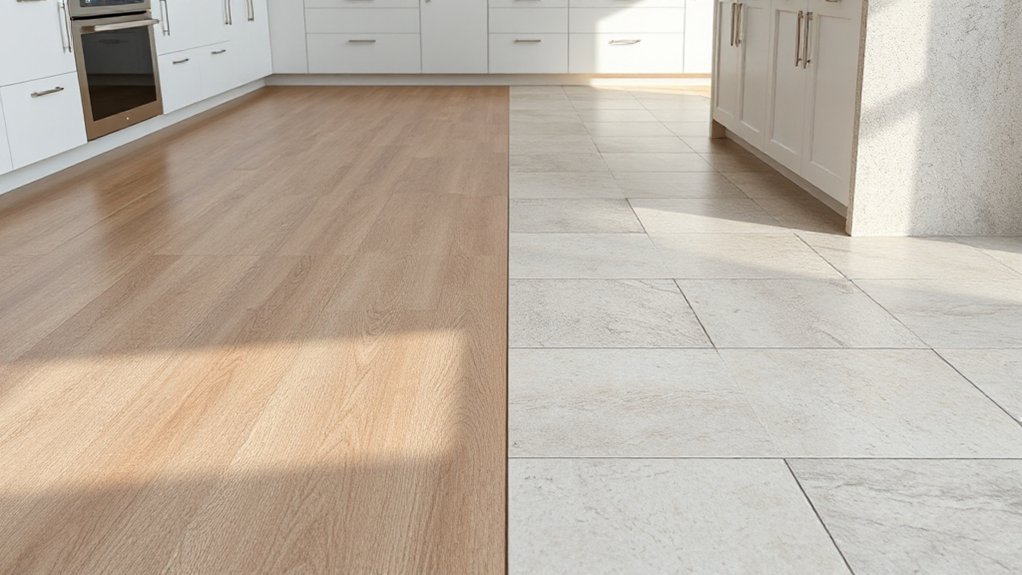
Laminate and luxury vinyl tile (LVT) offer distinct advantages in cost, wear, and maintenance, making the choice largely about performance needs and budget. You’ll compare total installed cost, long-term wear, and upkeep demands to decide what fits your kitchen.
Laminate typically carries lower initial costs and easier replacement, but moisture resistance varies; watch for seams and underlayment.
LVT usually offers superior water resistance, more forgiving installation, and broader design realism, which can affect ongoing maintenance and color retention.
For wear, consider wear-layer thickness and your traffic patterns; higher ratings translate to longer life.
Color coordination matters: choose tones that align with cabinet and countertop plans to avoid rapid visual updates.
Installation methods matter: floating planks vs glued-down sheets influence *transition* trims, substrate prep, and future renovations.
Solid Hardwood Vs Engineered Wood: Warmth With Practicality
Solid hardwood and engineered wood each bring distinct warmth to a kitchen, but they differ in structure, stability, and practicality. You’ll value longevity, maintenance, and cost when choosing between solid and engineered options, especially for color coordination and installation methods.
Engineered wood resists moisture better, while solid wood delivers authentic feel and potential refinishing. Your decision hinges on subfloor compatibility, room humidity, and traffic.
- Color coordination: match cabinet tones and lighting to preserve depth and uniformity
- Installation methods: click-lock vs Glue-down; floating layouts for stability
- Maintenance cadence: refinishing intervals, moisture control, and cleaning routines
In practice, engineered wood suits busy kitchens; solid wood excels in dry, controlled spaces. Consider room dynamics and future remodel plans to finalize your pick.
Stone and Ceramic Tile: Style, Toughness, and Care
Stone and ceramic tile offer enduring style plus exceptional durability, making them ideal for high-traffic kitchens and spill-prone zones. You assess tile options by material, finish, and grout quality, prioritizing non-slip surfaces in wet areas.
Natural textures help mimic stone or handmade ceramic looks while remaining easy to clean; choose honed, matte, or low-sheen finishes to reduce glare and show wear less.
Porcelain tiles deliver higher density and moisture resistance, suitable behind sinks and ranges, while ceramic offers broader pattern variety and cost efficiency.
Decor patterns—metro, herringbone, or basketweave—provide visual rhythm without sacrificing performance.
For care, seal porous stone and reseal as recommended; establish a routine of damp-mop cleaning and promptly address spills to prevent staining or glaze etching.
Choosing by Foot Traffic and Maintenance: A Quick, Decision-Path Guide
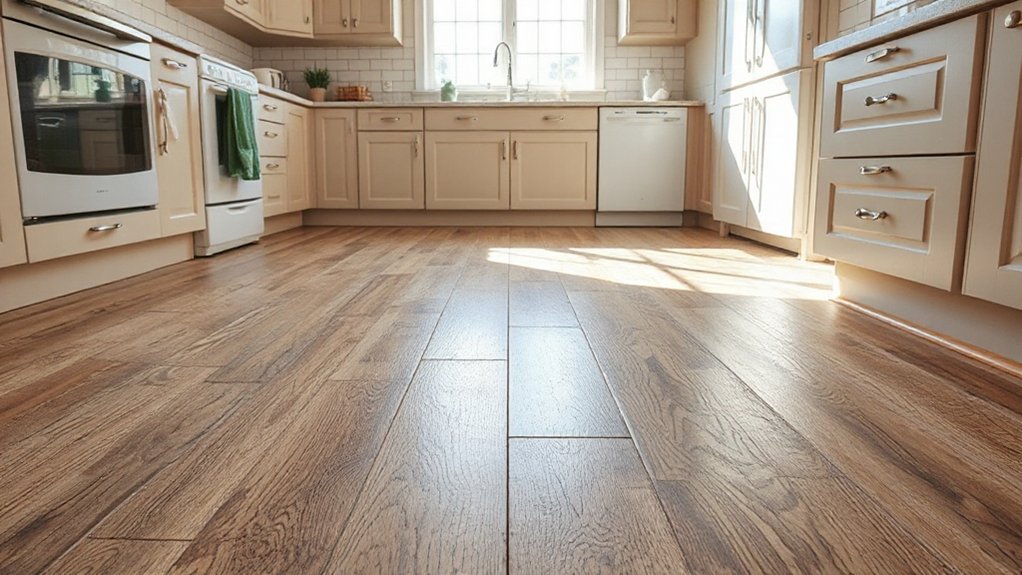
When choosing flooring for a kitchen, start by matching foot traffic and maintenance expectations to material performance. You’ll evaluate wear resistance, stain tolerance, and cleaning needs before committing to a finish, texture, or color scheme.
Color coordination matters for feel and flow, while installation techniques affect long-term durability and upkeep. Use a quick decision path to filter options by expected daily use, spill frequency, and cleaning ease, then confirm with a sample tray under typical lighting.
- Assess traffic pattern, then prioritize durability, slip resistance, and ease of cleaning
- Match color coordination to cabinet tones, countertop contrasts, and sheen for maintenance ease
- Verify installation techniques, underlayment, and expansion gaps to prevent future wear
Choose materials that balance performance with minimal, predictable upkeep.
Frequently Asked Questions
Which Flooring Holds up Best Under Frequent Spills and Humidity?
Engineered vinyl plank holds up best under frequent spills and humidity. It offers strong water resistance and superior stain resistance, plus durability against abrasion. You’ll appreciate its seamless seams and easy cleanup, which minimize water wicking and staining.
Avoid solid hardwood in damp kitchens; it warps. Ceramic tile is excellent too, but vinyl typically delivers easier maintenance and comfort.
For high humidity, prioritize products with a tight, waterproof core and certified water resistance ratings.
How Does Underlayment Impact Comfort and Insulation in Kitchens?
Underlayment matters more than you think: it cushions every step, dampens sound, and adds insulation. You’ll feel the warmth and quieter footsteps as you move across the kitchen floor.
This underlayment importance translates to steadier footing on spills and humidity, while reducing heat loss and cold drafts.
You gain insulation benefits by minimizing thermal transfer, improving comfort, and lowering energy use.
Pick a product with dense, moisture-resistant layers to maximize performance.
Are There Eco-Friendly Kitchen Flooring Options With Long Durability?
Yes. You can choose eco-friendly kitchen flooring with long durability. Eco friendly materials like bamboo, reclaimed wood, cork, recycled-content tiles, and linoleum offer strong wear life when properly installed.
Sustainable options include certified low-VOC products and durable finishes. For longevity, select dense composites and warranties, maintain with recommended care, and guarantee moisture barriers where needed.
You’ll balance sustainability with performance by evaluating lifecycle data, impact on indoor air quality, and installation suitability for your space.
Can I Refinish Vinyl Plank or Laminate if Damaged?
Yes, you can refinish laminate and repair vinyl, but with limits.
For Vinyl repairs, replace damaged planks or patches; vinyl rarely refinishes like wood.
For Laminate refinishing, you generally can’t sand and refinish; you must replace the damaged plank or board.
Use color-matched patches, seam fillers, and proper underlayment inspection.
Confirm moisture barriers and warranty terms are respected.
Consider professional assessment for large damage to avoid ghosting or cupping.
What Maintenance Routine Keeps Natural Stone Looking New?
Maintain natural stone with a strict routine: dust mats, wipe spills promptly, and use pH-neutral cleaners. About 90% of surface damage comes from improper cleaning, so stick to a consistent cleaning schedule.
After monthly, seal with a compatible penetrating sealer; re-seal every 1–3 years based on wear. Cleaning schedules and sealing techniques matter for longevity.
You’ll protect sheen, reduce etching, and keep grout joints sealed. Use a microfiber mop and avoid acidic or abrasive products.
Conclusion
You want durability, moisture resistance, and easy upkeep. You want comfort underfoot, cohesive style, and lasting value. You want a kitchen that performs, resists spills, cleans quickly, and endures heavy traffic. You want choices that fit your budget, your lifestyle, and your space. You want confidence in your selection, clarity in comparison, and guidance from a trusted source. You want results you can measure in years, not moments. You want the right flooring—today, tomorrow, for every kitchen you inhabit.