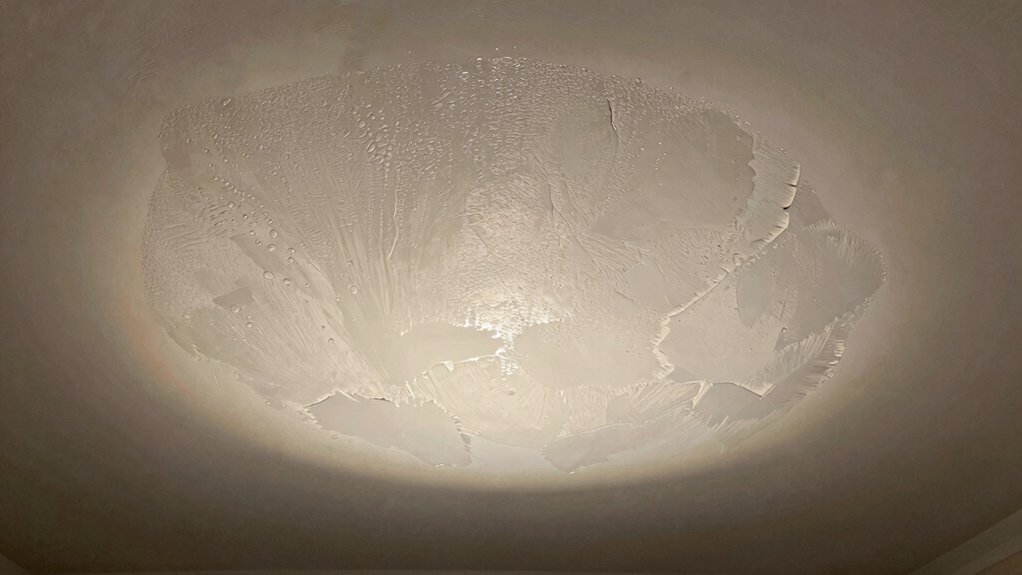
Ceiling condensation happens when your warm, moist indoor air meets a cold ceiling surface, causing humidity to cool into droplets. You’ll see this more with cooks, showers, and laundry indoors, especially if you lack ventilation or have gaps that let outdoor air in. Temperature gaps between indoors and the attic or roof, plus insufficient insulation, worsen the effect. Tackle sealing, insulation, and airflow carefully, and you’ll likely notice but the real test isn’t far off.
Humidity Sources in Living Spaces
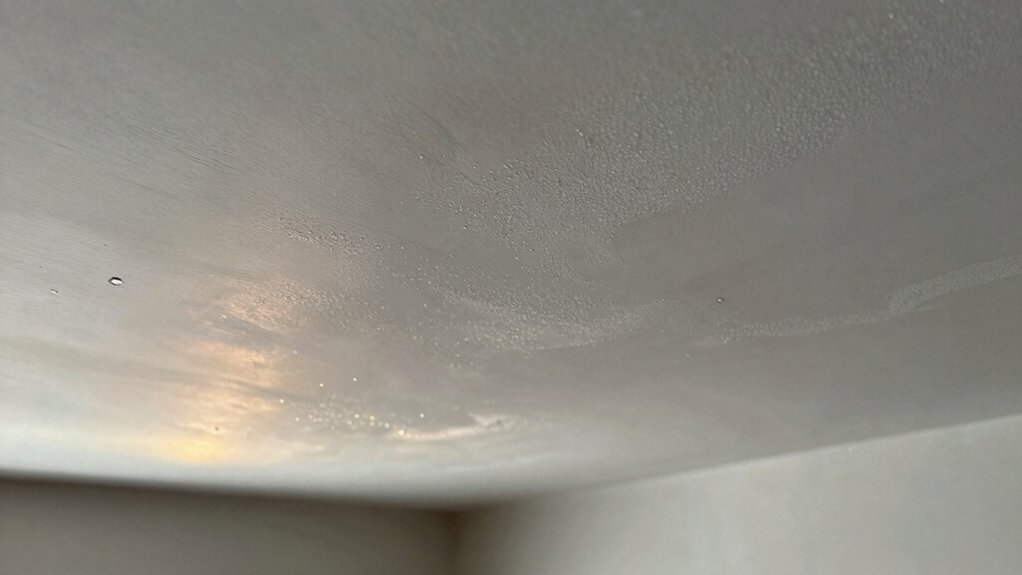
Humidity sources in living spaces come from both occupants and the environment. You measure contributions by tracking moisture-producing activities and surroundings. Occupant-related sources include cooking steam, boiling water, showers, and laundry drying indoors, all releasing water vapor into air. Breathing also adds moisture continuously, though modestly. You’ll notice higher humidity when several people are present or when doors remain closed to control airflow.
Environmentally, exterior weather leaks bring humidity indoors through imperfect seals, windows, and vents. Indoor plants add small amounts of moisture via transpiration, while humidifiers deliberately increase RH for comfort or preservation. Damp basements, poorly ventilated bathrooms, and recent renovations can elevate baseline moisture without obvious activity.
To assess risk, quantify indoor RH over time and compare against recommended ranges, identifying dominant sources for targeted mitigation.
How Temperature Differences Promote Condensation
You’ll see condensation form when there’s a Temperature Gap between warm room air and a cold ceiling.
Warmer air holds more moisture, and as it contacts the chilly ceiling, the excess moisture can condense.
This interaction—Warmer Air meeting a Cold Ceiling—drives the initial onset and helps explain how temperature differences promote condensation.
Temperature Gap Effects
When the air inside a space is warmer than the surface it contacts, a temperature gap forms that drives condensation. You observe that warmer air transfers sensible heat to the cooler surface, while moisture in the air remains.
The gap lowers the surface temperature, increasing relative humidity at the interface and promoting phase change. You quantify this with surface dew point and ambient conditions, noting that the larger the difference, the quicker the surface cools and the higher the condensation rate.
Air movement, insulation, and surface emissivity influence the gap’s persistence. You track how transient spikes in indoor temperature or outdoor cold snaps extend the period of condensation risk.
Warmer Air, Cold Ceiling
A warmer interior air column meeting a cold ceiling creates a similar condensation risk to a cold surface, but with a different thermal driver. You observe that warm air carries more water vapor and rises until it contacts the cold ceiling.
The surface temperature drop causes the vapor to reach its dew point on contact, forming droplets. Unlike a cold surface, the driving force here is a vertical temperature gradient and controlled air exchange, not static coolness alone.
You measure that humidity, airflow, and insulation quality determine where condensation concentrates. When the ceiling remains below the dew point, droplets form, coalesce, and may drip.
Mitigation relies on reducing interior humidity, enhancing ceiling temperature equality, and improving air circulation to disrupt localized vapor accumulation. Precise control yields predictable, repeatable outcomes.
The Role of Ventilation and Airflow
Ventilation basics set the stage for moisture balance, so you’ll assess how air exchange reduces stagnant humidity that promotes condensation.
We’ll examine airflow patterns to show how moving air from warm to cooler zones minimizes dew point risks and where cross-ventilation or mechanical systems matter most.
Finally, you’ll compare moisture control strategies—including exhaust placement, filtration, and humidity targets—to identify practical steps for preventing ceiling condensation.
Ventilation Basics
Ventilation is essential for controlling moisture, odors, and indoor pollutants by moving stale air out and bringing in fresh air. You’ll measure how air exchange reduces humidity buildup, and you’ll document the basic mechanisms: dilution, removal, and conditioned supply.
In practical terms, you assess exchanger performance with simple metrics like air changes per hour and relative humidity changes after operational adjustments. You’ll note that effective ventilation requires proper intake and exhaust placement, minimizing short-circuiting, and avoiding dead zones where moisture stagnates.
You’ll distinguish between mechanical systems and natural ones, explaining that reliability and control improve when fans, dampers, and seals are well maintained. Finally, you’ll specify baseline targets for residential spaces to inform condensation risk assessments.
Airflow Patterns
Airflow patterns shape how ventilation impacts moisture, temperature, and contaminants across a space. You assess how air moves from sources to surfaces, noting that supply and exhaust locations create directed currents, not random swirls.
In practice, you identify high and low pressure zones, then trace streamlines to ceilings, walls, and corners where condensation tends to form. You recognize that layer interfaces—cold surfaces versus warmer interiors—drive dew points, so you map heat sources, occupancy shifts, and appliance use to predict patterns.
You measure velocity and direction at intervals, avoiding assumptions, and compare readings to expected drafts. You document disruptions—closed doors, furniture, or blocked vents—and adjust to maintain uniform exchange, reducing stagnation without introducing excessive flow that could force moisture elsewhere.
Moisture Control Strategies
Moisture control hinges on how ventilation and airflow are managed to limit condensation opportunities. You determine how air moves, where it stagnates, and how humidity shifts with activity.
Effective strategies begin with calculating target air exchange rates for each space, then selecting appropriate ventilation methods. Mechanical systems should provide continuous, controllable flow, balanced to prevent drafts while removing moist air efficiently.
In kitchens and bathrooms, use exhaust fans that vent outdoors, paired with makeup air to avoid pressure imbalances. In living spaces, promote cross-ventilation when conditions permit, and avoid blockages that impede air movement.
Insulation and sealing reduce temperature differentials that foster condensation, complementing airflow controls. Regular maintenance ensures fans, ducts, and seals perform as designed, sustaining reliable moisture management.
Impact of Insulation and Building Envelope
Insulation and the building envelope play a decisive role in when and how ceiling condensation forms. You assess thermal resistance, exterior and interior thermal bridges, and air leakage paths to predict moisture behavior.
You’ll find that insufficient insulation allows warm indoor air to meet cold ceiling surfaces, increasing dew point proximity and condensate formation. Conversely, well‑selected insulation reduces temperature gradients, limiting condensation potential.
The building envelope controls moisture ingress and drying potential; effective vapor barriers and airtight assemblies minimize inward moisture diffusion while permitting controlled drying to the interior or exterior as appropriate.
You measure sealing quality, insulation continuity, and surface temperatures to gauge risk, then compare to design specifications and field conditions. Accurate assessment relies on empirical data, repeatable measurements, and conservative safety margins.
Seasonal and Roof-Related Factors
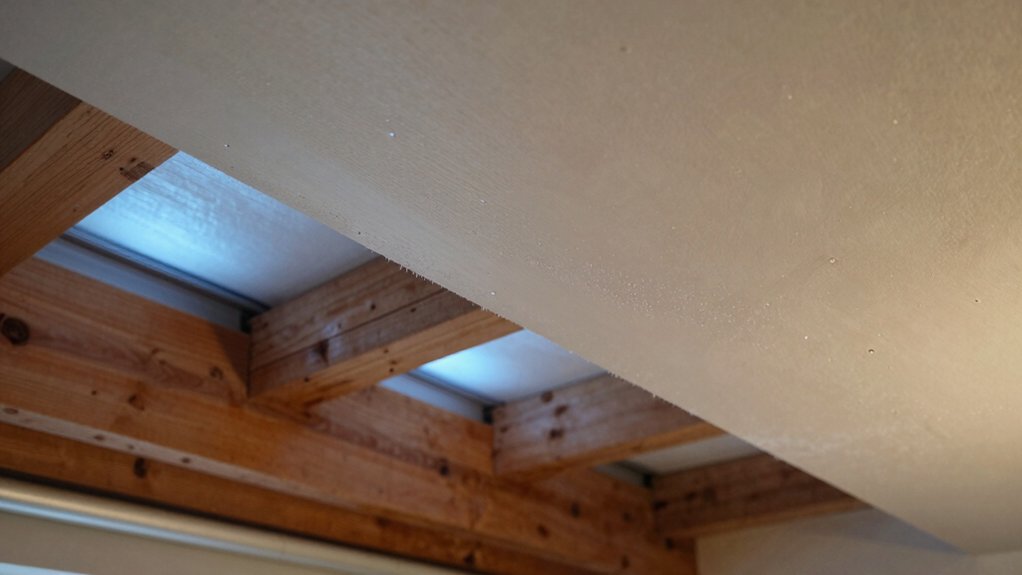
Seasonal shifts and roof conditions directly influence ceiling condensation by altering temperatures, moisture loads, and drying pathways. You’ll notice colder exterior temperatures in winter intensify interior dew points when warm indoor air contacts cool surfaces, increasing condensation risk on ceilings beneath uninsulated or poorly vented roofs.
In spring and fall, fluctuating humidity from outdoor air can raise moisture transfer through roofing assemblies, elevating interior humidity near ceiling lines.
Snow, ice dams, and saturated roof materials, common after storms, raise attic moisture that can migrate inward if attic ventilation is inadequate.
Roof design also matters: ventilation gaps, vent placement, and soffit-to-ridge airflow patterns determine drying efficiency.
You should assess seasonal weather patterns alongside roof condition to anticipate condensation-prone periods and target mitigations effectively.
Signs of Ceiling Condensation to Watch For
You’ll notice several telltale indicators when ceiling condensation is developing. First, inspect the ceiling surface for damp patches or darkened stains that appear without obvious water leaks. Next, check for persistent, cool air drafts near upper walls, which often accompany moisture buildup. You may observe a faint, musty odor that intensifies with time, signaling standing moisture.
Look for small droplets or a visible foggy sheen on painted or plastered areas, especially in high-humidity rooms. Pay attention to peeling paint, bubbling, or softening drywall in localized spots, as these symptoms point to moisture intrusion. Track humidity levels; readings above 60 percent commonly correlate with condensation zones.
Finally, note any visible mold growth in corners or around fixtures, a logical consequence of prolonged moisture exposure.
Practical Prevention and Mitigation Strategies
To prevent ceiling condensation, start by controlling indoor humidity and improving air exchange. Maintain relative humidity between 30% and 50% through dehumidification or ventilation, especially after cooking or showering. Use exhaust fans at source and run them for 15–30 minutes post-activity.
Improve airflow by removing barriers, opening doors, and using ceiling or oscillating fans to promote vertical and horizontal mixing.
Insulate cold ceilings or attics where condensation forms, ensuring vapor barriers on warm-side surfaces.
Seal obvious building leaks and ensure HVAC systems balance supply and return air.
Treat moisture sources: fix leaks, insulate plumbing, and heat colder spaces to reduce dew point proximity.
Monitor humidity with a hygrometer, adjusting strategies as conditions change empirically. Reassess monthly to maintain stable results.
Conclusion
You’ll see ceiling condensation when humidity meets a cold surface, especially with poor insulation or ventilation. In practice, you’ll note moisture from showers, cooking, and laundry raising indoor humidity, while rooftop or attic temperature differences drive droplets to ceilings. A methodical case: a well-sealed kitchen reduced humidity by 15%, cutting condensation occurrences. By improving insulation and adding vents, you’ll minimize moisture buildup, protect ceilings, and create a drier, healthier living environment.