
Infrared heaters deliver rapid, targeted warmth with minimal air movement, while convection units heat the air to create uniform room warmth. Infrared provides quick surface temperature gains and zone-specific comfort, but depends on emissivity and exposure; convection offers steadier, whole-room temperature with potential fan noise. Both have distinct efficiency profiles: infrared often lowers standby losses, convection emphasizes airflow design and distribution. Initial costs differ, but long-term energy use aligns with usage and electricity source. If you continue, you’ll uncover practical selection guidance and trade-offs.
Which Heater Should You Choose: Quick Criteria for Infrared Vs Convection
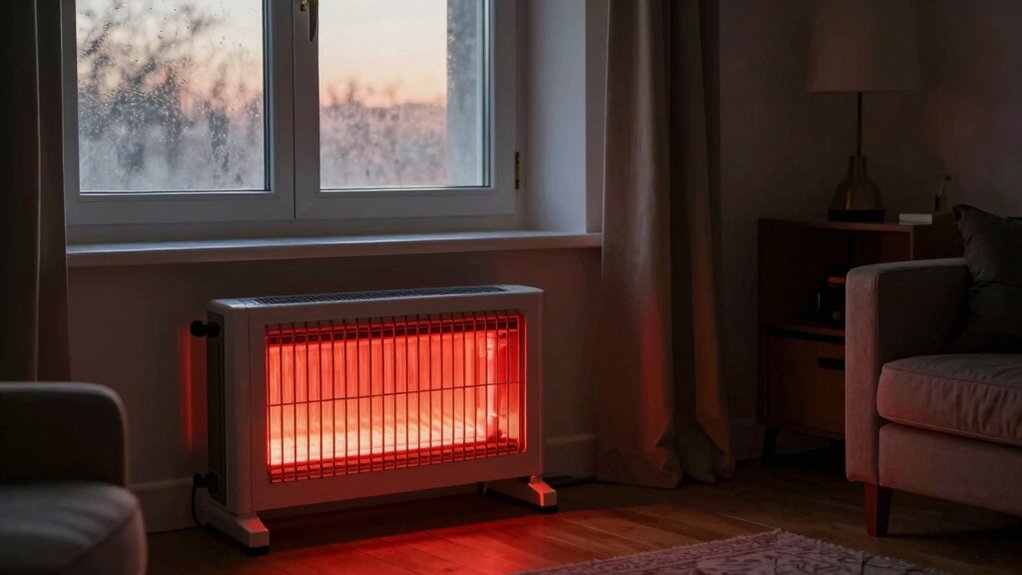
Infrared and convection heaters differ in how they deliver warmth, so your choice should hinge on the space and usage pattern.
In small, occupied areas with irregular schedules, infrared units deliver instantaneous warmth at the point of contact, reducing standby losses and improving perceived comfort.
Convection models excel in larger, open environments with uniform heat distribution, supporting steady temperature maintenance through air circulation.
For energy efficiency, compare wattage-to-heat output, not just input power; infrared often provides higher surface warmth per watt, while convection promotes whole-room comfort with lower surface temperatures.
Noise, installation, and safety ratings matter: select sealed or sealed-with-fan variants to minimize dust dispersion, and verify tip-over and overheat protections.
Finally, align your choice with typical occupancy duration, budget, and desired temperature consistency.
How Infrared and Convection Heating Actually Work
When you compare infrared and convection heating, the core distinction lies in how energy is transferred and distributed in space. Infrared heating emits radiant energy that directly warms objects, people, and surfaces without first heating the surrounding air. Its efficiency hinges on emissivity, wavelength, and target exposure, yielding rapid surface heating with reduced air movement.
Convection heating relies on air as the primary medium; a heater warms the circulating air, which then transfers heat to objects via conduction and radiation from surfaces. System design factors include heater placement, output control, and ducting or fan characteristics.
Efficiency metrics to examine are net radiant fraction, sensible heat delivered to occupied zones, and heat loss through ventilation. Both modalities aim for uniform indoor warmth while managing thermal stratification and standby losses.
Real-World Performance: Warmth, Speed, Air Quality, and Comfort
Real-world performance hinges on how quickly each system delivers usable warmth, how promptly occupants perceive comfort, and how air quality remains within acceptable thresholds. Infrared units typically raise surface temperatures rapidly, delivering perceptible warmth to occupants and objects without heating all air; this can create a steady zoning feel in occupied zones, especially near the source.
Convection heaters circulate air to achieve uniform room heating, often producing faster perceived warmth when air mixing distributes heat from a central source. Air quality effects hinge on filtration, particulates, and humidity; infrared systems generally have minimal air disruption, while convection units may alter humidity slightly through air movement.
Comfort aligns with temperature stability, response time, and absence of drafts, favoring well-calibrated controls and proper sizing. Both systems require accurate room assessment for consistent, measurable comfort.
Energy Efficiency, Cost of Ownership, and Environmental Impact
Energy efficiency, ownership costs, and environmental impact hinge on how each system converts energy to usable heat, the upfront and ongoing expenses, and the broader ecological footprint.
You evaluate infrared heaters by radiant efficiency and low standby losses; their performance hinges on target surface temperatures and room occupancy.
Convection units rely on circulating air, with efficiency tied to fan power, heat exchanger design, and distribution uniformity.
In ownership terms, initial cost, maintenance, and lifespan vary: infrared often costs more upfront but may reduce heat loss in unoccupied spaces, while convection tends toward lower upfront prices and predictable replacement cycles.
Environmental impact considers energy source, grid emissions, and embodied material effects.
Data show comparable annualized energy use in similar spaces, with emissions dominated by electricity mix and usage patterns rather than heater type alone.
Use-Case Guides: Selecting by Space, Budget, and Safety Considerations
Selecting the right heater depends on space, budget, and safety requirements, so use-case guides should map each option to scenario specifics. You evaluate room volume, occupancy patterns, and insulation to determine heating load and required duration.
Infrared units excel in spot heating for occupied zones with minimal air movement, making them cost-efficient in small to medium spaces with high transverse heat needs.
Convection models deliver uniform ambient warmth, suitable for enclosed rooms with steady, long-duration use and lower local heat intensity.
Budget considerations include installation costs, energy rates, and maintenance intervals; compact infrared options often reduce upfront expenditure, while whole-room convection systems may incur higher initial outlays but lower operational costs over time.
Safety factors encompass surface temperatures, tip-over protection, and child/pet access controls for all configurations.
Frequently Asked Questions
Do Infrared and Convection Heaters Pose Different Fire Risks?
Yes, infrared and convection heaters pose different fire risks: infrared units run hot on surfaces, potentially igniting nearby materials, while convection heaters risk overheating internal components if airflow is blocked; both require clearance, proper use, and regular maintenance.
How Do Noise Levels Compare Between Heater Types?
You’ll notice similar noise levels overall, with radiant infrared units typically near 20–40 dB idle and up to 50–60 dB when fans run, while convection models hover around 20–40 dB, depending on fan speed and design.
Can These Heaters Be Safely Used Outdoors?
Yes, you can use these outdoors, but only with weatherproof, outdoor-rated units. Make certain of proper mounting, wind protection, and GFCI power, and follow manufacturer guidelines; infrared units resist wind better, while convection requires enclosure and ventilation. Use caution.
What Maintenance Schedules Maximize Lifespan?
You should perform quarterly inspections, monthly dusting, and annual professional servicing to maximize lifespan. Replace worn components promptly, maintain clean electrical connections, monitor thermostat accuracy, and document all maintenance actions for traceability and predictive reliability.
Are There Health Considerations With Radiant Heat Exposure?
Yes, radiant heat can affect you; skin and eyes may experience irritation or burns at close range, and prolonged exposure risks thermal discomfort. Follow manufacturer guidance, keep safe distances, monitor ambient temperatures, and use appropriate protective measures.
Conclusion
In short, infrared and convection heaters each excel in different scenarios. Infrared delivers rapid, targeted warmth to objects and people, reducing air movement and perceived draft. Convection heats air evenly, improving ambient comfort in enclosed spaces with steady, uniform temperatures. Efficiency depends on insulation, space, and usage patterns. Choose infrared for spot heating and energy focus; choose convection for whole-room comfort and ongoing comfort. Consider upfront cost, operating expense, and safety features. Prioritize your space, budget, and thermal goals.