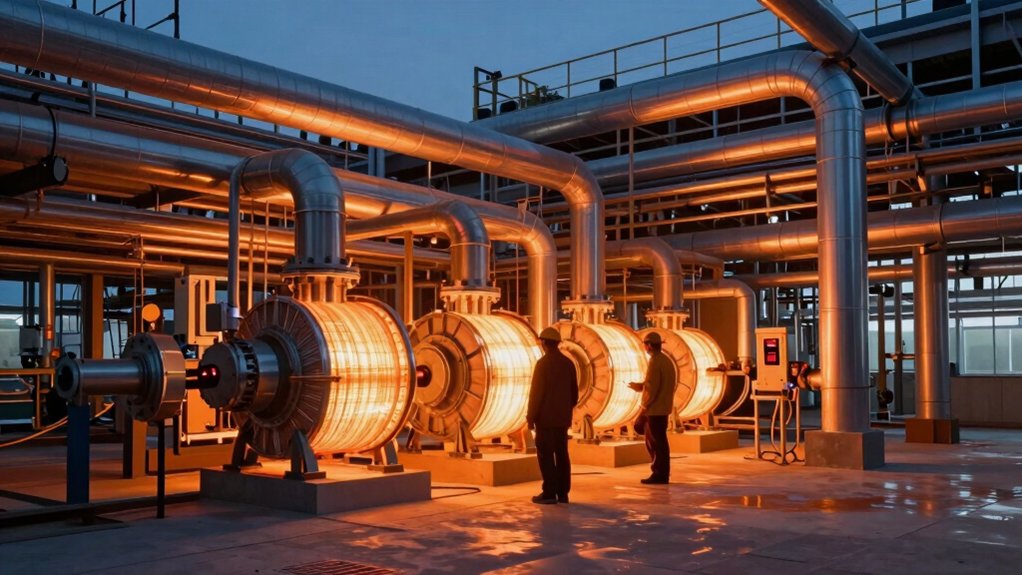
Infrared heating cuts carbon by delivering heat directly to people and objects, reducing wasted energy in spaces. You minimize standby losses through targeted heat delivery that follows occupancy and load profiles, so heat isn’t wasted in empty zones. Electrification becomes greener when paired with demand-responsive controls, storage, and grid-friendly devices. Industrial efficiency rises as you map energy flows and fix small losses, while longer equipment life cuts material waste. If you keep exploring, you’ll see how these ideas connect across sectors.
How Infrared Heating Cuts Energy Waste in Real Spaces
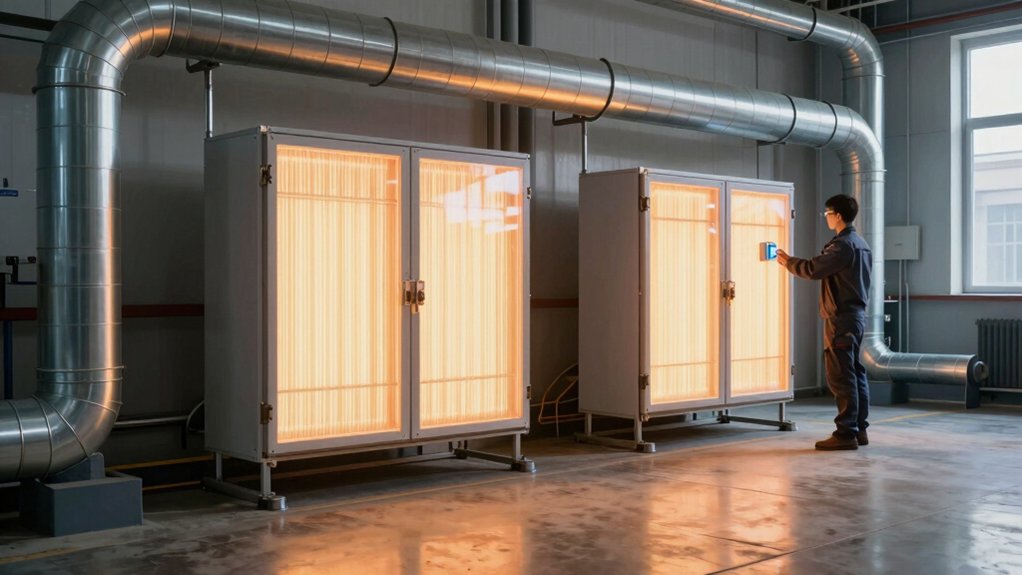
Infrared heating minimizes energy waste by warming objects and people directly rather than heating the surrounding air.
You assess spaces by occupancy patterns, surface temperatures, and reflective losses, enabling selective heating where it yields the greatest return.
In practice, infrared systems reduce air stratification and heat dispersion, so you experience comfort without overconditioning entire rooms.
You compare baseline electric or fossil-fueled systems, gathering data on supply temperature, setpoints, and switching cycles.
The result is lower overall energy use per occupied hour, especially in intermittently occupied or draft-prone zones.
You also factor in building envelope quality, since high-insulation margins amplify gains from targeted radiant delivery.
Policy-wise, you’d favor standards rewarding verified, occupancy-responsive heat delivery and metrics that quantify avoided heating of unoccupied volumes.
Lowering Standby Losses With Targeted Heat Delivery
Although standby losses are small per unit area, they accumulate quickly across occupied hours and facilities, making targeted heat delivery essential for minimizing wasted energy. You can reduce idle heat by aligning infrared emitters with real-time occupancy and load profiles, ensuring heat appears where and when needed.
Data-driven controls enable rapid response to demand shifts, cutting unnecessary warmth in unoccupied zones and preventing gradual thermal drift that wastes energy. In practice, thermally stratified spaces benefit from zoned infrared arrays and smart scheduling, which lower baseline heat while preserving comfort.
Policy relevance emerges as utility and building codes favor efficiency metrics tied to demand-responsive operations. The result is measurable emissions reductions, improved energy performance guarantees, and clearer accountability for energy use across complex facilities.
Enabling Greener Electrification for Heating Systems
Effective electrification of heating hinges on aligning grid-enabled technologies with building-level energy demand, system reliability, and policy incentives. You assess how demand-responsive heat pumps, thermal storage, and grid-integrated controls shape peak demand, ensuring grid stability while lowering emissions.
You evaluate data showing load diversification, reduced carbon intensity from cleaner grids, and the value of modular deployment across sectors. You emphasize governance and transparent performance metrics, including reliability, maintenance costs, and customer bills.
You analyze policy levers—time-varying tariffs, incentives for heat pump adoption, and building codes—that drive uptake without compromising comfort. You underscore interoperability standards, data sharing, and cybersecurity as prerequisites for scalable, verifiable, greener electrification.
You conclude that evidence-based planning is essential to align incentives with measurable emission reductions.
Boosting Industrial Efficiency to Reduce Emissions
Industrial efficiency is the primary lever for cutting emissions in energy-intensive sectors, and its impact hinges on targeted, data-driven improvements across processes, equipment, and energy procurement.
You assess process heat use, map energy flows, and quantify losses with transparent metrics. Small gains in furnaces, kilns, or reactors compound across scales, delivering outsized emissions reductions.
You implement real-time monitoring, predictive maintenance, and operator training to minimize downtime and waste heat, while aligning procurement with low-carbon energy tariffs.
Policy relevance comes from documenting baselines, setting credible targets, and reporting progress in standardized formats.
You emphasize cross-cutting efficiency measures—heat-recovery, load matching, and energy-efficient controls—that are compatible with existing infra and scalable.
The result: cleaner throughput without compromising output or safety.
Extending Equipment Life to Minimize Material Waste
Extending equipment life reduces material waste by lowering replacement demand and trimming scrap generation, while preserving process integrity and throughput. You can quantify gains by tracking failure rates, mean time between failures, and maintenance intervals, then align them with material usage data and scrap logs.
By prioritizing predictive maintenance, you minimize unplanned downtime and reduce overhauls that create wasteful rework. You should adopt design-for-durability principles, selecting components with higher reliability, and implement operating envelopes that avoid thermal shocks and excessive loading.
Data-driven policies can reward teams for achieving uptime targets without escalating consumption. You must guarantee proper calibration, clean interfaces, and documented procedures to sustain performance.
Frequently Asked Questions
How Does Infrared Heating Affect Indoor Air Quality Compared to Traditional Systems?
Infrared heating can improve indoor air quality by reducing convective dust distribution and limiting humidity swings, compared with traditional systems; you’ll experience steadier comfort, lower particulate resuspension, and fewer HVAC-driven air contaminants, though input/output air exchange remains important.
Can Infrared Heat Improve Occupant Comfort in Irregularly Shaped Spaces?
Infrared heat can boost comfort in irregular spaces by delivering targeted warmth where you need it. Think of it as a tailored suit: precise, efficient, and data-driven, optimizing thermal stratification and reducing cold spots while supporting occupant comfort policy goals.
Are There Safety Concerns With Infrared Heating at High Intensities?
Yes, there are safety concerns with high-intensity infrared heating, including skin and eye injury risks, overheating, and material hazards. You should enforce exposure limits, install shielding, implement interlocks, and monitor temperatures with data-driven, policy-aligned protocols.
What Are the Lifecycle Costs of Infrared Panels vs. Conventional Heaters?
Infrared panels often lower lifetime costs than conventional heaters, thanks to lower operating energy and longer lifespans; you may save up to 30% over 15 years, with payback in about 5–8 years given typical usage.
How Scalable Are Infrared Solutions for Multi-Zone, Large Facilities?
Infrared solutions scale well for multi-zone facilities, offering modular deployment and rapid ROI. You can segment zones, adapt to loads, and maintain efficiency with centralized controls, though upfront planning, insulation quality, and maintenance discipline determine long-run performance and reliability.
Conclusion
You’ll see that infrared heating isn’t just a change in tech—it’s a policy-relevant shift in how energy is delivered. You’ll find the data supports lower energy waste, quicker responsiveness, and longer equipment life, which torques decisions toward smarter electrification and decarbonization. You’ll test the theory that targeted heat delivery reduces standby losses and boosts system-wide efficiency. If you measure the right metrics, the rhythm of evidence makes the case for infrared both compelling and actionable.