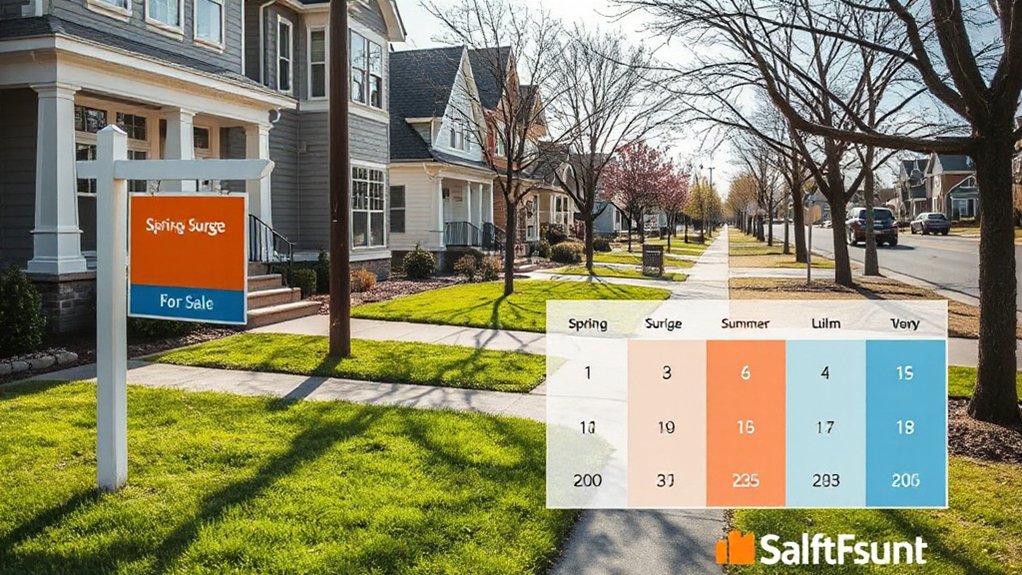
Seasonal trends drive real estate like tides: you’ll see spring demand surge and higher prices as buyers rush in, then summer listings rise while price momentum cools and inventory grows. Autumn brings stabilization, while winter slows and bargaining power shifts to motivated buyers. Timing, contingencies, and offers shift with each cycle, so pricing, staging, and showings should align with peak windows. If you want to anticipate moves and optimize terms, you’ll uncover more as you continue.
Why Seasonal Trends Move Real Estate Markets

Seasonal trends move real estate markets because buyers and sellers operate on concrete calendars, not just long-term forecasts. You observe cycles where demand peaks when school years reset, job starts occur, and holidays shorten or extend attention.
Data show price momentum aligns with these windows, then eases as inventories rise. You’ll see volume surge as lenders favor end-of-quarter closings and families lock in rates before anniversaries of leases.
Market psychology shifts with momentum, creating self-reinforcing pushes or pullbacks that repeat annually. Seasonal marketing channels amplify these effects, guiding messaging to align with buyer temperaments and seller readiness at each stage.
What Drives Spring Buying Demand and Price Levels
Spring buying demand accelerates as households align purchases with tax refunds, school calendars, and favorable mortgage terms. You’ll notice higher bidding activity in the first quarter post-winter lull, then a taper as listings stabilize before spring’s peak.
Data show price levels rise on tighter inventory and stronger buyer intent, with valuations tracking mortgage rate expectations and seasonal affordability shifts. Garden landscaping adds perceived value, signaling low-maintenance, curb appeal, and enhanced outdoor living—drivers buyers repeatedly factor into offers.
Home staging further compresses time-on-market, lifting perceived condition and usable space, which correlates with higher comp prices in neighborhoods with robust demand.
Predictable seasonal cycles imply continued price resilience when supply remains constrained and buyer confidence improves after favorable economic signals. Finite inventory plus renewed optimism sustains spring’s price trajectory.
Summer Listings: Opportunities for Sellers and Investors
As spring momentum winds down, summer listings begin shaping new opportunities for sellers and investors alike. You’ll notice volume rises in early summer, yet price momentum often softens, creating tempered competition.
Data shows higher inventory in opportunity zones during peak season, offering motivated buyers clearer paths to closing and smoother cycle-to-cycle shifts. You gain precision by aligning marketing with school calendar dispatches and project timelines, capturing families and yield-focused investors who prefer longer closing windows.
Seasonal demand shifts favor properties with efficient update cycles, staged interiors, and favorable cap rates in central neighborhoods. Look for price stabilization mid-season, followed by selective upticks as activity resumes late June into July.
Plan with a conservative forecast, but stay ready to capitalize on momentum as incentives crest.
Autumn Activity: Stabilization and Back-to-School Shifts

Autumn activity typically brings stabilization after the summer surge, as buyers recalibrate budgets and sellers adjust pricing strategies to reflect mid–year demand. You’ll notice fewer dramatic price swings and a steadier listing-to-sale ratio as cycle momentum shifts from peak summer enthusiasm toward a more measured pace.
Data show inventory inches upward, yet days-on-market compress modestly when motivated buyers reallocate budgets for school-year needs. In this phase, affordability improves for certain demographics, while lenders tighten criteria selectively, tempering rapid bidding.
Back-to-school shifts concentrate cash flow toward practical housing needs, prompting modest, price-anchored offers rather than overzealous bids. If you monitor regional absorption rates and price-per-square-foot trends, you’ll forecast stabilization windows and align strategies with prevailing seasonal momentum.
Autumn activity signals a prudent recalibration, not a market reversal.
Winter Slowdowns: Bargaining Power for Motivated Buyers
Winter slows bring a reset to the market, and the numbers back it up: demand cools, days on market extend, and buyers with strong motivation gain leverage.
You’ll notice prices plateau or edge lower as inventory remains modest but buyers react decisively when facing fewer competing offers. In cycles, this lull tightens negotiation windows for motivated buyers, who can leverage time to secure concessions on price, terms, or contingencies.
Data shows fewer buyers prowling listings, increased seller readiness to entertain offers, and quicker close timelines when buyers present strong, well-financed positions.
Expect seasonally driven volatility to favor well-prepared bidders who prioritize value and certainty. Winter bargains emerge where buyers align urgency with precise financing, inspections, and clear exit strategies, sustaining momentum into the next growth phase.
The Seasonal Calendar for Real Estate: Months by Region
Regional Seasonal Variations shape when demand peaks or slows, so you’ll see consistent year-to-year patterns by latitude and climate.
Our look at Yearly Market Rhythms reveals how timing shifts with holidays, school calendars, and weather, forecasting windows for buyers and sellers.
Start with Regional Calendar Milestones to map the pros and cons for action in your area.
Regional Seasonal Variations
Seasonal patterns vary by region, shaping buyer demand, listing velocity, and price momentum as the year unfolds. In this subsection, you’ll see how regional clocks produce distinct cycles: some markets heat up in spring with renewed inventory, others slow in winter as weather and holidays compress activity.
You’ll observe fluctuations in local sale-to-listing ratios and days-on-market that align with regional calendars, not a national lull. Data shows that Local market trends diverge by climate zones, school calendars, and regional employment cycles, creating divergent price trajectories across areas.
Weather impact remains a key variable, moderating buyer confidence and move-out timing. By triangulating monthly sales, inventory, and price data, you’ll forecast near-term shifts and calibrate expectations for region-specific demand.
Yearly Market Rhythms
The yearly market rhythm maps how demand and supply ebb and flow across months in each region, not as a single nationwide lull but as region-specific cycles guided by weather, school calendars, and local employment rhythms.
You’ll see patterns emerge: steadier pricing when families anchor moves in spring, quicker listings in late summer, and slower activity during winter holidays. Track these cadence shifts to forecast days on market, price adjustments, and inventory changes.
Use data cues like regional sales velocity, mortgage approval rates, and construction starts to anticipate turns. Property aesthetics and neighborhood amenities often influence timing, nudging buyers toward upgrades or relocations at peak windows.
Consider these steps:
1) Monitor monthly demand versus supply indicators
2) Align showings with school calendars
3) Correlate upgrades to seasonal buyer enthusiasm
Regional Calendar Milestones
Across the year, regional calendars reveal how months map to distinct demand surges and slowdowns, shaped by weather, school calendars, and local economic rhythms. You’ll notice recurring patterns: spring rushes in growth corridors, summer cooling in coastal markets, autumn rebalancing as listings rise before holidays, and winter consolidation in slower climates.
Regional milestones align with school transitions, budget cycles, and urban development timelines, creating predictable windows for buyers and sellers. Track milestones by region to anticipate price momentum, inventory shifts, and financing activity.
You’ll see market diversification accelerate when cities pursue mixed-use projects and transit–oriented development, broadening buyer pools. This cyclical lens helps you forecast demand corridors, calibrate pricing, and time marketing to regional urban development initiatives and diversification strategies.
Climate and Local Geography Shape Market Cycles

1) Climate-driven demand spikes in peak seasons, followed by moderation as inventories adjust.
2) Geographic factors determine liquidity, travel cost, and migration flows that preprice neighborhoods.
3) Market resilience hinges on infrastructure exposure, seasonal recovery timelines, and long-run amenity value.
These indicators inform proactive positioning and risk-aware pricing strategies.
School Calendars and Family Move Windows
School calendars shape when families move, creating predictable windows that align with school year cycles and break periods. You’ll notice peaks when new academic years begin, followed by quieter months as families settle routines.
Data show move activity accelerates in late winter and late summer, then tapers during major testing seasons and holidays. Forecasts indicate these windows persist, reinforcing cyclical demand tied to school sessions rather than calendar-only timing.
Neighborhood amenities influence choices: proximity to quality schools, parks, and transit boosts appeal within these cycles, shifting buyer priorities toward livability alongside affordability.
You’ll also see property staging play a critical role in converting seasonal interest into offers, highlighting flow, light, and function that align with family life.
Holidays, Breaks, and Market Pace
Holidays and school breaks inject predictable pauses into market pace, creating short-lived slowdowns followed by quick rebounds as buyers re-engage when calendars reset. You’ll notice data showing dips in listing activity and transactions during mid-winter and late summer holidays, then rapid catch-up as demand resurges.
This cycle aligns with lifestyle shifts—vacation planning narrows time for tours, yet open houses spike once teams reassemble.
- Monitor holiday decorations and seasonal displays as minor demand signals, not primary drivers.
- Track vacation planning windows to anticipate upticks in showings after long weekends.
- Compare week-over-week pricing trends before and after break periods to gauge momentum shifts.
Forecast: pace tightens post-breaks, with valuation sensitivity persisting through the next seasonal pivot.
Economic Conditions and Seasonal Sensitivity

Economic conditions shape seasonal sensitivity by tightening or loosening buyers’ budgets and lenders’ appetites across cycles. You’ll notice that macro trends—employment, wage growth, and inflation—reshuffle demand just as calendar shifts do.
In spring, favorable credit terms often align with rising buyer activity, while autumn slowdowns can magnify scarcity signals. Data show inventory fluctuations tend to widen during economic tightening, creating sharper price ceilings and delayed closings, then rebound when liquidity returns.
Market psychology amplifies these moves: confidence ebbs with uncertainty and improves with clarity on policy trajectories. You should expect cyclical cadence to persist, with policy surprises, wage trends, and consumer sentiment driving short-term cooldowns or spurts.
Anticipate nuanced interactions rather than uniform swings, and monitor liquidity cycles for timing opportunities.
Price Expectations Across Seasons: What to Anticipate
Seasonal price expectations shift as demand and supply tighten and loosen, and you’ll want to track those cycles rather than rely on static forecasts. Across seasons, you’ll notice pricing rhythms that align with activity bursts and lull periods, shaped by market psychology and broader economic signals.
This pattern isn’t random: it’s data-driven, cyclical, and predictive, helping you calibrate expectations with realism rather rather than hope.
- Expect sharper peaks in spring-summer when activity rises, followed by modest pullbacks in autumn.
- Anticipate slower intervals in winter, with potential price stabilizers as inventory tightens.
- Gauge longer-term drift by comparing year-over-year momentum rather than single-quarter snapshots.
Rely on seasonal marketing signals and robust price baselines to set informed targets and adjust as cycles unfold.
Seasonal Negotiation Levers: Timing, Contingencies, and Offers
Timing, contingencies, and offers are your levers for steering seasonal swings, because negotiation dynamics tighten when demand peaks and loosen as activity cools. You’ll track price trajectories, inventory flares, and days-on-market to anticipate where leverage shifts.
Timing matters: you gain by aligning showings and deadlines with peak buyer interest, yet preserve flexibility as momentum ebbs. Contingencies become sharper in slower windows, cushioning risk without derailing deals.
Offers should reflect current pacing—concessions may be earned through data-backed thresholds rather than broad discounts. Market psychology and seasonal psychology shape expectations; buyers calibrate demand signals, while sellers price to perceived momentum.
Prognosticate cycles, not one-off moves, and adjust terms as indicators evolve, preserving credibility, speed, and closing probability across the seasonal continuum.
Seasonal Strategies for Buyers: When to Act for Value

Timing shifts across the year shape market value windows, so you should align offers with predictable cycles rather than impulse.
Data shows price momentum and inventory ebbs and flows by season, giving you clearer opportunities to act when value peaks.
If you track these patterns, you’ll act with foresight rather than hindsight, improving your odds of securing favorable terms.
Timing Across Seasons
If you’re aiming for value, act when demand cools and inventory ticks up, because buyer-friendly seasons tend to cluster around shift months. In a data-driven view, timing ebbs and flows with cyclical patterns: supply expands after peak selling seasons; prices adjust as competition softens.
Across years, forecasts show walks in, not leaps, with gradual shifts that reflect macro cycles and local dynamics. By tracking inventory days, you’ll spot windows before pronounced price resets.
- Act after peak selling bursts, when listings plateau.
- Target the lull before active spring upticks, aligning with buyer confidence.
- Monitor monthly momentum indicators to confirm value inflection.
Seasonal gardening and holiday decor trends inform neighborhood aesthetics, subtly shaping buyer expectations and timing incentives.
Market Value Windows
Data show price momentum often flips after quarterly reporting cycles and tax deadlines, creating detectable windows for value discovery. Track days on market and comparable sale spreads to time offers, avoiding bid wars that reduce savings.
Seasonal gardening calendars correlate with buyer sentiment and property condition disclosures, while holiday decor trends influence perceived value as neighborhoods refresh curb appeal.
When autumn inventory rises, you gain bargaining power before winter slowdowns, but beware thinning demand near holidays. Act decisively in identified windows for *ideal* outcomes.
Seasonal Strategies for Sellers and Investors
Seasonal shifts shape buyer behavior and pricing power, so you should align your selling and investing plan with the cycle rather than chasing a single peak.
To navigate this cycle, adopt data-driven pacing, measure inventory age, and forecast demand spikes by month. You’ll improve outcomes when you time updates, pricing, and marketing to the season rather than to emotion.
- Align pricing windows with demand metrics and local comps, not gut instinct.
- Invest in property staging and interior design that highlights seasonal appeal and space practicality.
- Schedule showings and campaigns to match peak activity periods while preserving steady momentum during slower months.
Read the Rhythm: A 5-Step Framework to Time Your Move
You’ve already seen how seasonal rhythms shape pricing and demand, so you can time your move with precision. Read the rhythm as a practical, five-step roadmap that aligns behavior with data.
Step one signals when demand compresses or expands, using recent weekly pricing and days-on-market trends.
Step two translates market psychology into buyer speed, highlighting when enthusiasm wanes or surges.
Step three maps seasonal fluctuations onto your timeline, choosing windows with favorable closings and mortgage terms.
Step four tests scenarios via sensitivity checks—price bands, competing inventories, and financing shifts.
Step five seals the plan with a calendar, milestones, and risk buffers.
Frequently Asked Questions
Do Microclimates Erase National Seasonal Patterns?
Microclimate variations can soften nationwide patterns, but you’ll still see cycles. Localized weather skews timing and prices, yet broad seasonal signals persist; you’ll rely on data to forecast shifts, not assume uniform national behavior across microclimates.
How Do Regional School Calendars Alter Timing?
You’ll notice school holidays gently steer activity, as regional academic schedules shift buyer timing and listings. You ride cyclical patterns, projecting fluxes, with data guiding your moves—seasonal demand ebbs in tune with school calendars and holidays.
Can Weather Anomalies Shift Typical Peaks?
Yes, weather anomalies can shift typical peaks, as climate change fuels volatility; you’ll notice market unpredictability rise when storms, droughts, or heatwaves distort supply, demand, and timing, creating cyclical deviations that require data-driven, prognostic planning.
Are Luxury Markets Seasonal or Steady Year-Round?
You’ll find luxury markets are mostly steady year-round, with selective seasonality around demand catalysts. Luxury pricing remains buoyant during strong cycles, and market stability hinges on macro fundamentals, liquidity, and inventory tightness, signaling cyclical, data-driven resilience rather than uniform growth.
How Do Political Events Affect Seasonal Volatility?
Storms of politics tilt seasonal volatility; you ride the data wave. Political stability steadies markets, while Election cycles spark brief swings. You observe cyclical patterns, forecast trends, and adjust strategies as indicators signal shifting momentum.
Conclusion
Seasonal cycles aren’t random; they map demand, inventory, and price swings with predictable rhythm. You’ll notice spring boosts, summer listings, autumn stabilization, and winter bargains materialize as yearly data trends converge. If you act with timing, you maximize leverage—yet many doubt seasonality’s bite. Don’t. Use the cycle: buy low when inventories rise, sell when demand peaks, and bake contingencies into offers. The data-backed cadence gives you value, but only if you align your strategy with the calendar.