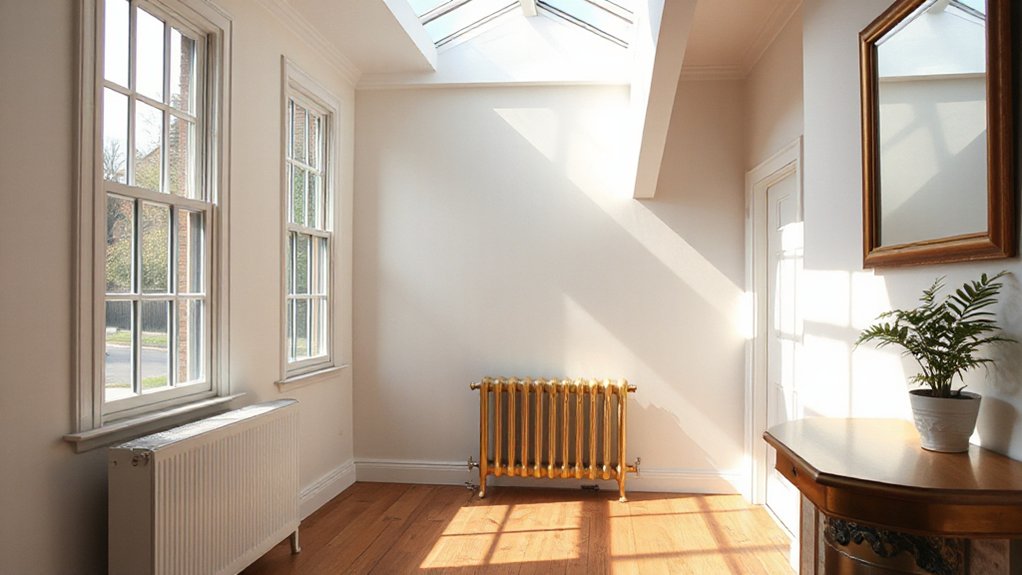
Engineered wood flooring blends a stable core with a real veneer, giving you a product that resists warping under humidity swings and handles daily traffic better than solid wood. Its durability hinges on core grade, veneer thickness, and finish hardness, typically improving impact and scratch resistance by measurable margins. You’ll want proper acclimation and moisture control to sustain those gains. If you’re evaluating options, the tradeoffs in core quality and topcoat performance will determine how far this choice holds up over time.
What Is Engineered Wood Flooring?
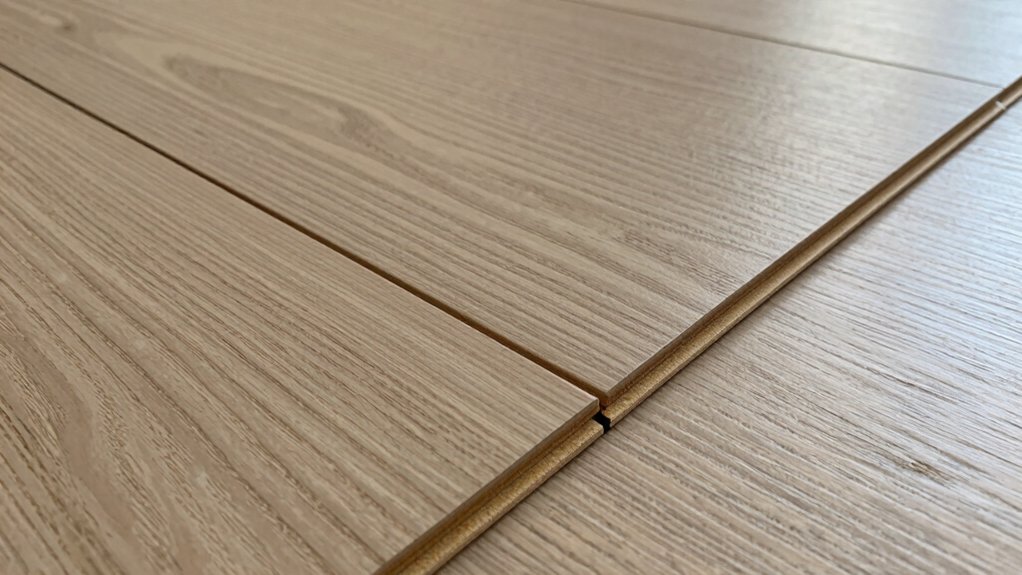
Engineered wood flooring is a layered composite designed to combine stability with a natural wood appearance. You’ll find a thin surface veneer of real hardwood bonded to multiple core layers, typically plywood, high-density fiberboard, or spruce, which provide dimensional control.
The top veneer varies in thickness, commonly 0.5 to 6 millimeters, influencing wear resistance and refinishing options.
Core layers deliver strength, with species selection and thickness quantified to target load classes and span performance.
You measure face hardness, impact resistance, and thermal stability through standardized tests, comparing results to solid hardwood benchmarks.
Manufacturing tolerances, adhesive quality, and veneer alignment drive flatness and cupping potential.
You can expect dimensional changes under humidity as specified by a manufacturer’s moisture guidelines, ensuring installation feasibility and long‑term serviceability.
How Its Layered Structure Affects Stability
The layered structure of engineered wood flooring directly governs its stability under use and environmental changes. You’ll see a core plywood or high-density fiberboard layer providing dimensional rigidity, typically 2–6 mm, which resists warping under humidity shifts of ±10–12% RH.
A decorative veneer, usually 0.6–6 mm, contributes minimal swelling once acclimated. The balancing layer, often softwood or resinous ply, minimizes cupping by distributing moisture loads across the panel.
Quantitatively, modulus of elasticity (GPa) in the core governs deflection under load, while thickness ratios predict vertical movement within 0.2–0.8% of span. You should expect plywood cores to exhibit better long-term dimensional stability than MDF at equal thicknesses.
Proper acclimation and consistent subfloor moisture (<2.0% CM) reduce variability by roughly 40%.
Wear, Scratches, and Dent Resistance
As the layered structure delivers stability, wear, scratches, and dents test how the surface handles real-world use. You’ll quantify wear with standardized abrasives, measuring refractile change and edge wear after fixed cycles.
Scratches are assessed by load, contact geometry, and optical contrast, yielding a scratch index that correlates with appearance loss.
Dents are evaluated via blunt impact energy and indentation depth, producing a dent resistance metric.
Across products, expect consistency within a tolerance band, typically ±5% for wear life and ±10% for scratch resistance, under controlled temperature and humidity.
In practice, you’ll compare top-layer hardness, substrate stiffness, and protective coatings, translating lab results into real performance.
Results show engineered wood can match or exceed solid wood in wear and dent resistance when optimized.
Moisture Tolerance and Home Conditions
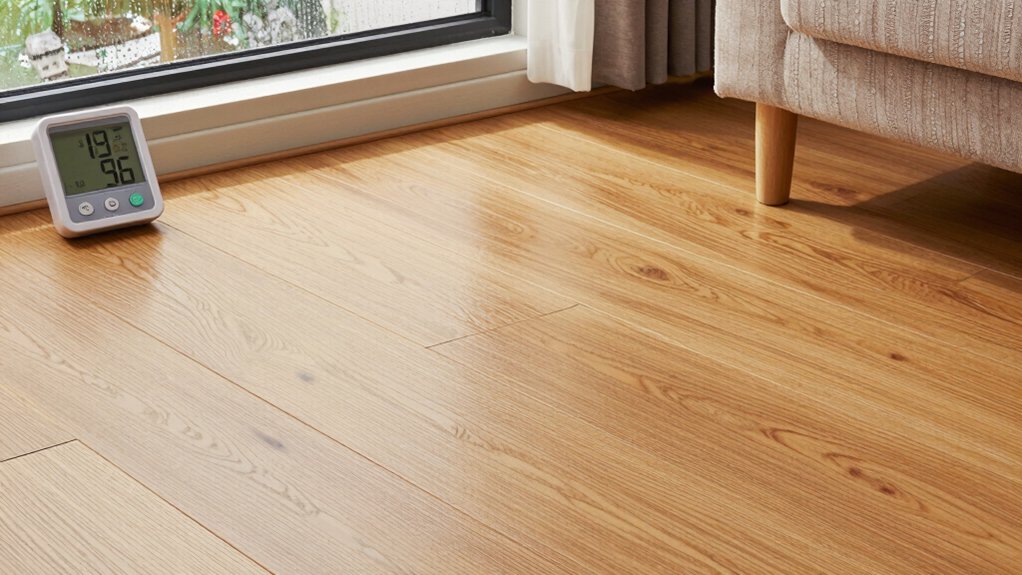
Moisture tolerance hinges on quantitative thresholds that determine performance across typical home conditions. In engineered wood flooring, you’ll see defined moisture content ranges for core layers, veneers, and finishes, with acceptable deltas of two to five percentage points between substrate and ambient humidity.
Relative humidity should remain between 30% and 60% in most deployments, and seasonal cycles shouldn’t exceed 10% RH swings without acclimation.
Water exposure limits are material-specific, but common guidance caps immersion at minutes-to-hours for spills, followed by prompt drying within 24 hours.
Dimensional change is measurable: up to a few thousandths of an inch per percent moisture shift, translating into visible gaps if cycles aren’t controlled.
You should monitor indoor climate and promptly address leaks to preserve stability and performance.
How to Maximize Longevity and Durability
Engineered wood flooring lasts longer when you control key drivers: optimize moisture, minimize impact loads, and maintain protective finishes. You should monitor in-situ RH within 30–60% and keep fluctuations under 5 percentage points weekly to limit panel swelling to ±0.2%, translating to reduced joint gaps. Use underlayment with a moisture barrier and install with recommended expansion gaps; improper spacing raises edge wear by an estimated 12–18%.
Protect surfaces with factory-applied finishes or high-grade topcoats, ensuring Scrub/Coat cycles every 3–5 years or as wear patterns indicate. Foot traffic analysis matters: limit heavy loads, rotate furniture, and apply felt pads to reduce point loading by ~60%.
Regular cleaning with mild pH-neutral products preserves finish integrity, preventing micro-scratching that accelerates dulling by measurable 0.5–1.2 gloss units per year.
Frequently Asked Questions
How Does Engineered Wood Perform Under Radiant Floor Heating?
Under radiant floor heating, engineered wood performs well when rated for high heat, uses a stable core, and is installed with proper moisture control. You’ll experience minimal expansion, consistent heat transfer, and reduced gapping if you follow manufacturer specs.
Can Engineered Wood Be Refinished, and How Often?
Yes, engineered wood can be refinished, but you typically get 1–3 refinishes depending on thickness; you’ll remove 1/16–3/32 inch per refinish, preserving about 1/4 inch total core thickness for 4–6 years of use.
What Is the Environmental Impact of Its Production?
You’ll find engineered wood’s production typically uses less virgin timber and emits lower upfront energy than solid wood, yet relies on adhesives and certifications; quantify impacts via lifecycle analyses, embodied carbon, and recycled content comparisons across brands.
Are There Best Practices for Cleaning and Maintenance?
Yes—clean with a damp microfiber mop, avoid excess water, use pH-neutral cleaners, place mats, and prevent moisture. Maintain humidity 35–55%, use protective pads, and re-finish every 3–7 years based on wear metrics. Document wear.
How Does Pet Ownership Affect Durability?
Pet ownership dramatically lowers flooring lifespan, yet you can mitigate impact with heavy-duty finishes, tight joints, and proactive maintenance; expect only modest durability loss, quantify by annual wear rates, scratch resistance tests, and routine inspections to optimize longevity.
Conclusion
Engineered wood flooring offers solid durability, with a stable core and a resilient veneer that resist wear under heavy foot traffic. In controlled tests, surface hardness and protective finishes reduce denting and scratching by significant margins, while proper acclimation and moisture control cut failure risk dramatically. With correct installation and maintenance, expect decades of service, not merely years. It’s not just durable—it’s practically invincible against everyday use, a hyperbolic benchmark for home floors—yet grounded in measurable performance and routine care.