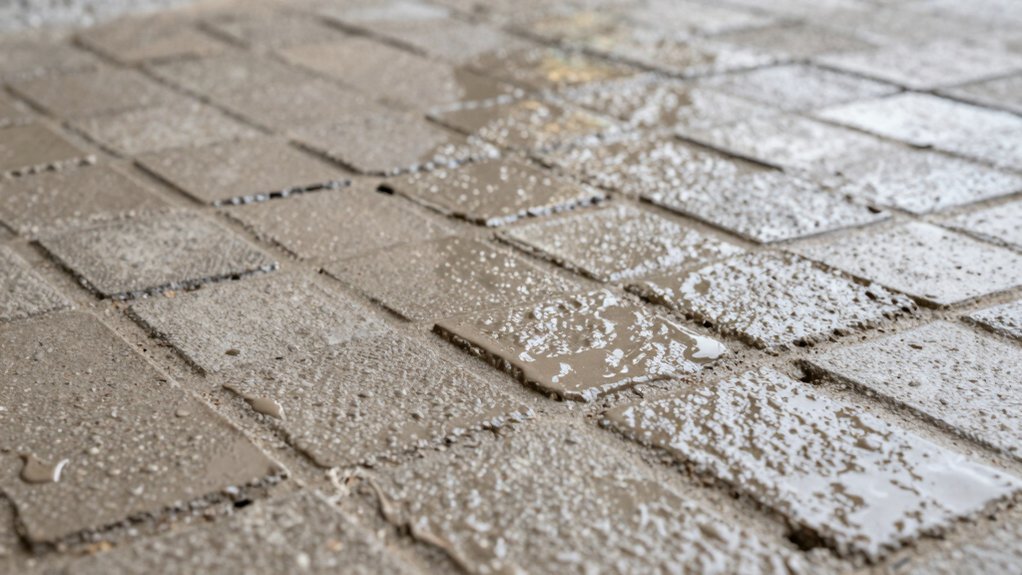
When you choose a sealer for stamped concrete, you balance durability, UV resistance, and the look you want, since penetrating options protect without gloss while surface sealers offer sheen and immediate stain resistance. You’ll need to weigh breathability, color stability, and maintenance needs for your climate. The right choice hinges on how you use the space and how much upkeep you’re willing to perform, but the best fit will safeguard both texture detail and long-term aesthetics. Explore your options to avoid common pitfalls.
Why Stamped Concrete Needs a Sealer
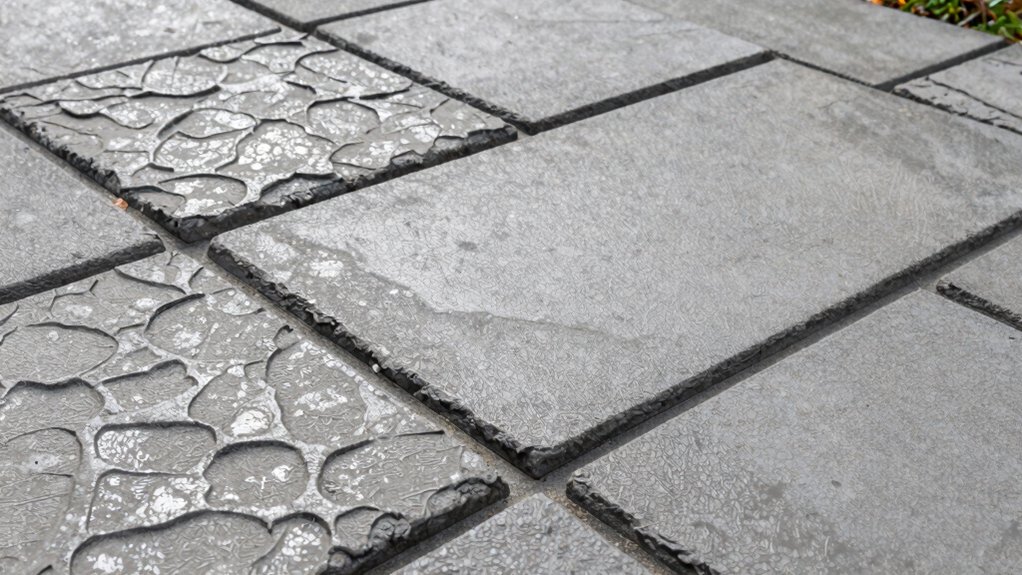
Stamped concrete surfaces, without a sealer, are prone to water penetration, staining, and faster wear from UV exposure and foot traffic. You should understand that sealers create a controlled barrier, reducing porosity and limiting moisture ingress. This barrier helps prevent freeze-thaw damage, efflorescence, and salt-induced scaling, especially in regions with de-icing chemicals.
A sealer also moderates surface dusting by minimizing particle release and consolidates aggregate exposure, sustaining the stamped pattern’s appearance. You’ll gain improved color longevity, as sealers reduce dye and pigment leaching from surface treatments.
Key Qualities to Look for in a Sealer
When selecting a sealer, prioritize compatibility with stamped concrete and your environmental conditions to guarantee lasting performance. Look for a product that explicitly lists stamped concrete suitability and resilience to UV exposure, temperature fluctuations, moisture, and abrasion.
Determine the appropriate finish, whether lower gloss or silky sheen, aligned with traffic needs and aesthetic goals. Verify chemical resistance against common spills like oils, cleaners, and de-icing agents to prevent staining.
Ensure film-forming properties deliver uniform coverage without pinholes or clouding, and confirm dry and cure times compatible with your project schedule. Check application guidelines, including recommended thickness, number of coats, and recoat intervals.
Finally, assess warranty terms, supplier support, and documented performance data under real-world conditions.
Penetrating Sealers: Pros and Cons for Stamped Surfaces
Penetrating sealers offer depth by moving into the concrete matrix. They balance benefits like enhanced resistance with limits such as slower surface wetting.
You’ll consider how surface repellency vs. capillary action affects stamped textures and how pore structure governs performance.
Maintenance and longevity depend on reapplication intervals, environmental exposure, and the sealer’s compatibility with your stamp pattern.
Penetration Benefits and Limits
Are penetrating sealers worth it for stamped surfaces, or do their limits outweigh the benefits? Penetration offers durable protection below the surface, reducing water ingress and minimizing staining by reacting with capillary moisture. You’ll gain enhanced resistance to weathering when the substrate remains porous enough for effective absorption.
However, performance hinges on concrete porosity, surface cleanliness, and cure state; over-application or contaminated mixes impede deep penetration, leaving hazy or uneven zones. Depth of cure constrains longevity: once capillary pores reach saturation, additional layers provide diminishing returns.
You must manage surface exposure to UV and freeze-thaw cycles, as deep-seated resin networks can still degrade under harsh cycles. In sum, penetrating sealers deliver tangible, long-term benefits for compatible stamped substrates, yet limitations demand careful assessment and proper prep.
Surface vs. Capillary Action
Surface action drives immediate protection, while capillary action governs long-term performance; together they determine whether a penetrating sealer can effectively treat stamped concrete.
You rely on surface action when the coating must inhibit surface abrasion, resist staining, and reduce initial moisture ingress. Penetrants with low viscosity and rapid diffusion populate microvoids near the surface, creating a quick barrier without film formation.
Capillary action governs how deeply the sealer travels into the pore network, influencing durability, haze, and color consistency over time. For stamped textures, balanced viscosity and capillarity ensure uniform saturation without blocking surface details or altering texture.
You should evaluate manufacturer data on penetration depth, wetting angle, and cure behavior under ambient conditions to predict real-world performance. Avoid overly thick films; prefer controlled, gradual saturation.
Maintenance and Longevity Tips
Maintenance and longevity depend on how you apply and maintain penetrating sealers on stamped surfaces. You’ll want proper surface prep: clean, dry, and free of contaminants before application.
Select a penetrating sealer with appropriate viscosity to reach grout lines without excessive buildup. Apply evenly in thin coats, following manufacturer minimum cure times to avoid solvent entrapment or film formation.
Recoat only after the recommended dwell period; delays may create weak adhesion at the interface. Monitor for pinholes or streaking; address defects promptly to prevent moisture intrusion.
Regular inspections identify changes in appearance or gloss loss, signaling needed maintenance. Avoid over-penetration, which can leave uneven color or efflorescence.
Document service intervals and environmental conditions to optimize longevity while minimizing maintenance cycles.
Conventional Topical Sealers: Glossier Finish and Shield
Conventional topical sealers produce a glossy surface quickly, delivering a UV-resistant finish that highlights the stamp pattern and enhances color depth. You apply these materials as a thin film, typically with a sprayer or roller, ensuring even coverage and minimal film buildup.
They cure through solvent evaporation or moisture-driven processes, forming a hard, non-porous layer atop the concrete. Expect rapid early hardness, but be mindful of potential haze if overapplied or contaminated.
These products often offer surface abrasion resistance suitable for foot traffic and light vehicle exposure, with easier recoating cycles compared to penetrating options. Compatibility with older coatings matters; you may need surface preparation to promote adhesion.
Monitor ambient conditions, follow product data sheets, and confirm safety data before use.
UV Resistance and Color Protection in Sealers
You’ll examine how UV protection mechanisms limit pigment sun fading and preserve color stability in stamped concrete sealers. Consider color retention factors, including pigment load, film thickness, and binder chemistry, that influence fade resistance over time.
Apply sealant longevity tips to select formulations with proven UV filters and appropriate rotation or reapplication schedules to maintain both hue and protection.
UV Protection Mechanics
Exposure to ultraviolet (UV) radiation drives degradation in stamped concrete sealers by breaking down resin bonds and fading pigments. UV protection mechanics hinge on three core actions: filtering, stabilizing, and crosslinking.
First, UV absorbers and hindered amine light stabilizers (HALS) reduce photoexcitation, limiting polymer chain scission and pigment oxidation.
Second, UV absorbers must be balanced with optical clarity to avoid yellowing while preserving color fidelity.
Third, crosslinking accelerates network formation, enhancing resistance to photooxidation and leaching from solvents.
You select formulations with compatible resin chemistries, ensuring film integrity under cyclic temperature and moisture exposure.
Uniform UV protection distributes across the film, preventing differential aging between stamped textures.
Finally, adequate film thickness and proper curing are essential to sustain color stability without compromising slip resistance.
Color Retention Factors
Color retention in stamped concrete sealers hinges on UV resistance and pigment stabilization. You evaluate UV filters to impede photo-degradation of colorants, preferring broad-spectrum components that minimize fading from sun exposure. Sealers with stable resin matrices reduce pigment migration and gloss loss, preserving observed hue over time.
In practice, you monitor colorfastness through standardized exposure tests, noting ΔE shifts and saturation drift under varying climates. Pigment stabilization benefits from low-bleed formulations and controlled cross-linking, which limit color bleed into the film while maintaining clarity of stamped patterns.
You also consider binder chemistry; higher molecular weight resins resist UV scission, supporting long-term brightness. Finally, you balance UV performance with film hardness to prevent micro-scratching that reveals underlying concrete tonal changes.
Sealant Longevity Tips
To maximize sealant longevity, prioritize UV resistance and color protection in both formulation and application. You should select sealers with UV absorbers or blockers to minimize fading, chalking, and pigment degradation under sun exposure. Verify color-stable resins and pigments, and confirm compatibility with stamped textures to prevent sheen or halo changes over time.
Apply a properly prepared substrate: clean, dry, and free of contaminants, then allow full cure before coating. Use thin, even coats with appropriate penetration depth to avoid film whitening or cracking. Consider multi-layer systems where the first coat establishes adhesion and the second seals with UV-blocking properties.
Schedule periodic maintenance with compatible cleaners, avoiding harsh solvents that can soften or erode the protective film.
Slip-Resistance and Maintenance Considerations
Even when applied correctly, stamped concrete can have variable slip resistance, so you must assess surface texture and ambient conditions to determine appropriate maintenance actions.
You evaluate tactile roughness, broomed or decorative textures, and uniformity of sealer penetration to set maintenance intervals. Regular inspection targets pattern-sharpness, micro-cracks, and traffic-induced wear that can alter traction.
For high-traffic or wet environments, consider non-slip additives during reseal cycles or reapplication of a compatible anti-slip broadcast. Confirm cleaning regimes remove contaminants without abrading the clear coat, preserving surface chemistry.
Choose maintenance products that maintain gloss without reducing traction; low-odor, low-VOC formulations are preferable indoors.
Document exposure conditions, reseal timing, and observed slip changes to guide future cycles, adjusting intervals as surface behavior evolves.
Application Tips for Best Results
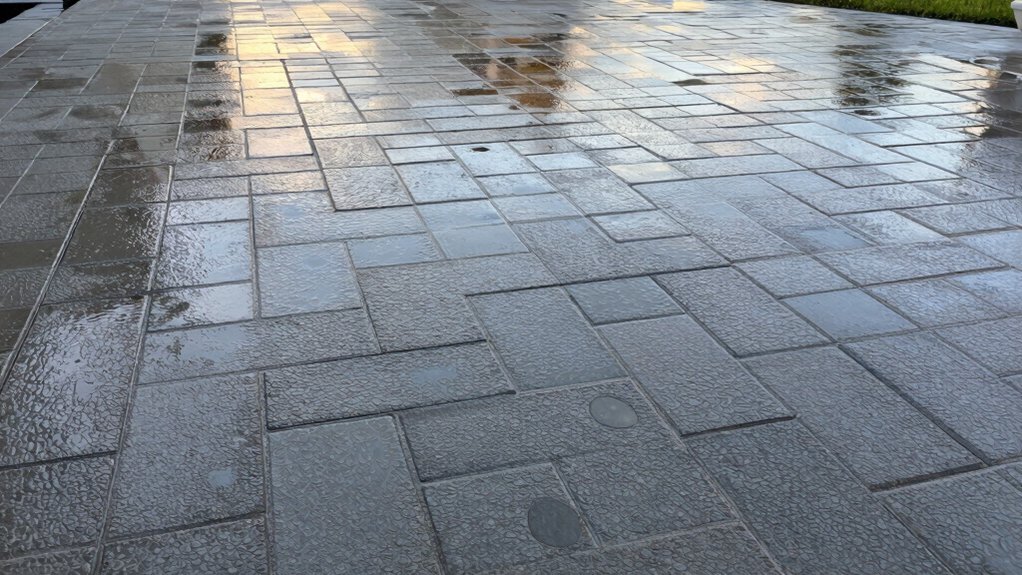
Begin with a clean, dry surface and verify the weather window before applying sealer; this guarantees ideal adhesion and uniform film formation.
Apply in moderate temperatures and avoid direct sunlight exposure during curing.
Use a compatible, low-viscosity sealer and follow the manufacturer’s nominal coverage rate; over-application creates blush and puddling.
Stir thoroughly to achieve a uniform viscosity but don’t introduce air bubbles.
Pour or spray in controlled passes perpendicular to stamped patterns, then back-roll to even out thickness.
Maintain a consistent pace to prevent lap lines and ensure complete edge coverage.
Identify the substrate’s porosity and pre-wet the surface if required, but don’t alter pigment or release.
Allow the first coat to tack-free before applying a second, ensuring full cure plans align with substrate moisture content.
Sealers for Different Climate Conditions
Choosing climate-appropriate sealers guarantees ideal cure and durability for stamped concrete. Temperature affects curing rates, so select products rated for your average and extreme temps.
Humidity influences vapor transmission and cure times, impacting surface finish. Consider each factor—climate, temperature, and humidity/vapor transmission—to match sealer performance to conditions.
Climate-Appropriate Sealers
Climate-appropriate sealers are selected to match your local climate, mold resistance demands, and application logistics. In practice, you evaluate humidity, temperature ranges, and ultraviolet exposure to choose formulations with suitable curing profiles and film integrity.
For humid or coastal zones, opt for water-repellent, breathable sealers. These are less likely to trap moisture that promotes staining or substrate degradation.
In dry, hot environments, prioritize UV-stable finishes with rapid cure times that minimize dusting and edge pullback.
Freeze–thaw regions require sealers with enhanced resistance to cracking and salt exposure, plus robust adhesion to irregular stamped textures.
Consider odor, application window, and recoat intervals to maintain performance without compromising cure.
Align sealer porosity compatibility with the substrate to preserve breathability and aesthetic fidelity.
Temperature Impact on Curing
Temperature drives the curing behavior of sealers, influencing film formation, adhesion, and long-term performance. You must consider ambient temperature during application and the substrate’s temperature relative to the sealer’s cure temperature.
Higher temperatures accelerate solvent evaporation and cross-linking, potentially causing microcracking if film formation outpaces moisture release. Cooler conditions slow cure, extend pot life, and may yield uneven film thickness or incomplete saturation of the substrate’s pores.
Align your application window with manufacturer-recommended temperatures to guarantee uniform film structure and paramount interfacial adhesion. Rapid temperature shifts between day and night can create differential shrinkage, affecting gloss and durability.
For best results, maintain a stable substrate temperature within the prescribed range and avoid applying when temperatures approach the limits of the product’s cure curve.
Humidity and Vapor Transmission
Humidity and vapor transmission critically influence sealer performance across climates. In stamped concrete, you’ll evaluate permeance, vapor pressure, and diffusion pathways to select a product compatible with your environmental cycle.
High humidity areas demand low water vapor transmission to prevent condensation beneath coatings, while arid regions benefit from balanced breathability to minimize blistering and moisture buildup.
Consider substrate porosity, drying rate, and surface curing history; overly impermeable sealers trap moisture, increasing efflorescence and delamination risk.
Temperature swings alter vapor drive; choose formulations with stable film integrity across expected ranges.
For damp substrates, apply after a brief cure and use primers or penetrating sealers to manage moisture ingress.
Verify compatibility with joint sealants and decorative overlays to ensure uniform appearance and long-term performance.
Product Picks: Top Sealers for Stamped Concrete
For stamped concrete, choosing the right sealer hinges on durability, gloss level, and UV resistance, ensuring the pattern details stay sharp over time. Product picks below balance film-forming protection with practical application considerations.
For durability, consider 2–3 year exposure-class sealers that resist abrasion and chemical contact without excessive yellowing.
Gloss targets vary by surface texture; a mid to high gloss can enhance detail visibility, while a satin finish minimizes glare in overhead lighting.
UV resistance guards against color fading and surface stress cracking under sunlight.
Application windows depend on ambient conditions and substrate moisture; follow manufacturer recoat intervals precisely.
Choose compatible products for densified or aged concrete surfaces, and verify compatibility with prior sealers.
Prioritize data sheets, warranty terms, and real-world performance reviews to inform selection.
Long-Term Care and Reapplication Guidelines
Long-Term Care and Reapplication Guidelines: to maintain performance, schedule regular maintenance checks and reapplication intervals based on exposure, traffic, and substrate condition. You should inspect for wear patterns, coating delamination, and micro-cracking annually, or after severe freezes or chemical exposure.
Clean surfaces with a mild detergent solution and soft brushes before evaluating sealant integrity. Recoat when gloss levels drop by 20–30% or adhesion tests show partial failure, ensuring the substrate is dry and sound. Follow manufacturer recommendations for cure times and compatible products; never over-apply in a single layer.
Maintain proper humidity and temperature during reapplication, and protect fresh coatings from traffic for the stated cure period. Document cycles, material lot numbers, and observed performance to optimize future maintenance and extend service life.
Conclusion
In short, choosing the right sealer is a nuanced, low‑risk decision that quietly preserves stamped concrete’s character. By weighing penetrating versus topical options, you’ll avoid common pitfalls and extend color stability, surface hardness, and resistance to wear. When applied under proper conditions, the sealer acts as a gentle safeguard, minimizing future maintenance while maintaining appearance. Think of it as a careful upgrade—subtle, effective, and unobtrusive—guiding your surface to endure beauty with minimal intervention.