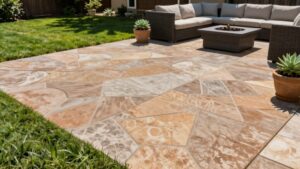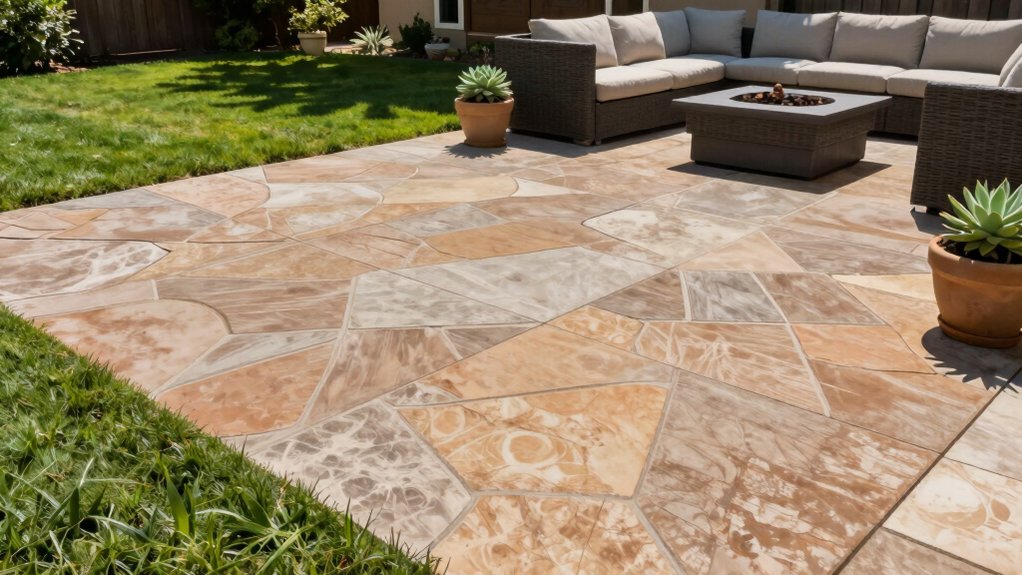
Backyard stamped concrete patio ideas blend durability with precise pattern planning. Choose textures like faux-brick and weathered stone to control edge definition, wear tolerance, and slip resistance. Use consistent line weight, corner radii, and staggered joints, aligning patterns across zones. Layer colors with base tones plus accents, seal after final wipe, and apply borders or inlays to create visual anchors. Zone areas by motif, facilitate smooth transition between patio and turf, and expect easy maintenance as you proceed. More details await.
Texture Options: Faux-Brick and Weathered Stone
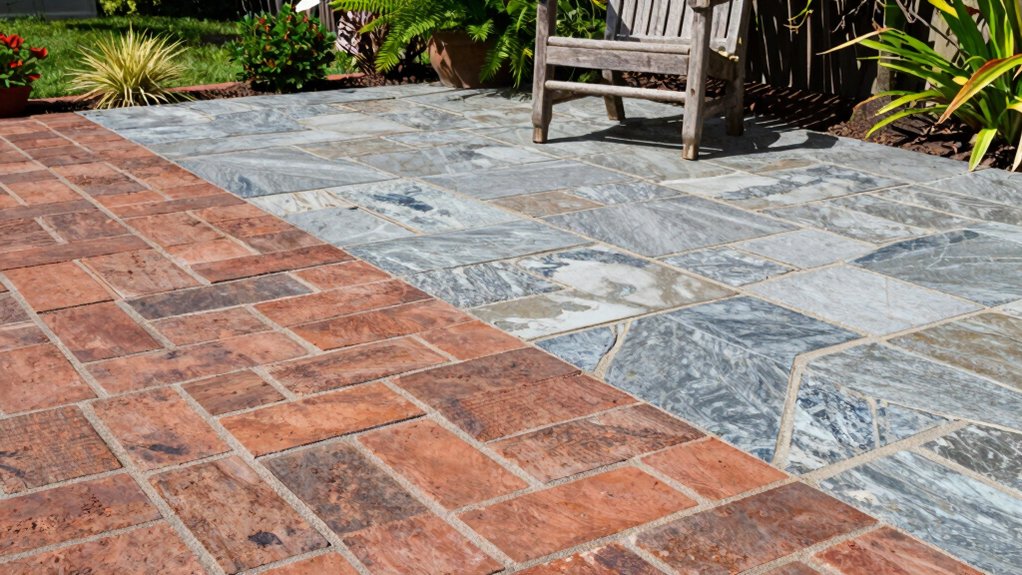
Texture options like faux-brick and weathered stone offer distinct visual effects and installation considerations for stamped concrete patios. You assess texture to control slip resistance, edge definition, and wear tolerance, ensuring long-term performance.
For faux-brick patterns, you align grooves and joints to mimic mortar lines, reducing stress concentrations and easing decorative edging integration.
Weathered stone requires careful color blending and crisp edge detailing to prevent pattern fading over time. You evaluate substrate rigidity, expansion joints, and curing parameters to maintain pattern fidelity under temperature cycling.
When planning garden pathways, choose textures that transition smoothly from patio to turf or paving. Document thickness, stamping sequence, and cure window to minimize color variation.
Precision labeling and consistent application yield durable, low-maintenance decorative features.
Geometric Patterns for Modern Appeal
Geometric patterns bring a contemporary edge to stamped concrete patios by leveraging clean lines, precise angles, and repeatable modules. You implement this by selecting tessellations that minimize corner drift, then aligning joint spacing to optimize load distribution.
Begin with a planned grid, map interlacing pathways, and reserve ample space for transition points between modules. Use consistent stamping templates to ensure uniform depth, texture, and pattern fidelity across the surface.
For garden pathways, extend the motif beyond the main deck to create visual continuity without overcomplicating joints. Decorative borders frame the area, defining edges and mitigating wear at door thresholds.
Control shrinkage gaps with calibrated expansion cuts and sealants, maintaining long-term dimensional stability. Document pattern codes for future maintenance, ensuring repeatability across seasonal repairs and resurfacing, preserving geometric integrity.
Bold Color Accents and Stain Techniques
Bold color accents and advanced stain techniques elevate stamped concrete patios by delivering durable, UV-resistant color ownership and controlled aesthetic outcomes. You’ll prioritize pigment stability, using commercial-grade stains formulated for exterior exposure and multi-layered color results.
Begin with a base color, then apply accent tones via controlled color layering to add depth without oversaturation. For uniform penetration, maintain consistent moisture and surface temperature, avoiding pooling.
Utilize stain wiping techniques to blend edges and soften abrupt transition, ensuring a natural look that remains durable against wear. Document application timelines and cure conditions to reproduce results.
Seal only after the final wipe ensures maximal clarity and UV protection. Finally, test sample boards to verify hue accuracy under direct sunlight before committing to full-scale work.
Creating Zoning With Stamp Patterns
Stamp pattern zoning lets you define use areas by distinct repeating motifs, creating clear functional boundaries without walls.
Use patterned area delineation to pair concrete textures with traffic flow, seating zones, and shiftings, ensuring consistent scale and alignment across patterns.
Consider edge treatments and joint spacing to maintain visual cohesion as you sequence patterns throughout the patio.
Stamp Pattern Zoning
To create functional zones within a stamped concrete patio, define distinct areas by varying stamp patterns across the surface. You implement Stamp Pattern Zoning by assigning specific motifs to each activity zone, then aligning grout lines and pattern boundaries to structural features.
Begin with a dominant field stamp for open dining or lounging, followed by a contrasting motif for entryways or transition zones. Maintain consistent scale transitions to avoid visual disruption, and plan joint spacing to preserve pattern integrity. Integrate practical elements, such as garden edging or plant bed borders, to reinforce borders without compromising texture.
Verify stamp depth and paint or sealer compatibility to prevent pattern bleed. Document the zoning map for future maintenance and re-stamping needs, ensuring durable, legible delineations.
Patterned Area Delineation
Patterned Area Delineation begins with a clear plan that translates activity needs into distinct stamp motifs. You map zones by traffic flow, sightlines, and function, preventing overlap and preserving surface integrity. Each motif should reflect intended use: dining, lounging, or circulation, with measurable boundaries and consistent grout lines for visual rhythm.
Apply contrasting textures selectively to enhance space reading, not overwhelm it. Document stamp sizes, elevation changes, and pattern repeats to maintain uniformity across gradation. Incorporate landscape integration by aligning patterns with surrounding plantings and hardscape edges, ensuring smooth visual continuity.
Consider privacy screening within zoning, using taller motifs near intimate zones and shorter, open-pattern sections along public-facing edges. Verify drainage, substrate stability, and curing timelines to avoid pattern distortion and maintenance gaps.
Tight coordination yields coherent, durable backyard design.
Integrating Borders and Inlays
Borders set the visual edge; choose a pattern and color contrast that frames your main stamping scheme without overpowering it.
Inlays should use durable materials and tight tolerances, aligning with joint spacing to prevent cracking while enhancing texture.
Coordinate border design ideas, inlay material options, and pattern coordination tips to guarantee a cohesive, long-lasting patio finish.
Border Design Ideas
Border design ideas for integrating borders and inlays: choose a layout that defines the patio edge with a contrasting band and an inset accent pattern. You implement precise gradients between stamped fields and borders, ensuring consistent joint spacing and color harmony.
Start with a straight, parallel border to establish boundaries, then introduce a secondary motif as an inset band that repeats along straight runs or around corners. Align patterns to grout lines for uniformity and avoid busy intersections that complicate stamping.
Consider garden edging as a functional separator that mitigates turf encroachment while preserving clean edges. Use narrow, continuous borders for subtle emphasis or wider, geometric bands for visual anchor points.
For visibility, position pathway borders where foot traffic converges, maintaining accessibility and flow without compromising stamp integrity.
Inlay Material Options
To integrate borders and inlays effectively, you’ll want to select inlay materials that complement your stamped field while maintaining performance under foot traffic and weather.
Begin by evaluating hardness, abrasion resistance, and freeze-thaw stability for each option, ensuring compatibility with concrete’s substrate.
Natural stone offers durable surface contrast and color permanence but may require routing precision for tight tolerances and proper sealant selection to prevent staining.
Glass inlays provide high visual contrast and light reflection, yet they demand meticulous setting and protective bedding to avoid cracking from substrate movement.
Consider pigment compatibility, edge detailing, and joint patterns to minimize uneven wear.
Favor materials with low porosity or sealed surfaces to reduce moisture intrusion and maintenance needs over time.
Ensure installation sequencing preserves substrate integrity and facilitates durable bonding.
Pattern Coordination Tips
Pattern coordination hinges on aligning border and inlay geometry with the stamped field to preserve visual continuity and wear resistance. You evaluate each border module against the main pattern to ensure proportional scaling and edge alignment. Use consistent line weight, corner radii, and staggered joints to minimize misregistrations at junctures.
When selecting inlay elements, verify that their texture and depth don’t create excessive relief contrasts that could trap debris. Plan color contrast deliberately: choose hues that maintain legibility of the pattern across lighting conditions and wear zones.
Monitor pattern repetition to avoid repetitive seams near doorways or seating areas, which can disrupt perception. Document tolerance bands for all shapes and junctures, and confirm field-to-border consistency before joint sealing.
Outdoor Living: Furniture and Lighting Synergy
Outdoor living hinges on how furniture and lighting work together to shape ambiance and usability. You assess sightlines, contrast, and task zones to maximize comfort without clutter.
Precision-driven layout pairs low-profile seating with indirect illumination, reducing glare while extending usability into evenings. You calibrate light temperature and intensity to complement stamped textures and paving color, ensuring consistent tonal harmony.
Functional zoning pairs seating clusters with lanterns or wall-wash fixtures, guiding movement and improving safety. You evaluate plant integration and garden privacy elements to prevent overexposure and maintain visual balance between open sightlines and intimate corners.
Avoid overcrowding by selecting modular furniture and accent lighting that scale with patio size. This approach yields cohesive, adaptable outdoor rooms without compromising durability or maintenance.
Durability and Maintenance Tips
Durability and maintenance start with material selection and proper installation, because stamped concrete patios rely on a stable substrate and accurate jointing to resist cracking and wear. You’ll optimize longevity by controlling slab thickness, reinforcement, and desynchronizing nearly universal expansion.
Post-install, ensure cure is complete and joints are properly angled to manage reflection cracking. For ongoing performance, implement a proactive cleaning schedule that minimizes embedded dirt and efflorescence. Use low-pressure washing and test pH compatibility before applying coatings.
When addressing surface issues, prioritize diagnostics over guesswork, documenting any observed cracks or spalling. For preservation, apply concrete sealing on a proven interval schedule, ensuring the sealant is compatible with pigment and textured patterns.
Regularly inspect for wear, then perform targeted stain cleaning to maintain color vibrancy without compromising texture.
Cost-Effective Stamped Concrete Ideas
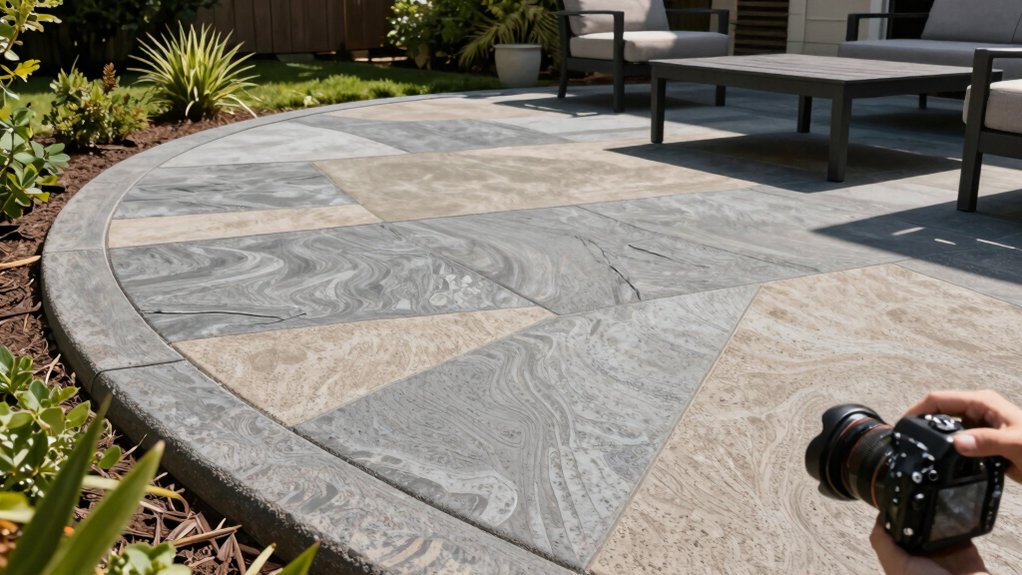
Consider cost-effective stamped concrete ideas by prioritizing substrate integrity and efficient patterns that deliver visual impact without escalating labor or material costs. You focus on solid base preparation, proper reinforcement, and consistent slump control to minimize repairs after curing.
Choose low-pattern-density stamps or pre-inked textures that resemble natural stone while preserving achievable grid layouts. Use integral coloring or beveled edges to enhance durability without expensive overlays.
Strategy targets garden pathways and decorative edging by outlining clean progressions and avoiding complex curvatures that extend installation time. Select scalable patterns, such as simple runs with alternating textures, to reduce formwork and joint spacing.
Maintain precise curing conditions, water management, and joint planning to prevent cracking. These practices yield economical, durable results with measured aesthetic impact.
Conclusion
You’ll see stamped concrete transforms your backyard faster than you can say “weathered stone.” With precise texture choices, bold stains, and smart patterns, you’ll create zones, borders, and focal spots that scream sophistication without shouting. Maintenance stays manageable, durability stays high, and costs stay predictable if you plan with exact measurements and quality sealers. Trust the technique, not luck—your patio will endure more neighborhood barbecues, more sunsets, and more compliments than any other upgrade you’ve ever made.