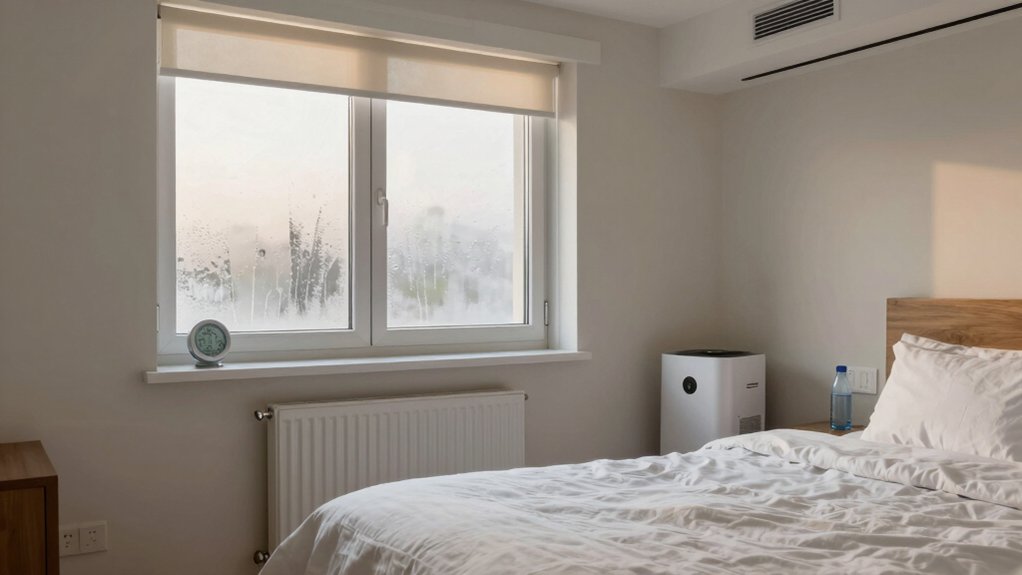
Condensation in bedrooms happens when warm, moist air meets cold surfaces. You’ll want to check humidity, target 40–60%, and spot cold spots behind walls or near windows. Practical steps combine sealing gaps, improving insulation, and controlled ventilation, so you reduce surface temperatures that invite moisture. Start with a quick audit of insulation and airflow, then plan a precise sequence to balance heat, moisture, and air exchange. The next move could make a real difference.
Understanding Why Condensation Forms in Bedrooms

Condensation in bedrooms forms when warm, moist air meets cooler surfaces, causing water vapor to condense into liquid droplets. You’re observing a balance between moisture generation and surface temperature.
When you exhale, shower, cook, or dry laundry indoors, you add moisture to the room. If surfaces approach dew-point temperature, droplets form on walls, windows, and furniture. Porous materials absorb some moisture, while smooth surfaces show visible film or beads.
Thermal performance matters: poorly insulated walls or single-glazed windows create cold spots where vapor condenses more readily. Air movement influences moisture distribution; stagnant zones allow buildup near ceilings, corners, or under furniture.
Relative humidity, surface temperature, and airflow interact, determining where and when condensation appears. Understanding these dynamics guides targeted prevention strategies.
Assessing Humidity Levels and Ideal Targets
To assess humidity levels accurately, you start by measuring both current indoor humidity and how it changes over time. You’ll track fluctuations with a hygrometer placed in the sleeping area and a secondary sensor in an adjacent room to capture diffusion effects.
Use a short-term window (hourly) and a long-term window (weekly) to distinguish transient spikes from baseline drift. Convert readings into relative humidity percentages and temperature-adjusted indices, then compare against established targets—generally 40–60% RH for bedrooms, lower in colder months to minimize condensation risk.
Identify peak daily periods and seasonal shifts, then calculate rate of change (percentage per hour) to gauge stability. Document anomalies, assess ventilation adequacy, and set a precise target range aligned with occupant comfort and moisture control goals.
Quick Habits to Reduce Moisture Daily
Effective daily moisture control starts with simple, repeatable habits that limit humidity buildup and promote rapid drying. You should monitor surface coolness and switch to dry every-room checks each day, targeting zones with higher moisture potential.
Run a timer to remind you to open a window for five to ten minutes if outside humidity is lower than indoors, or use an extractor fan in damp moments.
Wipe condensation as soon as it forms on windows or walls, not after it soaks in. Store damp towels promptly and avoid drying clothes indoors when possible.
Keep relative humidity near 40–60% by habit, not circumstance, and document deviations to refine routines.
Consistency yields measurable reductions in overnight condensation risks.
Ventilation Upgrades That Make a Difference
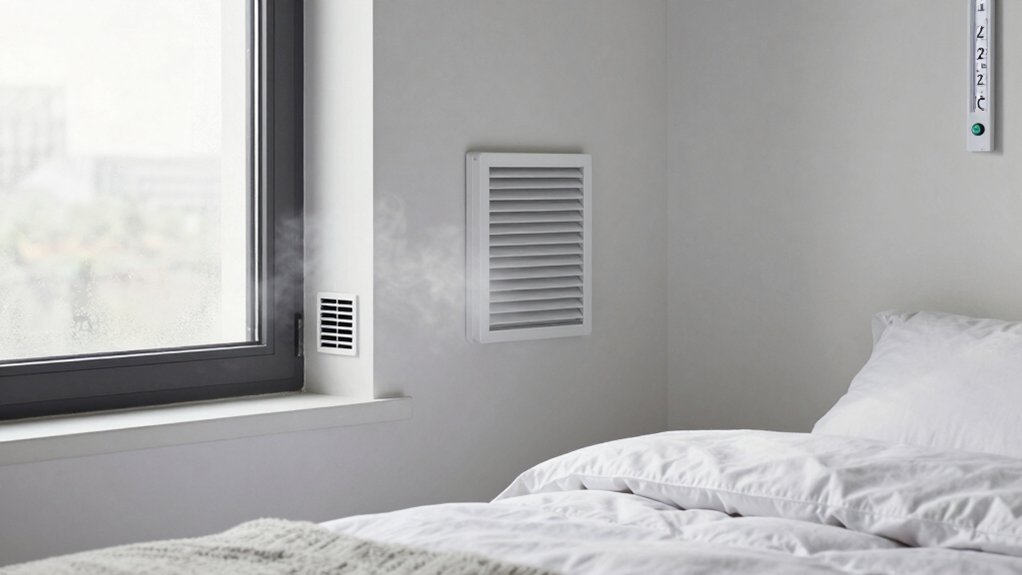
Improved air exchange reduces indoor humidity peaks and supports more stable condensation control.
For energy-efficient ventilation, choose devices with heat recovery or demand-controlled operation to minimize heat loss while maintaining effective moisture removal.
Consider humidity control factors such as setpoint ranges, sensor placement, and system sizing to guarantee consistent performance without unnecessary energy use.
Improve Air Exchange
Are you ensuring enough fresh air circulates in your room, or is moisture repeatedly lingering? Improve air exchange by evaluating current airflow paths and identifying bottlenecks. You’ll want a measurable approach: quantify ACH (air changes per hour), note where warm, humid air concentrates, and map exhaust routes.
Prioritize direct, low-resistance ventilation from sleeping areas to outlets or outdoors, avoiding recirculation through damp zones. Implement controlled intake and exhaust with properly sized vents, dampers, or fans, ensuring pressure remains balanced to prevent backdrafts. Consider intermittent operation during peak moisture periods, and synchronize with humidity readings to optimize effectiveness.
Regular maintenance matters: clean filters, seals, and ductwork, verify fan speeds, and confirm leak-free connections. This analytic method elevates air quality, reducing condensation risk without energy penalty.
Energy-Efficient Ventilation
To boost efficiency without sacrificing comfort, focus on ventilation upgrades that minimize energy use while maximizing air exchange. You’ll prioritize heat recovery, ensuring exhaust air transfers its energy to incoming fresh air, lowering conditioning loads. Choose a unit with high sensible heat recovery efficiency and a modest pressure drop to reduce fan power.
Automation matters: demand-controlled ventilation adjusts airflow to occupancy and CO2 levels, preventing over-ventilation and waste. Use airtight ducting, sealed joints, and well-insulated runs to minimize leaks and thermal losses.
Consider balanced systems over exhaust-only, since they maintain pressure neutrality and steady air change rates. When retrofit, target motors and controls with low standby consumption.
Finally, document performance metrics: air changes per hour, energy use, and cross-checked humidity trends to validate improvements.
Humidity Control Factors
Humidity control in ventilation upgrades hinges on how well the system manages moisture load alongside air exchange. You’ll evaluate humidity sensors, control algorithms, and feedback loops to minimize peak RH without over-venting.
Prioritize continuous monitoring of relative humidity, temperature, and outdoor conditions to prevent condensation risk. Choose sensors with fast response times and low drift, and calibrate them regularly.
Implement active controls that modulate airflow based on measured moisture, not just occupancy. Consider heat recovery to maintain comfort while exhausting humid air.
Design must account for latent loads from showers, cooking, and plants, plus seasonal humidity swings. Ensure proper sealing and duct design to prevent short-cycling.
Document setpoints and maintenance schedules for predictable performance over time.
Heating and Insulation Strategies for a Dryer Room
To minimize condensation in a dryer room, focus on proper insulation to reduce heat loss and maintain stable temperatures around the drying cycle.
Implement a heating strategy that supplies consistent, controllable heat while avoiding overheating and moisture buildup near walls and ducts.
Consider targeted improvements like insulating the drying space and selecting a heating approach that balances energy efficiency with effective moisture removal.
Drying Room Insulation
Drying rooms must be insulated and heated efficiently to curb condensation risks. You’ll assess wall and ceiling assemblies for low-thermal-bridging performance, prioritizing continuous insulation and high air-tightness targets.
Use a vapor-permeable but water-resistant membrane on exterior sheathing to manage moisture drive from inside. Choose insulation with a favorable fire and moisture rating, and ensure careful edge detailing around doors, windows, and ducts to minimize thermal gaps.
Install a perforated, in-wall vapor barrier only where you intend to restrict inward moisture transport, avoiding redundant layers that trap moisture.
For equipment, select energy-efficient, properly sealed dryers with integrated lint traps and exhaust ducts that maintain positive pressure differentials without leaks.
Finally, verify performance with blower-door tests and infrared scans to confirm uniform temperature distribution and minimal cold spots.
Heating Strategy Essentials
Effective heating and insulation strategies for a dryer room focus on delivering stable, high-temperature uniformity while minimizing thermal bridging and moisture-driven risks. You should prioritize continuous, well-sealed enclosure envelopes, avoiding gaps that create cold spots where condensation forms.
Use controlled heat sources with rated humidity tolerance, paired with demand-responsive controls to prevent overshoot and heat loss. Target a steady indoor delta-T that discourages moisture migration toward cooler surfaces, and deploy reflective, high-R insulation in exterior walls and ceiling to reduce surface temperature differentials.
Install a dedicated dryer exhaust with backdraft protection and a balanced ventilation rate to maintain air quality without flushing warm, moist air. Combine this with well-placed airflow diffusers to promote uniform temperature distribution and minimize localized condensate formation.
Regularly inspect seals, ducts, and insulation for integrity.
Practical Tools and Products for Moisture Control
There are several practical tools and products that directly reduce indoor moisture and prevent condensation, including dehumidifiers, hygrometers, exhaust fans, and moisture absorbers.
In this section, you evaluate each device by function, specifications, and interaction with your room’s air volume. Dehumidifiers remove water vapor through refrigeration or desiccation, so choose a unit sized to your space and run cycles aligned with humidity targets. Hygrometers provide continuous feedback, guiding operation thresholds. Exhaust fans move moist air outdoors, particularly during cooking, showering, and ventilation gaps. Moisture absorbers offer passive mitigation but require replacement or recharging as capacity declines.
Consider energy efficiency, noise levels, and maintenance schedules. Finally, integrate these tools with a consistent monitoring routine to sustain low dew points and durable comfort.
Step-by-Step Plan to Tackle Condensation Tonight
Tonight, start with a rapid assessment of your space to identify where condensation is most likely to form, then implement a targeted sequence: reduce moisture sources, improve air exchange, and monitor humidity to confirm results.
Begin by cataloging moisture inputs (steam from showers, drying clothes indoors, houseplants) and remove or minimize them tonight where feasible.
Next, increase ventilation: run a bath fan, crack a window briefly if safe, or use a fan to circulate air away from walls and windows.
Then measure ambient RH with a hygrometer and aim for 40–60%. If readings stay high, run dehumidification or an air purifier with a built-in humidity sensor.
Finally, re-check windows and surfaces for reduced condensation and document changes to validate the plan.
Conclusion
You’re not chasing ghosts; you’re chasing relative humidity like a caffeine-fueled scientist. In short, the romance of damp is solvable with data, discipline, and a few practical tweaks: monitor humidity, seal drafts, vent after showers, and keep temps steady. Condensation is a statistic, not a mood swing. If you act tonight, you’ll reduce surface dew, protect walls, and train your air to behave—because dry air isn’t a conspiracy, it’s a plan.