
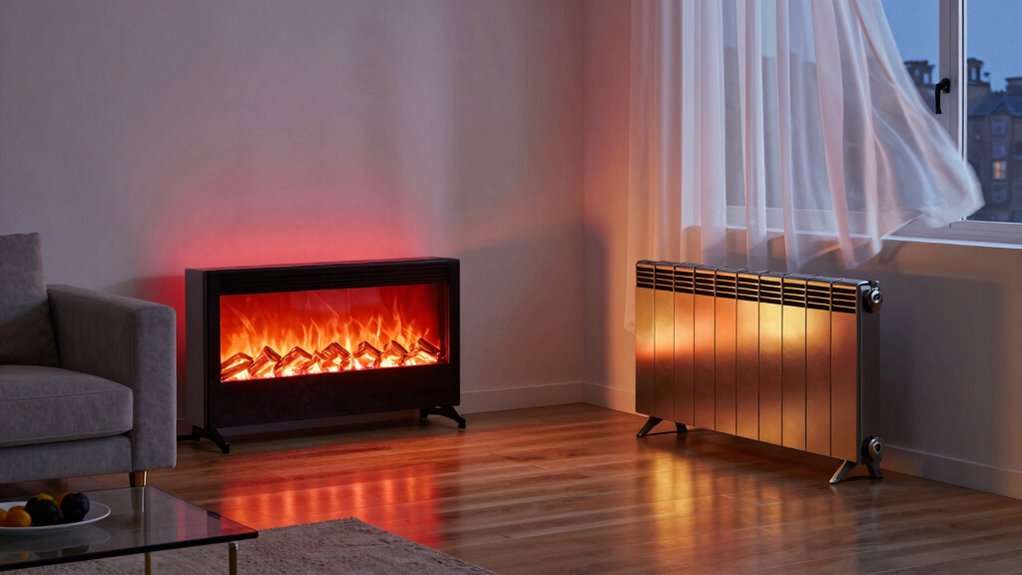
Infrared heating panels deliver targeted radiant warmth with fast response and minimal air disturbance, great for boundary-layer comfort and zones like bathrooms or studios. Electric radiators rely on convection, offering broader zoning, easy control, and rapid setpoint tracking, but can risk stratification and higher standby losses. If you need precise, surface-focused warmth and lower ambient air movement, go infrared; if you want flexible, per-room zoning and straightforward installation, choose electric radiators. For a nuanced decision, more specifics ahead.
What Are Infrared Panels and Electric Radiators, in Plain Terms
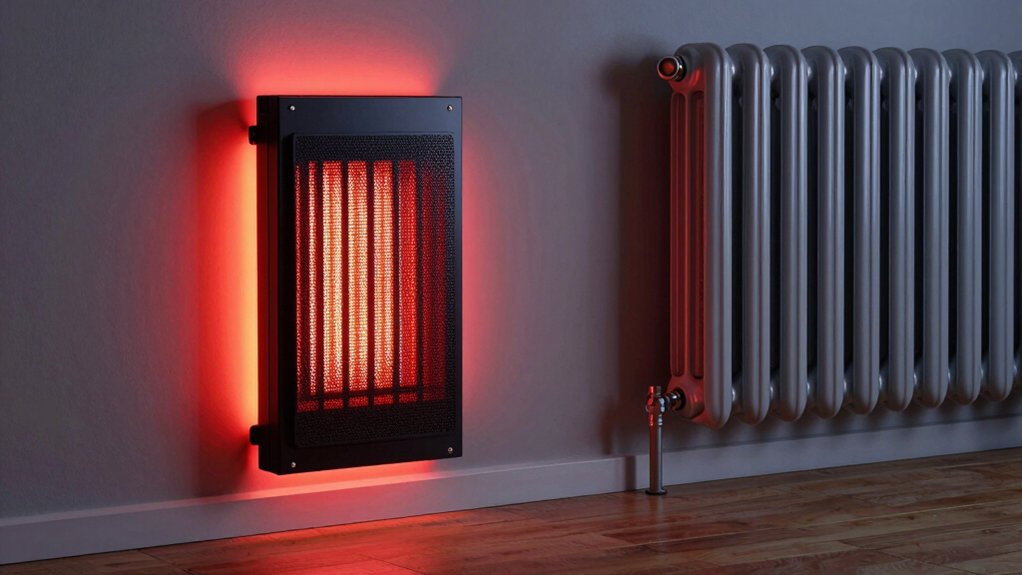
Infrared panels and electric radiators are two electric heating options that convert electrical energy into heat, but they do so in different ways.
You’re evaluating dispersed radiant emission versus convection plus surface warming. Infrared panels radiate energy directly to objects and occupants, delivering heat through longwave radiant transfer with minimal air mixing.
Electric radiators, by contrast, primarily heat via convection from heated panels and fins, circulating air to raise ambient temperature efficiently.
Both rely on electric resistance elements and temperature controls, yet their thermal paradigms diverge: radiant versus convective modalities, steady-state surface temperatures, and thermal inertia implications.
Installation footprints differ: slim, wall-mounted panels enable zoning with low airflow disruption; radiators offer portable or retrofittable flexibility with integrated heatsinks.
Choose based on heat delivery profile, control zoning, and space-conditioned goals.
How Infrared Panels Heat: The Core Mechanism Explained
You’ve seen that infrared panels deliver heat differently from electric radiators; now we focus on how they generate warmth. Infrared panels emit longwave radiation by a calibrated emitter surface, typically a ceramic or carbon-based element, heated to a controlled temperature.
The radiant field couples with exposed objects and occupants, elevating surface temperatures without bulk air heating. Heat transfer follows Planckian distribution within material emissivity limits, ensuring stable spectral output tailored to target wavelengths.
Subsurface layering—glazing, insulation, and substrate—defines thermal mass and transmittance, shaping start-up latency and steady-state gradients.
Controller circuitry modulates power using closed-loop sensing from integrated thermistors, preserving surface setpoints and preventing overshoot.
Safety interlocks, emissivity coatings, and temperature derating factors govern long-term reliability, while panel geometry determines angular distribution and felt intensity at ambient seating ranges.
How Electric Radiators Heat: The Core Mechanism Explained
Electric radiators generate warmth primarily through resistive heating of a metal element, converting electrical energy directly into heat that’s transferred to the surrounding space via convection and convection-assisted radiation.
You operate at controlled amperage through a low-loss metallic element, typically a clean copper or nichrome scaffold, embedded in a thermally conductive matrix. As current flows, resistive losses produce volumetric heat, elevating the element temperature and creating a stable heat flux into the surrounding casing.
The enclosure conducts and distributes energy through fins or an internal heat exchanger, fostering air movement via natural convection, sometimes aided by integrated fans.
Thermal inertia governs response time and setback performance.
Temperature regulation relies on chronometric or feedback-based sensors, modulating supply voltage or current to maintain setpoint while minimizing standby losses.
Heat transfer efficiency hinges on surface emissivity, enclosure design, and zoning strategy.
Pros of Infrared Heating for Comfort and Quick Warmth
The infrared approach delivers rapid, targeted warmth without relying on air movement, so occupants feel heat when and where it’s needed rather than waiting for room-wide convective currents to develop. You experience immediate sensation from surface-to-body transfer, minimizing thermal lag in occupied zones.
(IR) emitters deliver high radiant flux densities with predictable absorption profiles, enabling precise LoadMatched responses to varying surface emissivity and impedance. Heat delivery aligns with architectural heat paths, reducing stratification and underscoring boundary-layer efficiency.
Temperature control integrates with low-mass, low-thermal-miss footprints, enabling fast setpoint attainment without bulk heating cycles. You benefit from ergonomic comfort consistency across zones, while equipment duties remain decoupled from air-filtration dynamics.
Maintenance demands stay minimal, with stable electrical load characteristics and scalable retrofit potential for retrofit or new-build applications.
Pros of Electric Radiators for Zoning and Control
Electric radiators offer distinct zoning and control advantages through granular thermostat zoning and independent valve control, enabling targeted heat delivery across zones without crosstalk.
You’ll experience rapid temperature responsiveness and straightforward setpoint tuning, with predictable hysteresis and minimal overshoot in each zone.
This translates to flexible independent zone management, allowing precise occupancy-based heat allocation and efficient energy use.
Zoning Versus Granular Control
Zoning delivers straightforward, per-room control with electric radiators, enabling independent setpoints, faster response, and clear load management—benefits that streamline HVAC strategy for varied occupancy and use patterns.
You implement granular zoning with discrete zones and dedicated circuits, but electric radiators excel in predictable zoning granularity due to modular assets, fast thermal mass response, and straightforward commissioning.
Unlike granular, zone-based schemes, you gain reduced ductloss exposure and minimized inter-zone coupling, improving controllability and stability in setpoint adherence.
Control logic leverages proportional-integral derivatives, deadband tuning, and occupancy-based modulation to maintain target temperatures without over-conditioning.
Energy metering and localized thermostat communication enable precise demand shaping, peak shaving, and drift correction.
In practice, radiators deliver scalable zoning with simpler integration into existing electrical infrastructure, reducing commissioning risk.
Quick Temperature Responsiveness
Because electric radiators respond with low thermal inertia, you’ll observe rapid setpoint tracking when changing room demand or occupancy.
In zoning workflows, you’ll leverage fast closed-loop response to alter air temperatures without overrun. The control loop benefits from high actuator gain and minimal lag, enabling precise ramp rates and dwell time adherence per zone.
Embedded thermostats, PID tuning, and setback strategies converge to maintain setpoints within tight deadbands, reducing overshoot and steady-state error.
You’ll exploit rapid heat-release dynamics to compensate for transient load shifts, preserving comfort while minimizing thermal stratification.
In practice, this means tighter corridor-to-room matching, predictive occupancy models, and synchronized valve or fan-coil strategies that preserve energy efficiency without sacrificing responsiveness.
Avoids external thermal storage dependencies and supports straightforward commissioning for individual zones.
Independent Zone Flexibility
Independent zone flexibility arises from the ability to decouple control loops per room and assign bespoke heat delivery without shared thermal mass constraints. Electric radiators enable discrete zoning via individual thermostats, loop isolation, and targeted duty-cycle modulation, delivering predictable delta-T profiles across zones.
You’ll leverage variable-output models, feedback sensors, and control algorithms to maintain setpoints independently, reducing overshoot and thermal lag.
With masonry mass decoupled from auxiliary panels, you avoid cross-zone carryover effects, enabling tailored comfort bands and energy isolation. You can implement multi-zone sequencing, setback strategies, and occupancy-based modulation without rehoming large thermal stores.
System topology supports granular maintenance windows, faster commissioning, and granular telemetry. The result is tighter comfort per room, lower spillover, and enhanced overall energy efficiency through precise, autonomous thermal management.
Running Costs: What Actually Drives Your Bill in Each System
You’ll see real-world running costs hinge on system efficiency, load profiles, and thermostat strategy, not sticker wattage alone.
We’ll compare efficiency gaps between infrared panels and electric radiators, plus how control schemes and duty cycles shape consumption.
Hidden billing factors—standby losses, demand charges, and installation quirks—can skew the bill even when output looks similar.
Real-World Running Costs
Real-world running costs hinge on how each system converts electrical energy into usable heat and what that translates to on your bill. In practice, you’ll see cost variance driven by grid tariffs, standby losses, and thermostat discipline.
Infrared panels deliver radiant heat with lower air-settling losses, so instantaneous heat contribution can reduce dwell-time overheads, but minimal mass still requires sustained input for comfort, impacting kWh wear.
Electric radiators emit convective heat via fins and fluid, producing faster initial temperature rise but higher cumulative air exchange, increasing load during occupancy cycles.
Your bill hinges on time-of-use pricing, cumulative runtime, and controller philosophy—on/off cycling, setback strategies, and peak-shaving alignment.
Real-world economics favor systems that minimize off-cycle heat leakage while maintaining stable setpoints, under realistic occupancy patterns.
System Efficiency Differences
System efficiency differences drive running costs through distinct heat-transfer mechanisms and loss profiles. Infrared panels convert electricity into line-of-sight radiant energy with minimal convection, reducing volumetric air-change losses and duct leakage concerns, but suffer from spectral mismatch with room absorption and coating emissivity limits.
Electric radiators dissipate heat via convection and surface radiation, increasing thermal stratification risks and colder-spot inefficiencies in high-ceiling or well-insulated spaces. Panel systems favor near-field heat delivery, lowering mean radiant temperature penalties when targeting occupants, yet require precise layout to minimize gaps and shading losses.
Electric radiators incur broader surface-area losses and higher standby parasitics in some models, elevating baseline energy use. Overall, system design, zoning, and control strategy dominate energy per degree-hour, not device nominal COP.
Hidden Billing Factors
Hidden billing factors reveal how nominal device efficiency translates into real operating costs. When you compare IR heating panels to electric radiators, you must account for standby losses, controller overspec, and duty-cycle penalties.
You’ll see surface COP values diverge from metered performance due to emissive surface temperature, panel ingress losses, and radiator convection efficiency. Electricity pricing shape, tariff tiering, and time‑of‑use windows compress into instantaneous cost signals you pay monthly.
Transmission losses and supply voltage variance further bias energy input, so your bill hinges on loading profiles, not only rated wattage. Terminal demand charges rarely apply to low-mass panels, yet high-flow room interactions provoke cycling, affecting runtime.
In practice, model real hourly consumption, not annualized nominals, to forecast true running costs.
Efficiency and Heat Distribution: Infrared vs Air Heating
Infrared panels deliver heat directly to objects and occupants, reducing warm-up time and minimizing losses from air movement typical of forced-air systems.
You evaluate efficiency by surface-to-surface transfer coefficients and volumetric mixing penalties, not just room-setpoint delta. Infrared energy couples to exposed substrates with high emissivity, yielding steady-state temperature gradients that preserve comfort at lower air temperatures.
In contrast, air heating relies on convective transport, which incurs stratification and duct losses, plus fan motor efficiency and filtration penalties.
You measure overall system COP by usable radiant fraction and fan-auxiliary load, plus transient response to load shifts. Infrared maintains localized warmth with fewer distribution losses, while air systems exhibit greater variability from diffuser placement and door operation.
For uniform comfort, consider envelope transmissivity and sessioned occupancy patterns to optimize you know what.
Design, Installation, and Space Impact for Both Options
Design, installation, and space impact for infrared panels and electric radiators hinge on source characteristics, mounting strategy, and room geometry. You’ll optimize visibility, access, and thermal zoning by aligning panel emissivity, surface area, and wall or ceiling integration with occupancy patterns.
In practice, infrared panels demand LIS checks for emissivity stability, mounting heights, and reflected glare. Meanwhile, radiators require hydronic or electric feed routing, valve placement, and future-repair clearance.
Cable management, junction access, and paneling tolerances influence concealment, heat load distribution, and aesthetic integration. Ceiling or wall-centric layouts coordinate with furniture footprints, sightlines, and swing doors, minimizing obstructions.
Thermal zoning relies on precise sensor placement, calibrated control algorithms, and actuator response times. Consider serviceability, code compliance, and retrofit feasibility to balance capital expenditure with ongoing operational efficiency.
When Infrared Panels Shine: Best Rooms and Use Cases
Infrared panels excel in spaces where targeted warmth and rapid response drive comfort, such as living zones with variable occupancy and soaring heat loads.
You’ll appreciate ray-based comfort benefits that prioritize skin-level warmth and zone-specific heating, reducing blanket overheating and improving perceived thermal quality.
Consider ideal application areas like bathrooms, studios, and high-ceilinged lofts where precise, low-mass heat delivery aligns with demand profiles and energy efficiency goals.
Ideal Application Areas
Ideal application areas for infrared heating panels center on spaces where rapid, zone-specific warmth is desirable and where traditional convection heating is less effective or impractical. You target intermittent occupancy zones, high-ceiling interiors, and sealed or partially glazed enclosures where stratification and heat loss undermine convection systems.
Panels excel in spot-heating scenarios that demand immediate radiant output with minimal thermal lag, enabling precise temperature zoning without overconditioning adjacent areas. You’ll see propulsion in sunlit rooms, studios with irregular layouts, and retrofit projects constrained by ductwork absence or budget limitations.
For process-oriented environments, you leverage radiant envelopes to manage surface temperatures, reduce drafts, and maintain comfort at occupant-level meters. In retrofit or new-builds, panels deliver low inertia, modular scalability, and rapid commissioning for zone-by-zone thermal governance.
Ray-Based Comfort Benefits
When infrared panels operate, they deliver immediate radiant warmth that directly targets occupants and objects at measurable surface temperatures, reducing perceived cold spots even in draft-prone zones.
Ray-based comfort benefits hinge on controlled emissivity and spectral alignment with human skin response, optimizing surface-to-air temperature differentials without bulk heating.
You’ll notice faster thermal inertia reduction in zone-fired layouts, enabling lower ambient setpoints without comfort trade-offs.
In practice, panel arrays concentrate radiant flux on seating and workstation microclimates, preserving long-wave stealth heat that minimizes convective draft feeling.
System calibration leverages emissive coatings, panel spacing, and reflector geometry to fine-tune radiant intensity, dropout thresholds, and thermal glows.
Choose installations with proper zoning, feedback sensors, and dynamic controls to sustain uniform operability across mixed-use rooms while preserving energy performance.
When Electric Radiators Shine: Best Rooms and Use Cases
Electric radiators shine in zones demanding rapid, controlled warmth with minimal setup: bathrooms, freshly renovated areas, and rooms with high heat loss where quick cooldowns matter. You’ll deploy these units where response time and local zoning are critical, leveraging dry-fired convection curves and short-term thermal inertia to stabilize setpoints within minutes.
In tight floor plans, you’ll favor compact panel configurations with low surface temperatures for occupant comfort and surface fade limits. For retrofit projects, you’ll specify modular radiators with integrated thermostatic controls, weather-compensating logic, and compatibility with existing thermostats.
In transient spaces—data rooms, studios, or hospitality suites—you’ll exploit rapid ramp rates and predictable hysteresis. For safety-critical zones, you’ll implement splash-rated enclosures and IP-rated connectors, ensuring serviceable access while maintaining compliance with electrical standards.
Key Factors to Compare Before You Buy
Key factors to compare before you buy hinge on performance, efficiency, and interoperability: heat output versus room size, response time, and control granularity; energy consumption targets and operating cost; reliability, warranty, and serviceability; panel construction, surface temperatures, and IP ratings; compatibility with existing thermostats and building automation; installation constraints, electrical load, and voltage tolerances; and safety certifications, leakage class, and warranty terms.
You’ll assess radiant efficiency, emissivity stability, and drift under cyclic duty. Verify U-values for enclosure losses, thermal bridging, and edge-heat uniformity. Consider EMC compliance, thermal protection class, and ingress protections.
Check wiring schemes, phase balance, and start-up current. Ensure diagnostic interfaces, remote monitoring, and field-replaceable components align with maintenance SLAs. Confirm manufacturer QA, batch traceability, and recall history.
How to Decide: A Quick Decision Framework
To decide quickly and reliably, map your requirements to measurable criteria: target heat output per room size, acceptable response time, control granularity, and total cost of ownership over the system’s life.
You’ll benchmark IR panels versus electric radiators against these metrics, prioritizing load matching and thermal inertia.
Start with a heat-load model, then assign R-value, emissivity, and surface temperature constraints to each device class.
Assess response time from cooldown/heatup tests and controller latency, ensuring platform interoperability.
Quantify control granularity via zoning capability, scheduling resolution, and feedback fidelity.
Compute ownership costs: equipment price, installation complexity, maintenance, and energy tariffs.
Apply a decision matrix with weighted scores for reliability, safety features, and serviceability.
Conclude by selecting the configuration delivering required comfort with predictable performance, minimal overshoot, and transparent lifecycle economics.
FAQs You’ll Likely Search For After Reading the Guide
After evaluating the decision framework, you’ll likely want quick answers to common concerns about IR panels and electric radiators. This FAQ compiles practical clarifications for installation, efficiency, and lifecycle considerations.
Can IR panels be retrofitted into existing circuits without rewiring? Yes, within panel and breaker allowances; ensure proper amperage and impedance matching.
Do IR panels heat objects or air, and how does that affect comfort? Panels radiate selectively, warming occupants and surfaces first, with minimal air stratification.
Are standby losses significant? Infrared units draw power only during heat delivery; standby is negligible compared to convection heaters when sized correctly.
How do costs compare over 10–15 years? Consider upfront capital, maintenance, panel lifespan, and replacement cycles. Warranty terms, certification, and professional sizing remain essential.
Frequently Asked Questions
How Long Do Infrared Panels Last Before Replacement?
Typically, infrared panels last 15–25 years with proper mounting and electrical isolation; expect core ceramic elements to degrade slowly, and replace drivers or emitters only if output declines by ~10–20% or efficiency falls below spec. Regular diagnostics help.
Do Infrared Panels Emit Harmful UV or EMF?
Yes, infrared panels emit negligible UV and low EMF; compliant products meet safety standards, with minimal exposure at typical installation distances. You’ll experience no biological hazards when properly installed, maintained, and used within manufacturer specifications and regulatory limits.
Can Electric Radiators Work With Smart Home Systems?
Yes, electric radiators integrate with smart-home ecosystems via Wi‑Fi or Zigbee controllers; you’ll configure schedules, scenes, and remote monitoring, but guarantee compatible protocols and hub compatibility to avoid latency or device lock-in.
Which System Performs Better in High Ceilings or Open-Plan Rooms?
In high ceilings and open-plan rooms, infrared panels outperform radiators for rapid, uniform heat distribution, leveraging lower surface temperature and radiative transfer; radiators excel with higher heat-only loads but suffer slower stabilization and stratification. Choose based on mass, layout, and occupancy.
Are There Maintenance Needs for Infrared Panels?
Yes, infrared panels require minimal upkeep: clean surfaces with a soft, non-abrasive cloth, avoid solvents, guarantee unobstructed airflow, inspect mounting hardware annually, and monitor electrical connections for signs of wear; replace panels per manufacturer guidelines when efficiency declines.
Conclusion
Infrared panels heat objects and people, not air, delivering fast warmth with low air movement. Electric radiators heat air uniformly, offering precise zoning and controllability. If you value immediate comfort and space efficiency, infrared is your sprint option; for predictable room-by-room control and compatibility with existing radiators, electric units win the long game. Think of it as a relay race: infrared handles the quick start, radiators sustain the pace. Choose based on your priorities, energy strategy, and room layout.