
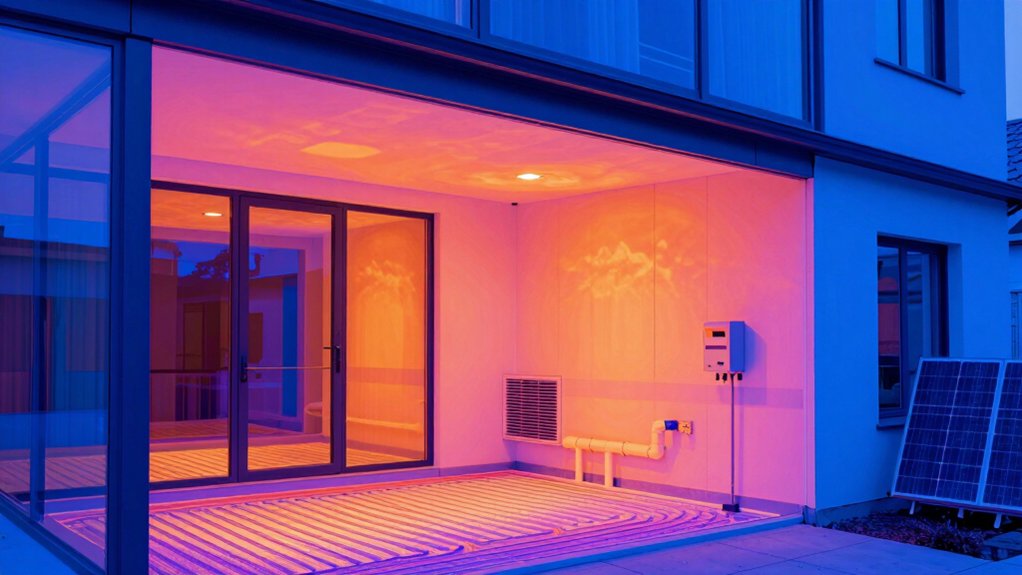
Infrared heating helps you meet green building standards by delivering direct, radiant warmth to occupants and objects, cutting HVAC load and energy use while reducing surface temperature variability. It supports energy-performance credits, lifecycle assessments, and retrofit criteria, with measurable gains in EUI, peak demand, and comfort. Coupled with commissioning, dashboards, and verifiable data, it aligns with LEED, BREEAM, and similar schemes, while enabling seamless integration with renewables and demand response. More benefits unfold as standards evolve—keep exploring the path ahead.
What Green Building Standards Require From Heating Systems
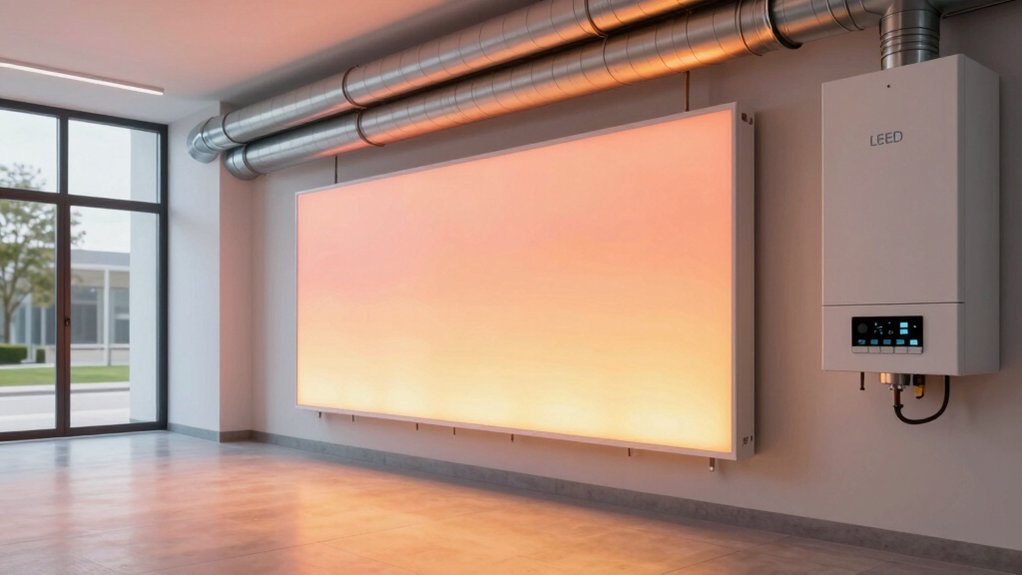
Green building standards set clear expectations for heating systems, emphasizing energy efficiency, emissions reductions, and occupant comfort. You’ll align designs with performance targets, ensuring units deliver precise output control, rapid response, and minimized standby losses.
Standards quantify efficiency through metrics like COP, HSPF, and AFUE, guiding equipment selection and system integration. They mandate zoning strategies that reduce overconditioning, specify balanced ventilation, and require robust controls for schedules, occupancy, and seasonal adjustments.
Documentation demands verifiable data: equipment ratings, commissioning results, and ongoing monitoring plans. Emissions considerations push you toward low- or zero-emission energy sources, refrigerant management, and leak prevention.
Reliability criteria establish fault tolerance, redundancy, and maintainability. Finally, lifecycle thinking asks for durable components, justifiable retrofit potential, and transparent performance reporting to stakeholders.
How Infrared Heating Targets Comfort With Lower Energy Use
Infrared heating targets comfort efficiently by delivering radiant warmth directly to occupants and objects, minimizing unnecessary air heating and circulation losses.
You’ll see lower overall energy use because only occupied zones receive heat, reducing stray convection that typically drives higher consumption. Data from verified installations show faster thermal response times, with fewer hours of elevated HVAC load, which translates to measurable peak-demand reductions.
Standards-focused analyses indicate consistent satisfaction metrics when surface temperatures stay within prescribed ranges, meaning less overshoot and shorter reheat cycles.
You benefit from precise temperature control and reduced drafts, while equipment operates closer to its rated efficiency.
Aligning Infrared With LEED Energy and Atmosphere Credits
To align infrared heating with LEED Energy and Atmosphere credits, focus on how radiant systems influence building performance metrics tracked by LEED: energy use intensity (EUI), source energy, and system efficiency.
You’ll compare post-installation performance against baseline models, demonstrating reductions in EUI through lower cooling and heating loads, improved thermal comfort, and reduced peak demand.
You should quantify site energy and source energy savings, accounting for fuel mix and energy transportation factors.
Emphasize system efficiency gains from near-uniform radiant heat, fewer zones, and shorter system runtimes, paired with high controllability and occupancy-responsive strategies.
Document measurement and verification plans, align with LEED EA prerequisites, and provide transparent data dashboards.
This data-driven approach strengthens credit narratives, supporting sustainable performance outcomes and long-term operational reliability.
Infrared’s Role in BREEAM and Similar Schemes
You’ll see how infrared technologies map to certification criteria, clarifying where energy modeling for schemes like BREEAM sits in the decision framework.
By aligning measurement inputs with scheme requirements, you can quantify thermal performance and forecast impacts on ratings.
This data-driven approach helps you determine where infrared can drive efficiencies within certification paths and related energy modeling workflows.
Infrared and Building Certification
How does infrared technology influence certification frameworks like BREEAM and similar schemes? You’ll see infrared’s role reflected in energy performance credits, lifecycle assessments, and retrofit criteria.
Data show rapid improvements in measured surface temperatures, reduced heat losses, and more uniform indoor comfort, which align with performance metrics used by certification bodies. You’ll rely on standardized testing protocols, including post-occupancy surveys and metered energy data, to substantiate claims.
Infrared contributes to documented reductions in primary energy use and CO2 emissions when integrated with efficient building envelopes and controls. You’ll align with credible third-party verification, guarantee traceability of materials and equipment, and provide transparent performance dashboards.
Taken together, infrared supports certification pathways by delivering measurable, auditable outcomes that meet evolving standards.
Energy Modeling for Schemes
Energy modeling sits at the core of how infrared contributes to certification schemes like BREEAM and similar programs. You’ll quantify radiant and auxiliary gains, translating measured surface temperatures into whole-building energy performance metrics.
Use standardized input data—occupancy schedules, envelope U-values, equipment loads—and align with scheme-specific criteria to demonstrate compliance.
Infrared’s role isn’t just monitoring; it’s informing decision-making through validated simulations, calibrated with field data, and reviewed against energy performance benchmarks.
You’ll show how reflective gains, thermal mass interaction, and system efficiency reduce modeled heating demand, peak loads, and carbon intensity.
Document assumptions, sensitivity ranges, and uncertainty analyses to strengthen credibility.
How Demand Response Benefits Infrared-Installed Buildings
Demand response introduces predictable demand patterns that you can quantify for infrared-installed buildings, enabling smarter that real-time energy use and cost optimization.
You’ll leverage infrared load flexibility to shift heat delivery, smoothing utility demand and supporting grid stability with data-driven targets.
This discussion aligns with standards-focused metrics on timing, capacity, and performance to maximize participation and reliability.
Demand Response Dynamics
While demand response (DR) programs coordinate building electricity use with grid needs, infrared-installed buildings can respond quickly to price signals and contingency events, reducing peak demand without sacrificing occupant comfort.
You gain dynamic load visibility through granular submetering and standardized DR signals, enabling precise curtailment or shift within established comfort bands.
Metrics track responsiveness, dwell time, and rebound behavior, aligning with performance contracts and grid reliability targets.
Infrared systems enable fine-tuned thermal batching, prioritizing zones by occupancy and critical loads, while maintaining rated efficiency and emission reductions.
Standards like ISO 50001 and ASHRAE signaling protocols guide control logic, ensuring interoperability with utility DR platforms and building management systems.
This data-driven approach supports predictable demand-side benefits, cost containment, and resilient grid-integrated operations.
Infrared Load Flexibility
Infrared load flexibility lets you rapidly align space heating and equipment use with grid signals, delivering measurable DR benefits while maintaining comfort and efficiency. You can leverage infrared’s fast response to shift demand without sacrificing indoor air quality or temperature stability.
When signals indicate a grid constraint, you adjust heater cycles, standby durations, or occupancy-driven setpoints, maximizing on-peak relief and off-peak recovery. Data shows precise control enables kilowatt-level reductions with minimal comfort impact, supporting demand response programs and capacity markets.
Integrating smart controls, occupancy sensors, and weather data improves predictability, reducing penalties and enhancing revenue streams. Standards-compliant implementations emphasize reliability, cyber hygiene, and measurement accuracy, ensuring verifiable savings.
In future grids, infrared load flexibility becomes a scalable, high-fidelity tool for resilient, energy-efficient buildings.
Retrofit Path: Upgrading to Infrared in Existing Envelopes
Upgrading existing envelopes with infrared (IR) heating presents a practical retrofit path that reduces energy waste while meeting evolving green building standards. You assess envelope performance with diagnostic tools, then target heat loss areas and thermal bridges where IR gains will be most effective.
IR retrofit works alongside insulation upgrades, air sealing, and moisture management to minimize you-know-where heat leaks, while preserving usable space. Data shows IR systems deliver rapid comfort improvements with low operating temperatures, enabling lower HVAC setpoints and reduced peak demand.
You’ll prioritize controllability, zoning, and occupancy patterns to maximize system efficiency. Standards-driven metrics—U-values, HERS/Rater scores, energy use intensity—guide specifications, commissioning, and performance verification.
The path emphasizes measurable outcomes, rapid payback, and scalable deployment within existing building stock.
New Construction: Designing Infrared Into High-Performance Envelopes
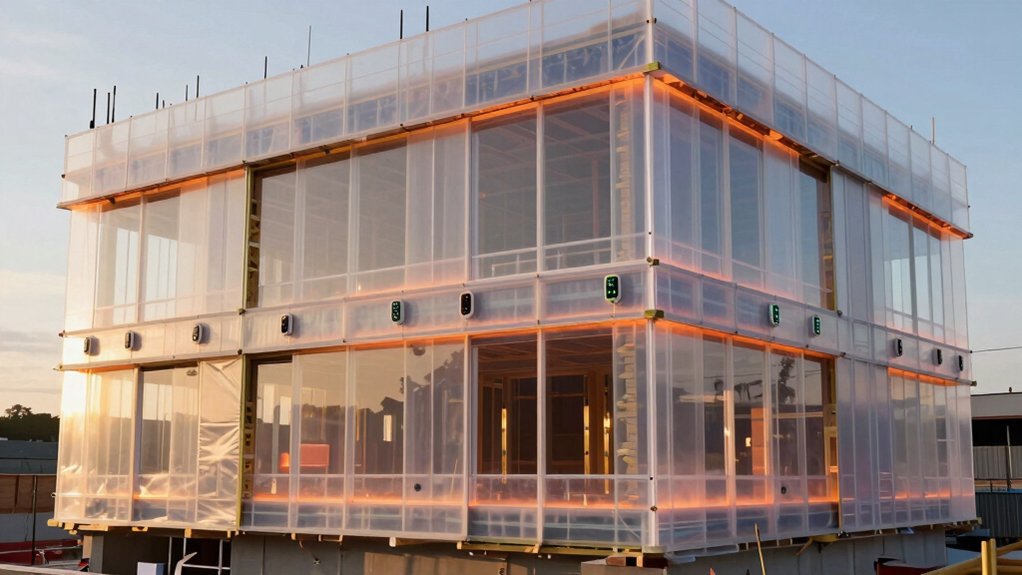
You’ll design high-performance envelopes with integrated infrared strategies that align with current standards and measurable performance targets.
By coupling envelope assemblies with infrared-enabled layers and controls, you can quantify heat transfer, comfort, and energy savings across operating conditions.
This approach should guide design decisions, set data-driven benchmarks, and inform code-compliant integration from first principles.
High-Performance Envelope Design
What makes a high-performance building truly resilient is how its envelope manages heat transfer, moisture, and air movement without sacrificing comfort. You’ll optimize thermal bridging, insulation continuity, and airtightness to meet or exceed code and performance standards.
Data shows that well-sealed assemblies with continuous insulation reduce modeled energy loads and peak demand, while dew-point control prevents condensation risk. You’ll specify high-performance vapor retarders, airtight barriers, and radiant-friendly surfaces that complement infrared heating without creating cold spots.
Material choices should align with standards like LEED, ASHRAE 90.1, and recently updated national codes, focusing on durability and lifecycle performance. Emphasize empirical testing, such as blower-door airtightness and thermal imagery, to validate design intent and support measurable energy reductions.
Infrared Integration Strategies
Infrared integration in new high-performance envelopes centers on aligning radiant heating with continuous insulation, airtightness, and moisture control to maximize comfort and energy efficiency.
You design this system to minimize thermal bridges, integrating embedded emitters with the wall, floor, or ceiling assemblies for uniform heat distribution.
Use performance metrics from standards such as measured U-values, solar gains, and surface temperatures to validate compatibility with building envelopes.
Prioritize pre-approved, manufacturer-equivalent data for emissivity, reflectivity, and lifespan to guarantee predictable performance across climate zones.
Model the retrofit potential and lifecycle costs to compare with conventional systems.
Document installation sequencing, commissioning tests, and maintenance plans that demonstrate compliance with evolving codes.
Emphasize data-driven indicators—heat flux, indoor temperatures, and energy use intensity—to guide ongoing optimization.
Comparing Infrared to Conventional HVAC: Energy Impact and Occupancy Comfort
When evaluating energy performance and occupant comfort, infrared heating offers a distinct set of implications compared to conventional HVAC systems. You’ll see lower uniform air volume exchange requirements in some spaces, as radiant panels deliver targeted warmth where occupants focus activity.
Measured whole-building energy intensity can improve when ambient air temperatures stay modest, reducing furnace or chiller runtime without sacrificing comfort for typical occupancy patterns. Compliance data often show faster setpoint recovery and fewer temperature gradients along walls and floors, supporting comfort standards.
However, peak-hour loads may shift to surface-heating contributions, demanding careful zoning. In performance modeling, infrared gains translate to reduced ventilation penalties and higher perceived warmth per watt.
Align designs with standards by validating surface temperature targets, occupancy profiles, and energy benchmarks before certification.
Measuring Performance: Key Metrics for Green Certification
Measuring performance for green certification hinges on a focused set of metrics that translate real-world operation into verifiable benchmarks. You’ll track energy intensity, combining site energy use with climate-adjusted baselines to reveal true efficiency gains.
Power quality and consistency matter, so you’ll monitor inverter efficiency, hot-spot mitigation, and system response times to load changes.
Thermal comfort metrics, like mean vote and dissatisfaction indices, pair with occupant satisfaction data to ensure design intent persists in practice.
Emissions footprints require scoped greenhouse gas accounting aligned with recognized standards, plus Life Cycle Assessment inputs for materials and components.
Reporting should be transparent, with auditable data trails and standardized dashboards that enable cross-site benchmarking.
Forward-looking, you’ll harmonize measurement protocols with evolving certification criteria to sustain verification integrity.
Cost Considerations and Return on Investment for Certifications
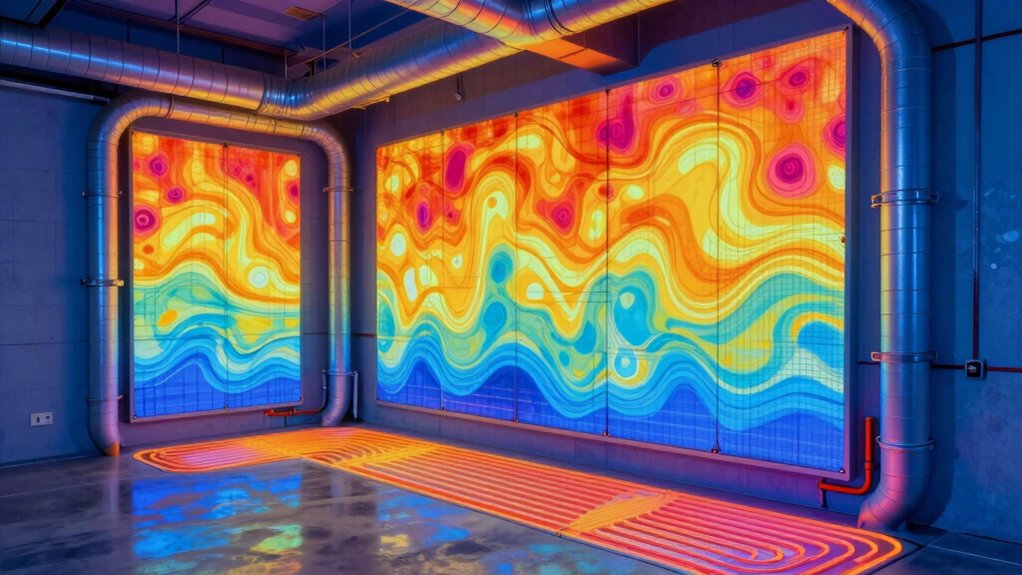
Cost considerations for certifications hinge on upfront project costs, ongoing maintenance, and the long-tail financial benefits of recognized standards. You’ll quantify capital expenses for infrared systems, energy modeling, and commissioning, then compare them against operational savings over the certification lifespan.
Data shows payback periods vary by climate, system integration, and occupancy patterns, but steady reductions in energy intensity consistently improve ROI. Certifications also facilitate incentives, higher asset value, and potential rent premiums, which can offset initial investments.
You should model different scenarios—with and without certifications—to reveal net present value and internal rate of return. Track performance metrics against baselines, adjust for degradation, and align with evolving standards.
A forward-looking approach emphasizes standard compliance, transparency, and measurable financial optimization.
Case Studies: Real-World Leed/Breeam Projects With Infrared
Real-world LEED and BREEAM projects that integrate infrared heating offer tangible proof points for standards-driven design. In these case studies, you’ll see measured energy savings, improved indoor comfort, and faster commissioning, all tied to explicit performance criteria.
Data shows infrared panels delivering targeted radiant warmth with reduced auxiliary heating loads, contributing to lower Source Energy use and optimized thermal envelopes. Projects report precise kWh reductions, peak-demand offsets, and enhanced daylighting compatibility, helping teams meet stringent thresholds for energy efficiency and occupant well-being.
You’ll note standardized verification through third-party audits, energy modeling with calibrated baselines, and post-occupancy performance monitoring. These real-world examples demonstrate scalable integration, repeatable results, and a data-forward path for future LEED and BREEAM submissions.
Practical Design Tips for Integration With Renewables and Controls
When integrating infrared heating with renewables and controls, start by aligning system architecture with clear performance targets and available renewable sources. Use modular, sensor-rich layouts that synchronize emitters, storage, and smart controls to minimize energy waste.
Prioritize performance data over guesses: define radiant heat targets, supply temperatures, and duty cycles, then map them to local solar, wind, or grid mixes. Design controls around demand response and occupancy patterns, employing predictive algorithms to preheat before peak pricing periods.
Specify interoperable standards and communication protocols to guarantee future upgrades remain seamless. Incorporate fault detection, easy commissioning, and annual performance verification to maintain baseline efficiency.
Document heat-loss budgets, insulation quality, and equipment efficiency ratings to support verifiable, standards-aligned outcomes. Continuous monitoring drives continuous improvement.
The Decision Framework: When Infrared Is the Right Path for Your Project
Infrared heating makes sense when your project has clear performance targets, compatible space layouts, and a favorable climate or occupancy pattern that benefits from rapid thermal response. The decision framework centers on measurable energy goals, lifecycle costs, and occupant comfort metrics aligned with standards like ASHRAE 90.1 and LEED.
Start with a heat load assessment that distinguishes intermittent versus continuous occupancy, then map infrared capabilities to zones with high surface heat demand and low draft losses.
Compare embedded system compatibility, retrofit feasibility, and upfront versus operating costs, including maintenance intervals.
Prioritize projects where rapid response reduces overshoot and improves control accuracy, enabling demand-response readiness.
Document performance baselines, test protocols, and verification milestones to support compliance, reliability, and long-term value.
Frequently Asked Questions
How Does Infrared Heating Influence Embodied Carbon in Builds?
Infrared heating reduces embodied carbon by enabling lighter, more efficient building envelopes and equipment. You’ll lower material demands and transport emissions, while meeting standards through accurate lifecycle data, optimized design, and compliance-focused, performance-based specifications driving lower total embodied carbon.
Can Infrared Systems Qualify for Performance-Based LEED Credits?
Yes, infrared systems can qualify for performance-based LEED credits, provided they demonstrate measurable energy performance, lifecycle data, and compliance with prerequisites. You’ll present data, simulations, and third-party verification to meet standards and advance credits efficiently.
Are Infrared Panels Suitable for Small vs. Large Spaces?
Yes, infrared panels scale well: for small spaces, you’ll benefit from rapid heat and targeted comfort; for large areas, use higher output panels or zoning. You optimize efficiency by aligning panel spacing with occupancy and insulation data.
What Maintenance Gaps Exist With Infrared Compared to HVAC?
You’ll notice fewer moving parts with infrared vs HVAC, but you’ll also need to monitor panel cleaning, sensor calibration, and radiant surface degradation. You maintain data-driven logs, standard-compliant inspections, and predictive replacements to prevent performance gaps.
How Do Occupancy Patterns Affect Infrared Comfort Metrics?
Occupancy patterns shape infrared comfort metrics by altering perceived warmth and radiant balance; you’ll notice faster warm-up, variable local temperatures, and potential draft-like effects. You should monitor occupancy-driven setpoints, recalibrate controls, and analyze data for continuous performance improvements.
Conclusion
You’ll see the energy story unfold in real numbers: infrared heating slashes embodied and operating costs while meeting ever-tougher green standards. With precise comfort delivery, rapid payback, and strong compatibility with LEED, BREEAM, and demand-response programs, it’s the data-backed path forward. Aligned with renewables and smart controls, infrared proves its mettle project after project—turning certification goals into measurable outcomes. Embrace this scalable, standards-driven approach, and watch your building rise as a benchmark for sustainable performance.