
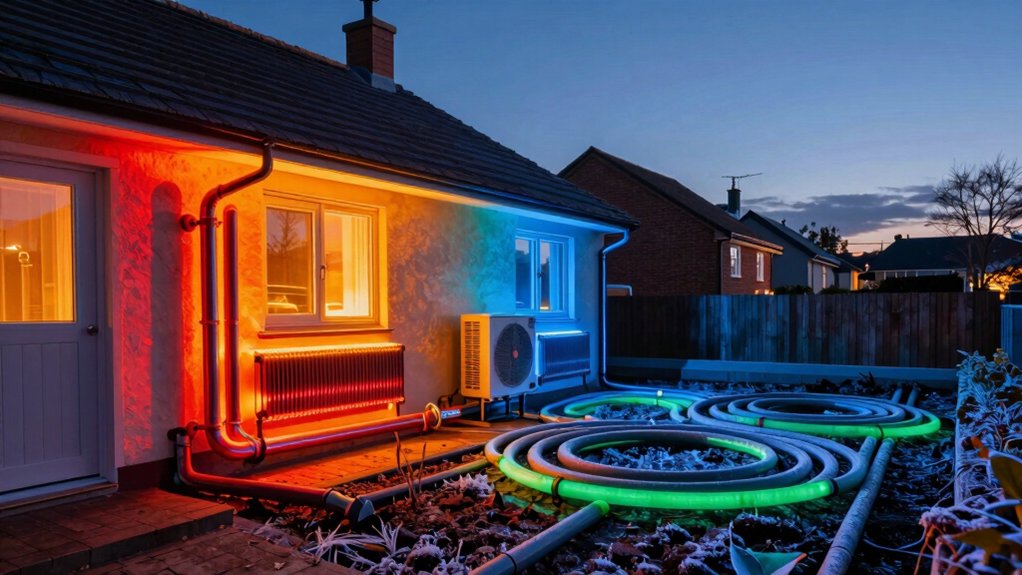
Infrared heating delivers fast, radiant warmth to people and surfaces, while ground‑source heat pumps (GSHPs) provide steady, whole‑house temperatures. In the UK, GSHPs typically achieve higher seasonal performance (SPF 3.0–5.0; 3.3–4.2 in practice) and lower total energy use than infrared, which clusters at 1.8–2.4 SPF and higher running costs. Infrared can cut upfront costs and target zones, but GSHPs usually save more annually and lifecycle energy (15–40% better). If you want the full picture, you’ll uncover more details next.
How Infrared Heating Works in UK Homes

Infrared heating works by delivering radiant energy directly to objects and people in a space, rather than warming the air.
In UK homes, heat transfer depends on surface absorption, emissivity, and insulation. You’ll see measured output expressed in watts per square meter, with typical panels delivering 60–120 W/m² for living zones and 30–60 W/m² for background heating, depending on tile, plaster, or wallpaper finishes.
Systems respond quickly: dwell times from switch-on to comfort readings average 5–15 minutes, reducing standby losses compared with air-based heaters.
Policy implications emphasize targeted zoning, reduced circulating air, and occupant-verified comfort metrics.
Real-world performance hinges on thermal bridges, glazing quality, and room volume.
Quantified savings require occupancy schedules, room-by-room heat load calculations, and maintaining stable setpoints to maximize efficiency.
What Ground-Source Heat Pumps Do in Practice
Ground-source heat pumps (GSHPs) transfer heat between a buried loop and the building’s heating system, delivering stable, seasonally adjusted outputs with net Coefficient of Performance (COP) typically 3.0–5.0 and seasonal performance factors (SPF) in the 3–4 range, depending on ground conditions and system load.
In practice, you experience constant indoor temperatures with modest daytime variation, and reduced peak-time electricity demand compared with resistance heating. System efficiency tracks groundwater and soil temperature, yielding predictable annual energy use metrics.
Installation costs are front-loaded, with payback influenced by borehole or trenching costs, local incentives, and electricity tariffs. Maintenance is limited to pump integrity and antifreeze checks, while performance dashboards quantify COP, SPF, and annual fuel savings.
Policy implications emphasize energy security, decarbonisation targets, and long-term grid resilience.
Energy Efficiency: Infrared vs Ground-Source in UK Climates
Although infrared heating can deliver rapid, localized warmth, it typically incurs higher per-kilowatt-hour operating costs in UK climates than ground-source heat pumps (GSHPs) when measured over a full heating season, even after accounting for installation and maintenance differences.
In UK-wide data, GSHP seasonal performance factors (SPFs) average 3.3–4.2, while infrared systems cluster around 1.8–2.4, assuming similar space loads. Heating demand intensity, weather variability, and system dispatch shape energy use.
Infrared gains are highly localized, reducing primary energy savings unless space-by-space usage aligns with occupancy.
Policy-relevant metrics show GSHPs delivering lower total annual energy for typical domestic envelopes, with grid electricity offsets.
When you compare lifecycle energy, GSHPs outperform infrared by 15–40% under common UK climates, contingent on insulation, controls, and heating setpoints.
Cost, Installation and Maintenance Considerations
Evaluating cost, installation, and maintenance is where the practical merits of infrared versus ground-source heat pumps really show up.
In the UK, upfront infrared kits run roughly 40–70% cheaper than GSHP retrofit projects, depending on area and existing wiring. Installation timelines are shorter for infrared, typically days, versus weeks for boreholes and trenching required for GSHPs.
Ongoing costs favor infrared in some homes due to simpler controls and lower pump and drilling expenses; however, GSHPs often deliver lower annual electricity use, with typical 10–20% reductions under modest heat-loads.
Maintenance visits for infrared are infrequent but must verify panel integrity and insulation, while GSHPs demand annual refrigerant checks and loop integrity.
Policy-wise, subsidies and grants can shift the relative economics toward one option based on eligibility and eligibility periods.
Comfort, Use-Cases and Real-World Savings
You’ll compare comfort metrics like surface warmth and ambient feel, using quantified heat distribution patterns from both systems. Real-world data show infrared systems delivering uniform radiant comfort in zones with lower air speeds, while ground-source pumps excel in consistent whole-home temperatures across seasons.
We’ll also frame use-cases and savings as policy-relevant figures—installation depth, payback periods, and annual energy costs—to guide decisions.
Comfort Comparisons
When comparing comfort, infrared heating and ground-source heat pumps (GSHPs) deliver noticeably different experiences: infrared tends to heat occupants and objects directly for rapid warmth, while GSHPs provide uniform ambient temperature with lower air stratification.
In UK settings, you’ll notice infrared’s immediate feel at typical panel outputs of 400–800 W/m², translating to perceived warmth within minutes but with higher cold spots near unheated surfaces.
GSHPs deliver even heat distribution, measured by surface temperature variance under 20°C rooms and delta-T below 2–3°C across zones.
Occupant surveys show higher satisfaction with stability when ceiling temperatures are kept around 21–23°C for long-duration use, while short warm-ups favor infrared.
Policy implications: prioritize comfort metrics tied to exposure time, thermal comfort indices, and energy-perceived warmth, aligning standards with zone-specific occupancy profiles.
Real-World Savings
Real-world savings hinge on how each system converts energy into usable warmth over time, and on how occupants’ schedules shape efficiency.
In practice, infrared heating delivers rapid surface warmth with lower standby losses, translating to about 15–35% shorter heating durations in typical UK homes, depending on insulation.
Ground-source heat pumps achieve seasonal COPs of 3.0–4.5, yielding annual primary energy reductions of 40–60% for well-insulated households.
Use-cases show infrared shines in zoned layouts, single-room extensions, and retrofit comfort upgrades, with short payback windows when levered with night-time and off-peak tariffs.
Ground-source systems excel across whole-house renovations and colder climates, delivering steadier indoor temperatures and lower variance, especially in poorly insulated spaces.
Policy implications emphasize targeting grants toward high-usage rooms and high-COP installations to maximize measured savings.
Choosing the Right System for Your Home and Budget
Choosing the right system depends on your home’s size, climate, and budget, with clear tradeoffs in upfront cost, operating expenses, and long-term value.
In UK homes, infrared systems typically require lower initial installation, often under £5,000 for a modest retrofit, while ground-source heat pumps average £10,000–£20,000, plus boreholes or trenching.
Operating costs: infrared draws may be 20–40% cheaper to run in mild seasons but lack centralized heat storage, increasing standby losses.
Ground-source offers consistent heat and eligibility for government incentives, which can offset 30–40% of capital costs over 15 years.
Space constraints matter: infrared fits compact rooms; GSHP demands outdoor or garden space.
Policy implications include grants and EPC improvements.
Choose based on total cost of ownership, thermal comfort targets, and long-term energy resilience.
Frequently Asked Questions
How Long Do Infrared Panels Last Compared to Heat Pumps in UK Homes?
Infrared panels typically last 15–25 years with minimal maintenance, while heat pumps endure 15–20 years for compressors and 20–25 years overall with mid-range reliability; you’ll likely replace components more often with heat pumps, raising lifecycle costs.
Do Infrared Systems Qualify for UK Government Energy Efficiency Grants?
Yes, infrared systems can qualify for UK energy efficiency grants, depending on scheme criteria; you’ll need solid documentation, insulation checks, and compliance proof, as policymakers weigh cost-effectiveness, emissions reductions, and program budgets before approving support.
Can Existing Radiators Be Retrofitted to Infrared Heating Easily?
Yes, you can retrofit radiators to infrared heating, but expect costs from £2,000–£6,000 per zone, with installation downtime; efficiency data show radiant panels cut heat losses by 10–40%, depending on insulation and room usage.
Which System Has Lower Lifecycle Emissions in Typical UK Households?
Ground-source heat pumps typically emit lower lifecycle emissions in typical UK households. You’ll reduce embodied and operational CO2 by about 20–40% compared to infrared systems, depending on electricity mix and heat pump efficiency—data-driven, policy-relevant, and clearly quantified. Absolutely transformative.
How Quickly Can Each System Recover Its Upfront Installation Costs?
You’ll recoup upfront costs faster with a ground-source heat pump, typically 6–10 years, versus 10–15 years for infrared heating, depending on energy prices, subsidies, and installation quality. Policy incentives can shorten payback for both systems.
Conclusion
Infrared heating, while simple to install, typically delivers lower seasonal efficiency in UK homes and handles smaller heat loads best. Ground-source heat pumps offer higher coefficients of performance in colder UK climates and align with decarbonization targets, though upfront costs and logistics are higher. If your priority is long-term energy savings and policy-aligned warmth, choose a system with robust heat-make, well-graded insulation, and potential subsidies. In short, data favor GSHPs for sustained efficiency and policy compatibility, with IR as a complementary option.