
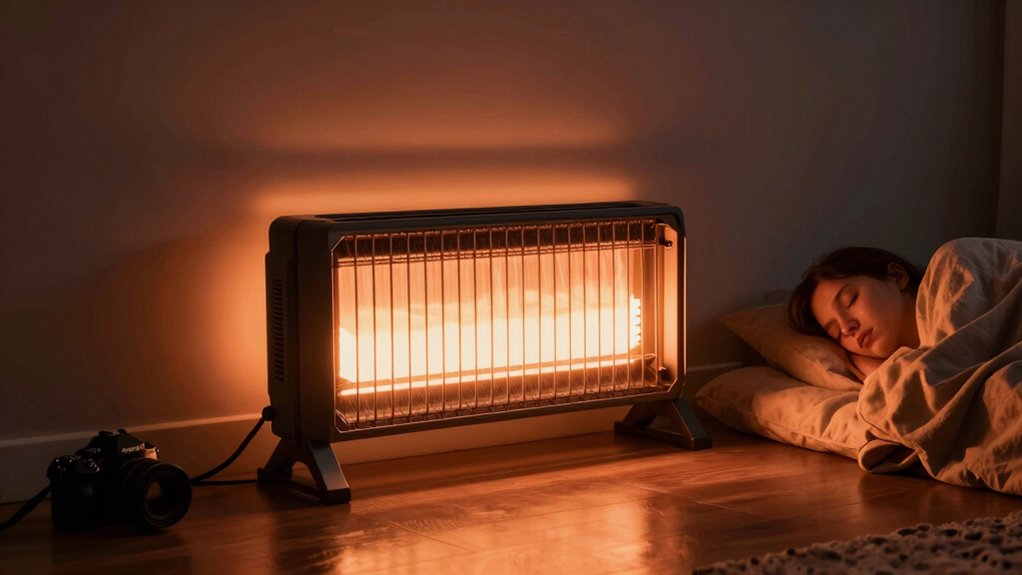
Infrared heaters work by emitting radiant energy that directly warms objects and people, not the surrounding air. You feel warmth where the radiation hits, quickly and with directional control. Heat transfer depends on emission, absorption, and surface properties, not convection. Shorter wavelengths heat surfaces fast; longer wavelengths penetrate more deeply. Material choice—ceramic, quartz, or carbon—shapes startup, stability, and spectrum. Proper placement and shaded airflow matter for comfort and efficiency. If you keep exploring, you’ll uncover how to optimize this radiant warmth.
What Is Infrared Heat and How It Differs From Traditional Warmth
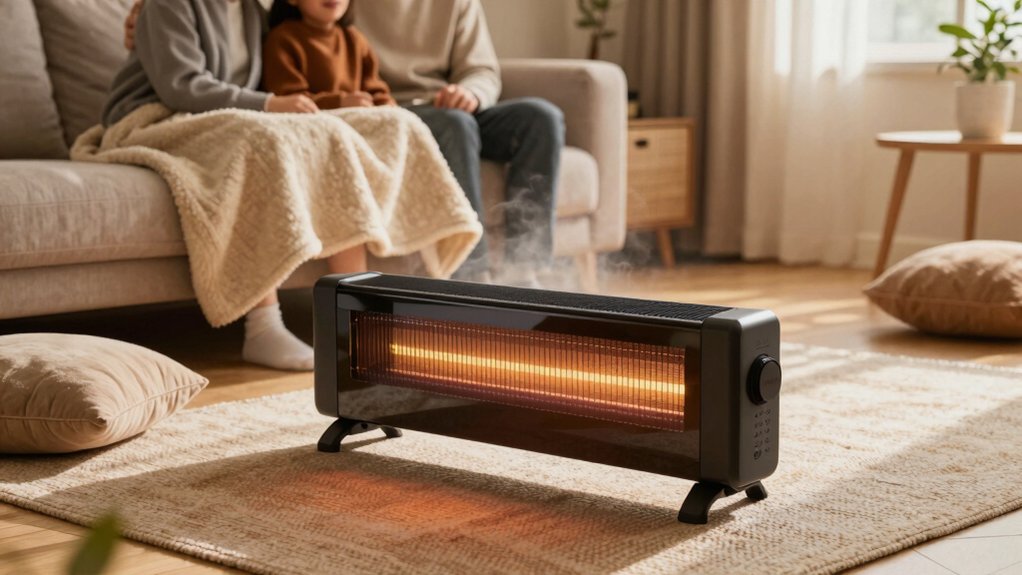
Infrared heat is radiant energy that travels as waves and warms objects directly, rather than heating the surrounding air. You’ll measure its effect by how surfaces feel warmer than the ambient environment, not by a general increase in room temperature.
Unlike convection-based warmth, infrared treats objects as heat sources, transferring energy when you stand before a radiant emitter. You’ll notice rapid onset; the air may stay cool while you perceive warmth at contact points, skin, or fabric.
In practice, infrared heat reacts with material, not with air density, enabling focused, directional heating. This mechanism differs from traditional warmth, which relies on circulating warm air to raise perceived temperature.
The result is targeted comfort, energy efficiency, and predictable heat delivery, contingent on distance and emissivity.
The Science Behind Radiant Heat Explained
Radiant heat transfer depends on how energy moves through space between a source and you, and how wavelength determines what materials absorb or reflect.
Your understanding hinges on matching wavelengths to material properties, so the right heater design delivers efficient warming with minimal loss.
Consider how different wavelengths interact with common substrates to forecast performance and safety in real-world use.
Radiant Heat Transfer
Radiant heat transfer describes how thermal energy moves directly from warmer objects to cooler ones through electromagnetic waves, bypassing the intervening medium.
You observe that this mechanism depends on emission, transmission, and absorption of infrared radiation, not convection or conduction through air.
In practice, hotter surfaces radiate more energy per unit area, and target bodies absorb a portion of that spectrum, increasing their internal energy.
You’re focusing on the direct exchange between a heat source and a recipient, with the intervening air largely transparent to the radiation involved.
This process is governed by surface temperatures, emissivity, and geometric alignment, which determine how efficiently energy is transferred.
You measure performance by incident flux and resulting temperature rise, independent of surrounding air flows.
Wavelength And Materials
Wavelength sets the fingerprint of radiant heat, dictating how efficiently a source emits energy and how a target absorbs it. You see that materials and wavelengths interact through emissivity, reflectivity, and absorption bands, shaping real-world performance.
Shorter wavelengths heat surfaces rapidly but penetrate less deeply, while longer wavelengths offer deeper penetration with slower surface warming. Metals, ceramics, and semiconductors exhibit distinct emissive behaviors, influencing efficiency and safety.
You’ll find that ceramic elements tolerate higher temperatures and maintain stable emission across decades, whereas metal surfaces reflect portions of the spectrum, reducing useful output. Material choice also affects spectral matching to targets: infrared emitters should align with the intended absorption window for effective heat transfer.
In design, you balance wavelength, emissivity, and durability to achieve predictable radiant performance.
The Role of Wavelength in Infrared Heating
You’ll see how wavelength shapes both efficiency and how infrared spectra respond to different materials.
Shorter wavelengths don’t always mean better heat transfer, and the spectrum you choose depends on the target surface and environment.
This sets up a precise look at Wavelength Efficiency and Infrared Spectra Impact to guide practical, evidence-based decisions.
Wavelength Efficiency
How does wavelength shape heating efficiency? You assess wavelength as a performance parameter, not a decorative detail. Shorter wavelengths deliver higher photon energy per unit, but interact differently with targets, surfaces, and air gaps. Longer wavelengths penetrate more deeply and transfer energy more broadly, yet may suffer greater scatter and lower surface coupling.
Wavelength efficiency, in practice, depends on matching emission bands to the absorptivity spectrum of the target and the geometry of the environment. You consider emissive source design, filter choices, and duty cycles to minimize wasted radiation.
Precision control of wavelength distribution reduces surface overheating and improves comfort at comparable power. Ultimately, the *ideal* wavelength profile aligns with material absorption, emissivity, and thermal path constraints, delivering effective radiant transfer with predictable temperature response.
Infrared Spectra Impact
Infrared spectra shape heating outcomes by dictating how efficiently emitted radiation couples to a target. You’ll see that wavelength determines absorption, penetration, and perceived warmth, not just intensity.
Shorter infrared bands interact with surface molecules, producing rapid surface heating with limited depth. Longer bands penetrate deeper, warming substrates rather than surfaces alone, which changes heat transfer dynamics and comfort profiles.
Your heater’s emission spectrum defines these interactions: matched to a material’s vibrational modes, it maximizes conversion to usable heat; mismatches increase reflectance or scatter, reducing efficiency.
Consider emissivity, material thickness, and environmental factors, since air gaps and coatings alter effective coupling.
Emissivity, Absorption, and How Surfaces Warm Up
When infrared radiation hits a surface, its ability to transfer heat depends on emissivity, which quantifies how effectively that surface emits and absorbs infrared energy. Emissivity ranges from near zero for highly reflective metals to near one for sooty or matte surfaces.
You, as a reader, should recognize that absorption drives surface warming; higher emissivity means more energy uptake and faster temperature rise under the same flux. Surface temperature and material properties determine spectral response, yet the principle remains: radiative transfer is governed by the product of incident intensity and the surface’s absorptivity, which closely tracks emissivity for opaque materials.
In practice, you’ll see warm-up rates vary with color, texture, and finish. Radiant heat exchange balances emission, absorption, and ambient temperature, yielding steady-state conditions when these rates converge.
Types of Infrared Heaters: Ceramic, Quartz, and Carbon Elements
You’ll compare Ceramic Element basics, Quartz versus Carbon differences, and how each profile affects heating efficiency.
Consider how ceramic’s stability and rapid response contrast with quartz’s fast surface heating and carbon’s efficiency at longer wavelengths.
This discussion will frame how material selection shapes performance, cost, and application suitability.
Ceramic Element Basics
Ceramic elements use a ceramic substrate heated by an electric current to emit infrared energy, offering rapid warmth with reliable durability. You’ll learn how the core behaves: resistance in the ceramic converts electrical power into heat, producing a steady infrared output with minimal fluctuations.
The design emphasizes uniform heating across the element, reducing hot spots and improving repeatability. Thermal mass is moderate, enabling quick ramp-up and cooldown without overshoot, which aids stable room temperature control.
Sealed housings and protective coatings limit corrosion and surface degradation, extending service life in typical indoor environments. Efficiency centers on direct radiant transfer, with the ceramic layer acting as a stable emitter surface.
Maintenance is straightforward: keep vents clear, inspect connections, and replace aging parts promptly to preserve performance.
Quartz vs Carbon Differences
Quartz and carbon elements differ primarily in how they emit infrared energy and respond to temperature changes. In practice, quartz elements generate radiant heat through rapid electron motion, delivering a sharp startup and higher surface temperatures. You’ll notice quicker heat delivery but shorter duty cycles, with intensity tied to electrical current and element resistance.
Carbon elements, by contrast, emit more gradually as the material reaches a stable temperature, producing a softer, broader spectrum of infrared radiation and a smoother thermal profile. You’ll often experience longer warm-up periods, yet improved low-load performance and endurance at continuous operation.
Control behavior reflects material dynamics: quartz reacts quickly to setpoints but may drift with thermal load; carbon offers steadier output but slower response. Both rely on encapsulation and reflectors to optimize directional efficiency.
Heating Efficiency Profiles
Heating efficiency profiles for infrared heaters hinge on how ceramic, quartz, and carbon elements convert electrical energy into radiant heat, with each type delivering distinct efficiency characteristics. You evaluate how each element couples to a heat-emitting surface and how rapidly it reaches steady-state output.
Ceramic elements offer stable, broad-spectrum emission and strong resistance to temperature fluctuation, yielding consistent efficiency across duty cycles.
Quartz elements achieve rapid ramp-up and high initial infrared output, but their efficiency can decline with offset temperatures and aging.
Carbon elements provide dense radiance at lower surface temperatures, improving overall energy use for prolonged operation, yet they may exhibit reduced short-term efficiency under cold-start conditions.
Consider system losses—reflector design, housing insulation, and control strategies—since they shape real-world performance more than element material alone.
How Glass, Metal, and Plastic Surfaces Interact With Infrared
Glass, metal, and plastic interact with infrared radiation in distinctly different ways, informing how efficiently each material absorbs, transmits, or reflects heat. When you expose glass to IR, you often see partial transmission in near-IR with notable reflection and limited absorption. Thick, thin glass can transmit certain wavelengths while blocking others.
Metal surfaces, conversely, exhibit high reflectivity across mid to far infrared, absorbing minimally unless roughened or coated. This makes them poor emitters in standard configurations.
Plastics vary by chemistry; many absorb in the near-IR, converting energy to heat within the polymer matrix, while others reflect or transmit depending on filler and thickness. Surface finish matters: roughness increases scattering and absorption; coatings can enhance emissivity or reduce it.
Choose materials aligned with desired heat transfer: emission efficiency, thermal buffering, and energy retention.
Indoor vs Outdoor Performance: What Affects Comfort
Indoor and outdoor performance of infrared heaters hinges on ambient conditions, enclosure effects, and user expectations; factors like humidity, wind, ambient temperature, and surface emissivity determine how efficiently heat is perceived and retained.
You evaluate comfort by rate of heat transfer, perceived warmth, and temporal stability. In enclosed spaces, reflective surfaces and infrared balance influence radiant feel, while ventilation and moisture control alter perceived dryness or dampness.
Outdoor use introduces convective losses from wind and ambient cooling, reducing effective radiant temperature at a given output. Emissivity of walls, floors, and objects shapes felt warmth independent of room air temperature.
Sensor placement and heat source distribution affect uniformity, yet your comfort ultimately depends on how quickly heat you perceive matches the target setpoint. Precision in measurement and expectation alignment ensures reliable comfort assessment.
Sizing and Placement: Maximizing Efficiency and Safety
To size and place infrared heaters effectively, start from the space you’re heating and the heat you expect to feel, then match heater output and location to those targets. Assess area dimensions, insulation, and doorways, then estimate surface temperatures you need.
Choose watts per square meter that align with occupancy, equipment, and safety margins. Prioritize unobstructed lines of sight between heater and targeted zones, avoiding glare or heat reflection on reflective surfaces.
Position heaters at appropriate heights to minimize contact risk while maximizing radiant exposure to occupants and objects. Use zoning rather than a single oversized unit, and document intended coverage.
Consider electrical service limits, circuit loading, and thermostat control compatibility. Verify clearances from combustibles and ensure accessible shutoffs for maintenance and safety checks.
Common Myths vs Realities About Infrared Heating
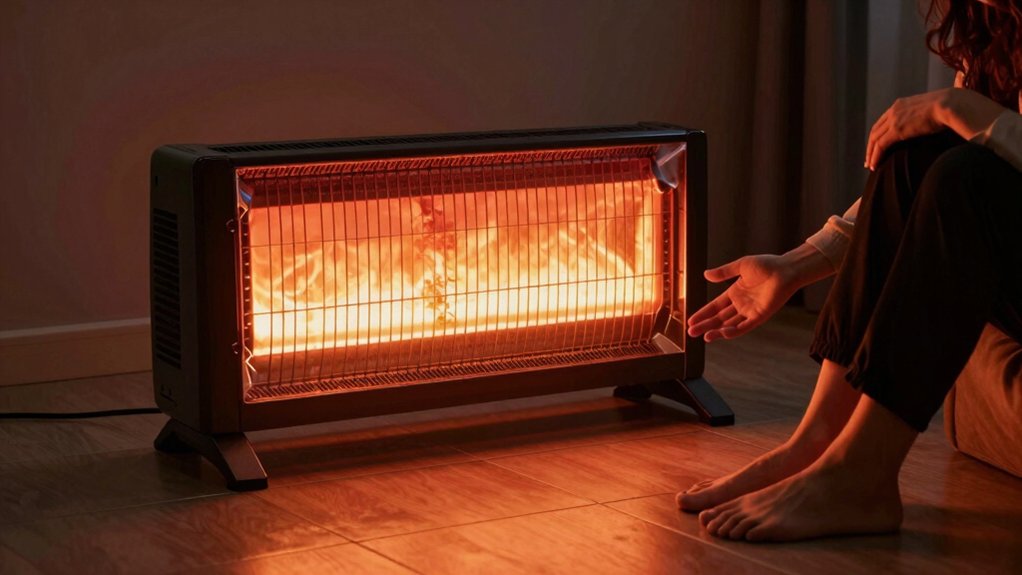
Common myths about infrared heating persist, but realities show the technology delivers targeted warmth without instantaneous, all-day heat loss. You’ll hear that infrared heaters burn energy or heat rooms unevenly; in truth, radiant heat transfers directly to objects and people, not through mass warming of air.
Misconceptions about safety persist, yet modern units incorporate protective features and stable elements at controlled temperatures. Some assume infrared feels only hot; in practice, you can tune intensity to achieve comfortable warmth at your desired surface, without overheating unoccupied spaces.
Another myth claims quick temperature swings due to radiation; thermal inertia from building materials governs response, not the heater’s action alone. When chosen and positioned correctly, infrared heating provides predictable, localized comfort with measurable performance.
Energy Efficiency: How Infrared Heaters Use Power
Infrared heaters maximize energy use by delivering warmth where it’s needed, not by warming the entire room. You select a unit with appropriate wattage for the target space, then monitor how quickly heat loads respond to operation.
Unlike convection systems, infrared energy converts to heat upon contact with objects and people, reducing standby losses when spaces aren’t actively occupied. Efficiency hinges on emissivity, distance, and temperature setpoints: higher emissivity surfaces absorb heat more effectively, while greater separation reduces radiant intensity at a given wattage.
You’ll benefit from proper zoning, avoiding oversized bases that contribute unnecessary drag. Controls matter: precise thermostats and high-quality reflectors minimize radiant loss, and programmable schedules curb runtime during unused periods.
In fundamental terms, efficiency stems from matching output to actual thermal demand and minimizing heat squander.
Installation Considerations for Home Use
Proper placement is essential for maximizing comfort and safety when installing infrared heaters for home use. You’ll determine line-of-sight exposure, avoiding obstructions that block radiant paths. Measure clearance from walls, furniture, and drapes to reduce heat-induced hazards and ensure adequate air circulation.
Verify mounting options—wall, ceiling, or freestanding—align with product specifications and local codes. Consider room geometry; place heaters to cover zones without creating hot spots or uneven temperatures.
Electrical demands must match circuit capacity; use dedicated circuits when required and install appropriate overcurrent protection. Cord management matters: secure cords, minimize trip risks, and protect from moisture or physical damage.
Documentation should include manufacturer instructions, warranty terms, and inspection schedules. Regularly review placement as room layouts or furnishings change.
Practical Tips to Optimize Comfort With Infrared Heat
To maximize comfort, position infrared heaters to illuminate the space you actually use most: keep a clear line of sight to frequently occupied areas and avoid blocking furniture or walls that could create shade or heat build-up.
Next, orient units to target cold spots rather than distributing heat uniformly, which reduces perceived warmth.
Maintain appropriate clearance from combustibles and water sources, following manufacturer guidance.
Use thermostatic control to sustain stable temperatures; avoidance of overshoot minimizes cycles that waste energy.
Calibrate placement to prevent direct exposure to seating areas, reducing glare and heat hotspots.
Combine infrared with passive strategies—proper insulation, draft sealing, and sun exposure—so gains persist.
Regularly inspect elements for wear, corrosion, or loose mounting, and replace aging panels promptly to preserve performance and safety.
Frequently Asked Questions
Do Infrared Heaters Cause Skin Burns or Eye Damage?
Infrared heaters can cause skin burns or eye damage if positioned too close or used improperly, especially with exposed skin or sensitive eyes. Follow safety guidelines, avoid direct eye exposure, and keep heaters at recommended distances and durations.
Can Infrared Heating Cause Indoor Humidity to Drop Significantly?
Yes, infrared heating can reduce indoor humidity modestly by increasing air temperature and triggering more water vapor condensation; however, overall humidity shifts depend on ventilation, moisture sources, and insulation, so effects vary and aren’t typically drastic.
Are Infrared Heaters Safer for Pets and Children?
Yes, infrared heaters can be safer for pets and children when used properly, with guards and stable temperatures. For example, a family uses a thermostated unit at low wattage, avoiding exposed elements and ensuring supervised, restricted access.
Do Infrared Heaters Fix Heat Without Increasing Energy Bills?
Yes, infrared heaters can reduce overall bills by targeting occupants and objects, not the air, boosting efficiency. However, savings depend on usage patterns, insulation, and heater wattage; neglecting these factors can still raise energy costs.
How Quickly Do Infrared Heaters Heat a Room Atmosphere?
Instant heat arrives quickly: infrared heaters warm you and surroundings within minutes, not hours. You feel targeted warmth energy-efficiently, so the room’s atmosphere shifts faster, and you notice comfort sooner, like a spark lighting a measured, precise flame.
Conclusion
Infrared heaters translate energy into warmth through radiant comfort, not bulk heat. You feel the warmth on your skin, much like sunlight on a cool morning, while objects absorb and re-radiate that energy for sustained coziness. A single data point: infrared efficiency can exceed 90% when targeting occupants and surfaces. Remember, placement matters—line-of-sight matters less for air, more for radiant gain. Precision matters: measure, compare, and optimize to avoid waste and maximize comfort.